🎧 Customer service · Business solutions
Ticket deflection with a self-service AI agent
30,000 resolved ticket a month
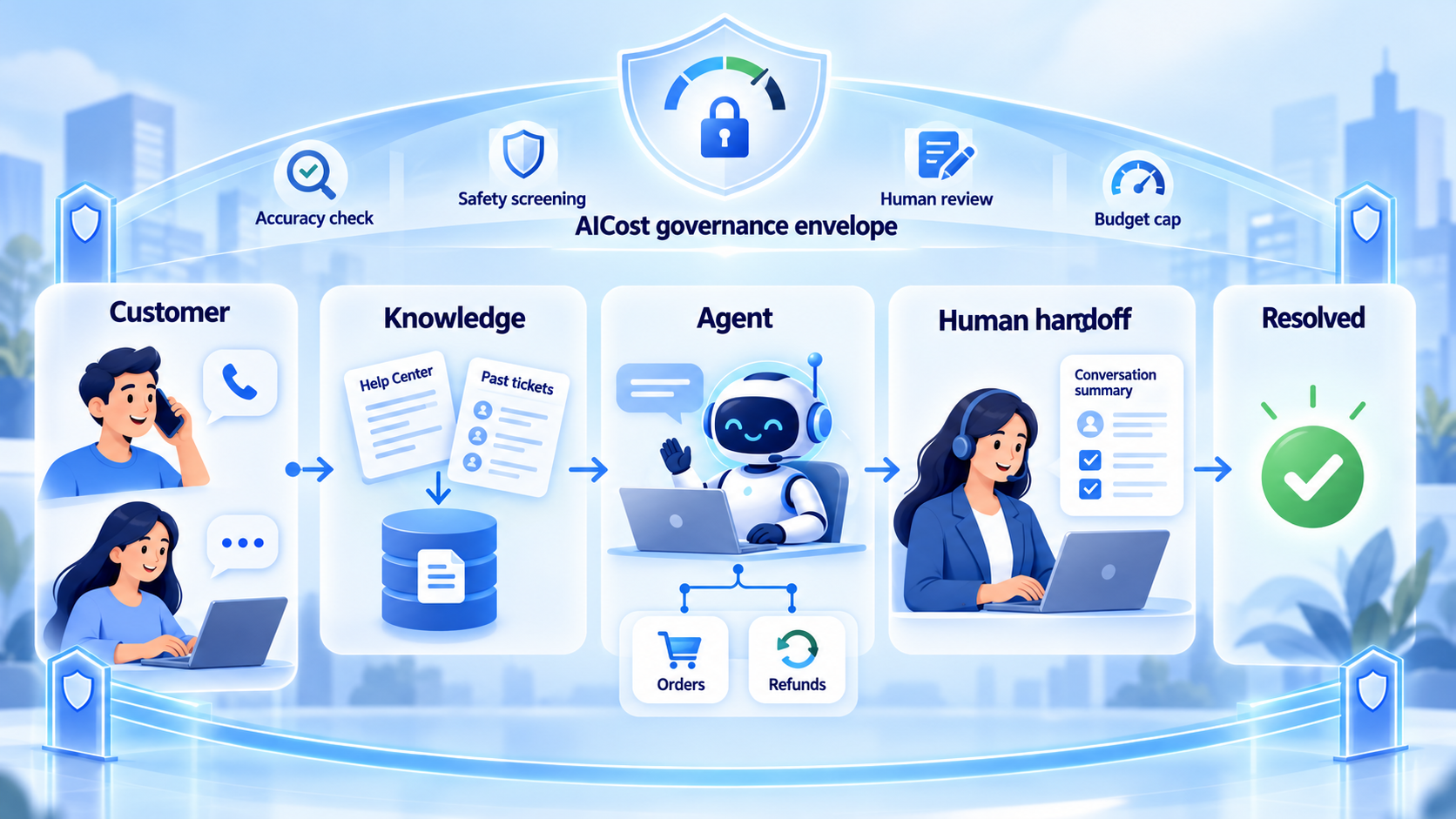
An AI agent answers customer questions in chat, email and the help widget from the help center and past tickets, looks up the order, and either resolves the request or hands it to a person with a summary.
1 · cost
Answer from the help center and past tickets
$975
$292
2 · gate
Trim long ticket history on every turn
3 · gate
Send simple questions to a cheaper model
4 · cost
Cap retries before handing off
$14,523
$6,775
5 · governance
Catch made-up policy answers
$96
6 · governance
Block PII leaks and unsafe refunds
$56
7 · governance
Human review for refunds and upset customers
$10,800
$5,400
8 · gate
Cost per resolved ticket vs a person
9 · gate
Daily budget and runaway stop
Without AICost
$26,450/mo
$0.88 per resolved ticket
With AICost
$12,619/mo
$0.42 per resolved ticket 52% lower
Monthly saving
$13,831/mo
5 cost levers applied
Governance controls
5
Monthly budget $8,000
Cost cutLoop cap → Cap retries before handing off −$7,748Prompt caching → Answer from the help center and past tickets −$165Context compaction → Answer from the help center and past tickets −$237Model routing → Answer from the help center and past tickets −$281Better grounding → Human review for refunds and upset customers −$5,400
Governance✓ Accuracy and hallucination checks → Catch made-up policy answers✓ Guardrail screening → Block PII leaks and unsafe refunds✓ Human review✓ Cost firewall at the gateway✓ Data-class model allowlist
Flow, picture, cost levers, governance and policy envelope
How the work flows today
1Customer asks in chat, email or the help widget
2Agent searches the help center, macros and past tickets
3Agent looks up the order or account and drafts an answer or takes the action (status, reset, return label)
4Low-confidence, angry or refund/credit cases go to a human with a summary
5Ticket closed, tagged and checked for CSAT
6Knowledge gaps sent back to the content owner
AICost engine chain (blue: cost, purple: governance)
Cost levers and the step they act on
Loop cap on step Cap retries before handing off −$7,74812 turns, 60k tokens, enforced by cost-firewall · Agent LoopA ceiling on turns and tokens per agent run, so a stuck agent cannot run up the bill.
How it works: Each agent run gets a maximum number of turns and tokens. A run that hits the ceiling stops and hands off instead of looping.
How AICost prices it: The Agent Loop engine prices the runs with and without the ceiling, including the runaway tail.
Governance: The cap is enforced by the cost firewall at your gateway, with an alert when it trips.
Prompt caching on step Answer from the help center and past tickets −$16560% cacheable, 75% hit (applied to every eligible workflow) (combined with the other knobs on this step) · Prompt CachingRepeated instructions and documents are cached, so you pay less for the same prompt text.
How it works: The stable part of each prompt (system instructions, tool definitions, reference text) is cached by the model provider and billed at the cached rate.
How AICost prices it: The Prompt Caching engine prices cacheable share and hit rate against the provider's cached-input price.
Governance: No change to answers, models or data. Only the billing of repeated text changes.
* Cacheable share and hit rate are typical values; your logs give the real ones.
Context compaction on step Answer from the help center and past tickets −$237trim history 60%, net of overhead (combined with the other knobs on this step) · Context TrimLong histories are trimmed each turn, so every call carries less text.
How it works: Older turns and long documents are summarized or trimmed before each call, keeping what the model needs.
How AICost prices it: The Context Trim engine prices the smaller context net of the cost of trimming.
Governance: Quality is checked before rollout; nothing reaches the model that it was not allowed to see.
* The trim size is an input; your evals confirm it keeps answer quality.
Model routing on step Answer from the help center and past tickets −$28150% of calls (intent detection, lookups and short answers) to Claude Haiku 5.5; critical work (policy, refund and account answers) stays on Claude Sonnet 5.5 (combined with the other knobs on this step) · Model RouterRoutine steps run on a cheaper model; critical steps stay on the primary model.
How it works: Each workflow type has routine work (triage, lookups, extraction, summaries, drafts) and critical work (the final answer, code changes, clinical or legal output, decisions). Routine calls go to the economy model; critical work stays on the primary model.
How AICost prices it: The Model Router engine prices the split between the economy and primary model on the workflow's own volume.
Governance: Only approved models for the data class are used. For patient and privileged legal data the share is capped and calls stay with the primary model's vendor and route, so the BAA still covers every call.
* The share of routine calls per workflow type is a starting assumption; your traffic sets the real split.
Better grounding on step Human review for refunds and upset customers −$5,400escalation 12% to 6% · Human ReviewAnswers come only from your approved sources, so fewer cases go to a person.
How it works: The assistant answers from your own approved content with the source attached, and says it does not know instead of guessing. Teams get there with cleaner knowledge-base articles, better retrieval (tighter chunks, reranking) and an answer check before the reply goes out.
How AICost prices it: Fewer low-confidence answers means fewer escalations. The Human Review engine prices reviewer minutes at the lower escalation rate; the saving is the difference.
Governance: Human review stays on for refunds, policy exceptions and anything still low-confidence. Only the share of cases that needed a person goes down.
* The demo assumes escalations fall by half (for example 12% to 6%). Your number comes from your own evaluation results.
Governance controls and the step they act on
Accuracy and hallucination checks on step Catch made-up policy answers $96
Golden-set and live-traffic scoring catch silent regressions.
Guardrail screening on step Block PII leaks and unsafe refunds $56
PII, prompt-attack and policy screening before the model acts.
Human review on step Human review for refunds and upset customers $10,800
Low-confidence, high-value or regulated cases go to a person.
Cost firewall at the gateway policy only, no cost
Monthly budget, daily cap, per-run ceiling, turn cap, spike rule, kill switch.
Data-class model allowlist policy only, no cost
Only models cleared for this data class are routable; others are refused at the gateway.
Policy envelope
Monthly budget$8,000
Daily hard cap$347
Per-run ceiling$0.13
Turn cap12
See the policy your gateway enforces
{
  "workload_id": "ticket-deflection-with-a-self-service-ai-agent",
  "scope": "workload",
  "monthly_budget_usd": 8000,
  "daily_warning_usd": 242.67,
  "daily_hard_limit_usd": 346.67,
  "max_cost_per_run_usd": 0.13,
  "max_model_calls_per_run": 12,
  "max_retries": 2,
  "max_output_tokens": 1200,
  "requests_per_min": 280,
  "anomaly": {
    "rolling_window": "7d",
    "spike_multiplier": 3,
    "rule": "flag any hour/day exceeding 3x the rolling average, or any single day above the daily hard limit"
  },
  "actions": {
    "warning_threshold": "notify",
    "soft_limit": "route_to:claude-haiku-5-5",
    "hard_limit": "block_noncritical_requests",
    "anomaly": "throttle_and_alert",
    "emergency": "block_all_and_require_approval"
  },
  "emergency_stop": {
    "enabled": true,
    "requires_approval_to_resume": true
  }
}
Where the cost runs away
- Per-resolution or per-conversation vendor pricing grows with volume, even for questions customers re-ask
- Long context from stuffing whole ticket histories and KB articles into every turn
- Multi-turn loops when the agent cannot resolve and keeps retrying before handoff
Talk to us about this workflow →
🎧 Customer service · Business solutions
Agent assist with automatic case and call summaries
40,000 agent-handled contact a month
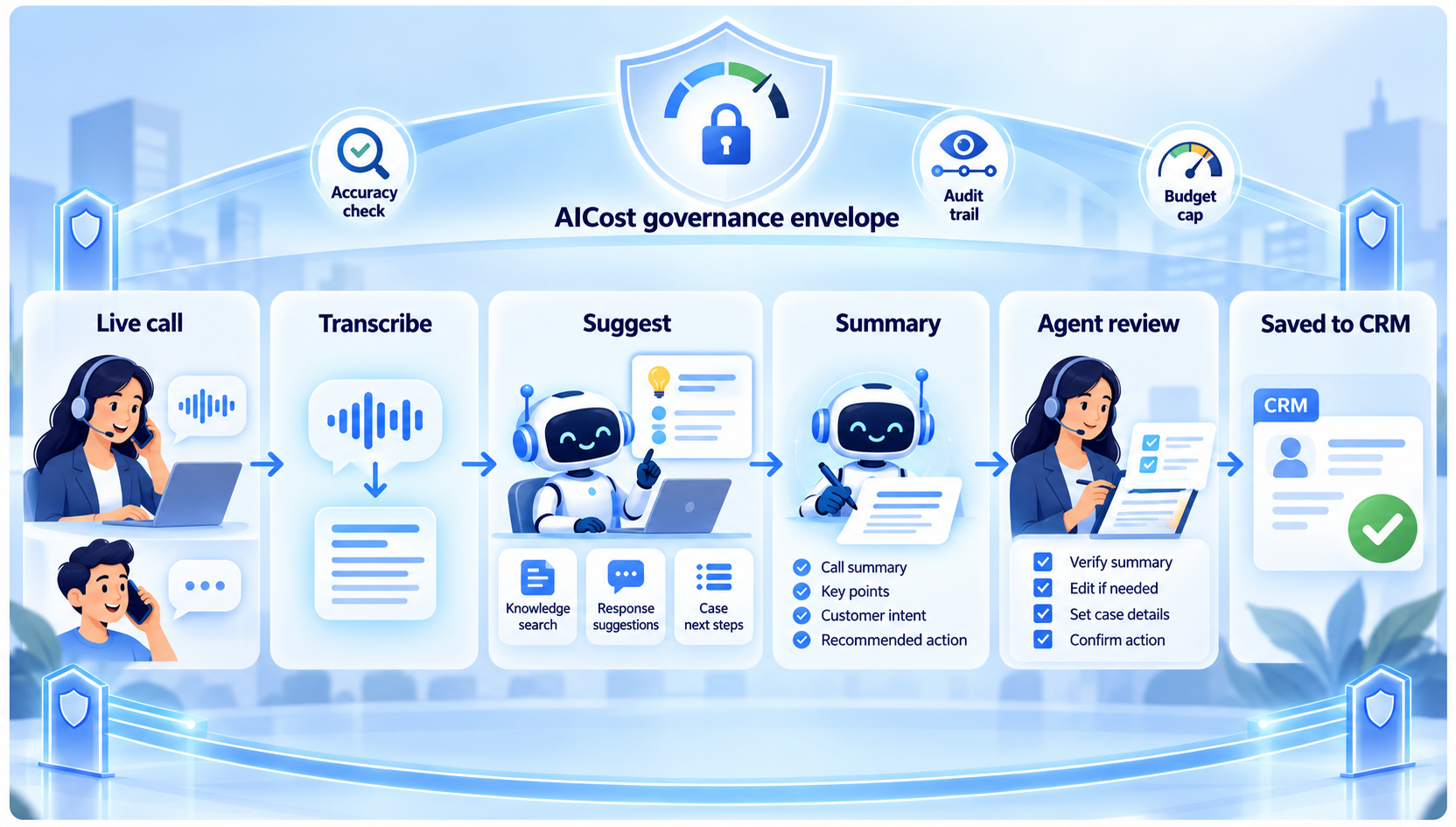
While a live agent talks to a customer, AI suggests answers and knowledge articles, then writes the case notes and follow-ups at wrap-up.
1 · cost
Transcribe live calls
$1,440
2 · cost
Suggest the right knowledge article
$1,285
$386
3 · gate
Reuse the knowledge prompt across calls
4 · gate
Run wrap-up summaries in batch
5 · governance
Check summaries against the transcript
$98
6 · governance
Sample and trace for QA
$3
7 · gate
Return per agent seat
Without AICost
$2,825/mo
$0.07 per agent-handled contact
With AICost
$1,926/mo
$0.05 per agent-handled contact 32% lower
Monthly saving
$899/mo
3 cost levers applied
Governance controls
4
Monthly budget $600
Cost cutPrompt caching → Suggest the right knowledge article −$354Context compaction → Suggest the right knowledge article −$318Model routing → Suggest the right knowledge article −$227
Governance✓ Accuracy and hallucination checks → Check summaries against the transcript✓ Tracing and audit log → Sample and trace for QA✓ Cost firewall at the gateway✓ Data-class model allowlist
Flow, picture, cost levers, governance and policy envelope
How the work flows today
1Customer contacts a live agent
2AI listens or reads along and suggests answers and knowledge articles
3AI drafts the reply or next step for the agent to edit
4At wrap-up AI writes the case notes, disposition and follow-ups
5Agent reviews and saves to the CRM
6QA team samples summaries for accuracy
AICost engine chain (blue: cost, purple: governance)
Cost levers and the step they act on
Prompt caching on step Suggest the right knowledge article −$35460% cacheable, 75% hit (combined with the other knobs on this step) · Prompt CachingRepeated instructions and documents are cached, so you pay less for the same prompt text.
How it works: The stable part of each prompt (system instructions, tool definitions, reference text) is cached by the model provider and billed at the cached rate.
How AICost prices it: The Prompt Caching engine prices cacheable share and hit rate against the provider's cached-input price.
Governance: No change to answers, models or data. Only the billing of repeated text changes.
* Cacheable share and hit rate are typical values; your logs give the real ones.
Context compaction on step Suggest the right knowledge article −$318trim history 60%, net of overhead (applied to every eligible workflow) (combined with the other knobs on this step) · Context TrimLong histories are trimmed each turn, so every call carries less text.
How it works: Older turns and long documents are summarized or trimmed before each call, keeping what the model needs.
How AICost prices it: The Context Trim engine prices the smaller context net of the cost of trimming.
Governance: Quality is checked before rollout; nothing reaches the model that it was not allowed to see.
* The trim size is an input; your evals confirm it keeps answer quality.
Model routing on step Suggest the right knowledge article −$22715% of calls (transcript cleanup and coding hints) to Claude Haiku 5.5; critical work (the clinical note itself) stays on Claude Sonnet 5.5 (applied to every eligible workflow) (combined with the other knobs on this step) · Model RouterRoutine steps run on a cheaper model; critical steps stay on the primary model.
How it works: Each workflow type has routine work (triage, lookups, extraction, summaries, drafts) and critical work (the final answer, code changes, clinical or legal output, decisions). Routine calls go to the economy model; critical work stays on the primary model.
How AICost prices it: The Model Router engine prices the split between the economy and primary model on the workflow's own volume.
Governance: Only approved models for the data class are used. For patient and privileged legal data the share is capped and calls stay with the primary model's vendor and route, so the BAA still covers every call.
* The share of routine calls per workflow type is a starting assumption; your traffic sets the real split.
Governance controls and the step they act on
Accuracy and hallucination checks on step Check summaries against the transcript $98
Golden-set and live-traffic scoring catch silent regressions.
Tracing and audit log on step Sample and trace for QA $3
Every call logged with principal, model, tokens and spend state.
Cost firewall at the gateway policy only, no cost
Monthly budget, daily cap, per-run ceiling, turn cap, spike rule, kill switch.
Data-class model allowlist policy only, no cost
Only models cleared for this data class are routable; others are refused at the gateway.
Policy envelope
Monthly budget$600
Daily hard cap$26
Per-run ceiling$0.13
Turn cap6
See the policy your gateway enforces
{
  "workload_id": "agent-assist-with-automatic-case-and-call-summaries",
  "scope": "workload",
  "monthly_budget_usd": 600,
  "daily_warning_usd": 18.2,
  "daily_hard_limit_usd": 26,
  "max_cost_per_run_usd": 0.13,
  "max_model_calls_per_run": 6,
  "max_retries": 2,
  "max_output_tokens": 1200,
  "requests_per_min": 380,
  "anomaly": {
    "rolling_window": "7d",
    "spike_multiplier": 3,
    "rule": "flag any hour/day exceeding 3x the rolling average, or any single day above the daily hard limit"
  },
  "actions": {
    "warning_threshold": "notify",
    "soft_limit": "route_to:claude-haiku-5-5",
    "hard_limit": "block_noncritical_requests",
    "anomaly": "throttle_and_alert",
    "emergency": "block_all_and_require_approval"
  },
  "emergency_stop": {
    "enabled": true,
    "requires_approval_to_resume": true
  }
}
Where the cost runs away
- Summarizing every call, including short or duplicate ones, at full transcript length
- Real-time suggestions firing on every utterance instead of at decision points
- Per-seat add-on licences bought for agents who rarely use them
Talk to us about this workflow →
🎧 Customer service · Business solutions
Voice AI agent that answers the phone line
20,000 phone call a month
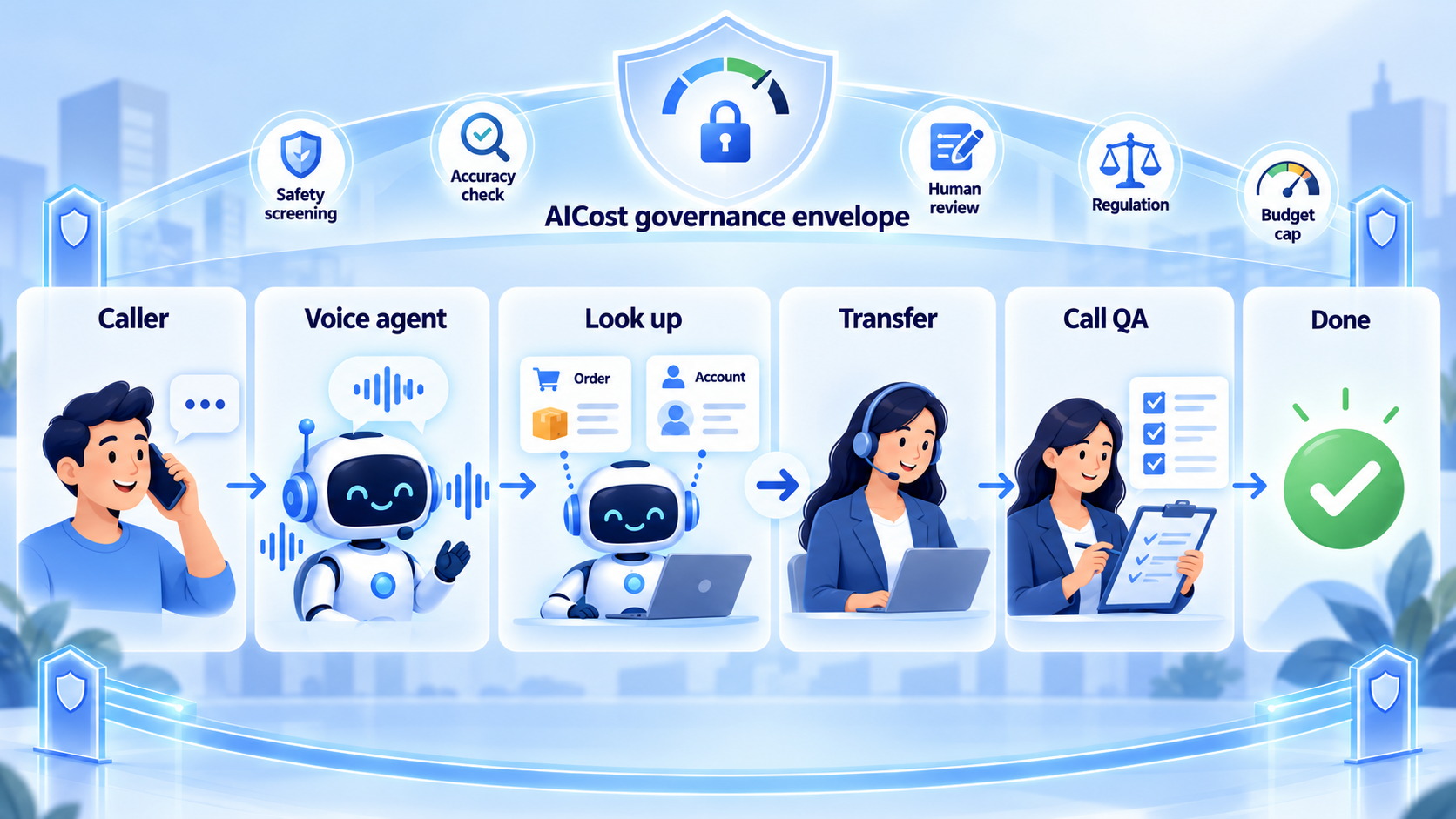
A voice agent answers the phone line, understands the caller in their own words, checks order or account systems and completes the task or transfers to a person with context.
1 · cost
Price each call: speech in, model, speech out
$9,760
$7,757
2 · cost
Limit turns per call
$10,887
$5,882
3 · cost
Order and CRM lookups
$1,472
4 · governance
Identity checks and payment safety
$50
5 · governance
Score call quality
$95
6 · governance
Transfer to a person
$10,000
$5,333
7 · gate
AI disclosure duties
8 · gate
Cost per call vs a live agent
Without AICost
$32,264/mo
$1.61 per phone call
With AICost
$20,589/mo
$1.03 per phone call 36% lower
Monthly saving
$11,675/mo
5 cost levers applied
Governance controls
5
Monthly budget $6,700
Cost cutLoop cap → Limit turns per call −$5,005Prompt caching → Price each call: speech in, model, speech out −$499Context compaction → Price each call: speech in, model, speech out −$896Model routing → Price each call: speech in, model, speech out −$608Better grounding → Transfer to a person −$4,667
Governance✓ Guardrail screening → Identity checks and payment safety✓ Accuracy and hallucination checks → Score call quality✓ Human review → Transfer to a person✓ Cost firewall at the gateway✓ Data-class model allowlist
Flow, picture, cost levers, governance and policy envelope
How the work flows today
1Customer calls and describes the issue in their own words (no phone menu)
2Voice agent identifies the reason for the call
3Agent checks order status, availability or account details through back-end systems
4Agent completes the task or sends a link by text
5Complex or upset callers are transferred to a human with context
6Call outcome logged and reviewed
AICost engine chain (blue: cost, purple: governance)
Cost levers and the step they act on
Loop cap on step Limit turns per call −$5,00516 turns, 60k tokens, enforced by cost-firewall · Agent LoopA ceiling on turns and tokens per agent run, so a stuck agent cannot run up the bill.
How it works: Each agent run gets a maximum number of turns and tokens. A run that hits the ceiling stops and hands off instead of looping.
How AICost prices it: The Agent Loop engine prices the runs with and without the ceiling, including the runaway tail.
Governance: The cap is enforced by the cost firewall at your gateway, with an alert when it trips.
Prompt caching on step Price each call: speech in, model, speech out −$49960% cacheable, 75% hit (applied to every eligible workflow) · Prompt CachingRepeated instructions and documents are cached, so you pay less for the same prompt text.
How it works: The stable part of each prompt (system instructions, tool definitions, reference text) is cached by the model provider and billed at the cached rate.
How AICost prices it: The Prompt Caching engine prices cacheable share and hit rate against the provider's cached-input price.
Governance: No change to answers, models or data. Only the billing of repeated text changes.
* Cacheable share and hit rate are typical values; your logs give the real ones.
Context compaction on step Price each call: speech in, model, speech out −$896trim history 60%, net of overhead (applied to every eligible workflow) · Context TrimLong histories are trimmed each turn, so every call carries less text.
How it works: Older turns and long documents are summarized or trimmed before each call, keeping what the model needs.
How AICost prices it: The Context Trim engine prices the smaller context net of the cost of trimming.
Governance: Quality is checked before rollout; nothing reaches the model that it was not allowed to see.
* The trim size is an input; your evals confirm it keeps answer quality.
Model routing on step Price each call: speech in, model, speech out −$60840% of calls (intent detection and lookups) to Claude Haiku 5.5; critical work (actions on the account) stays on Claude Sonnet 5.5 (applied to every eligible workflow) · Model RouterRoutine steps run on a cheaper model; critical steps stay on the primary model.
How it works: Each workflow type has routine work (triage, lookups, extraction, summaries, drafts) and critical work (the final answer, code changes, clinical or legal output, decisions). Routine calls go to the economy model; critical work stays on the primary model.
How AICost prices it: The Model Router engine prices the split between the economy and primary model on the workflow's own volume.
Governance: Only approved models for the data class are used. For patient and privileged legal data the share is capped and calls stay with the primary model's vendor and route, so the BAA still covers every call.
* The share of routine calls per workflow type is a starting assumption; your traffic sets the real split.
Better grounding on step Transfer to a person −$4,667escalation 15% to 8% · Human ReviewAnswers come only from your approved sources, so fewer cases go to a person.
How it works: The assistant answers from your own approved content with the source attached, and says it does not know instead of guessing. Teams get there with cleaner knowledge-base articles, better retrieval (tighter chunks, reranking) and an answer check before the reply goes out.
How AICost prices it: Fewer low-confidence answers means fewer escalations. The Human Review engine prices reviewer minutes at the lower escalation rate; the saving is the difference.
Governance: Human review stays on for refunds, policy exceptions and anything still low-confidence. Only the share of cases that needed a person goes down.
* The demo assumes escalations fall by half (for example 12% to 6%). Your number comes from your own evaluation results.
Governance controls and the step they act on
Guardrail screening on step Identity checks and payment safety $50
PII, prompt-attack and policy screening before the model acts.
Accuracy and hallucination checks on step Score call quality $95
Golden-set and live-traffic scoring catch silent regressions.
Human review on step Transfer to a person $10,000
Low-confidence, high-value or regulated cases go to a person.
Cost firewall at the gateway policy only, no cost
Monthly budget, daily cap, per-run ceiling, turn cap, spike rule, kill switch.
Data-class model allowlist policy only, no cost
Only models cleared for this data class are routable; others are refused at the gateway.
Policy envelope
Monthly budget$6,700
Daily hard cap$290
Per-run ceiling$1.95
Turn cap16
See the policy your gateway enforces
{
  "workload_id": "voice-ai-agent-that-answers-the-phone-line",
  "scope": "workload",
  "monthly_budget_usd": 6700,
  "daily_warning_usd": 203.23,
  "daily_hard_limit_usd": 290.33,
  "max_cost_per_run_usd": 1.95,
  "max_model_calls_per_run": 16,
  "max_retries": 2,
  "max_output_tokens": 1200,
  "requests_per_min": 190,
  "anomaly": {
    "rolling_window": "7d",
    "spike_multiplier": 3,
    "rule": "flag any hour/day exceeding 3x the rolling average, or any single day above the daily hard limit"
  },
  "actions": {
    "warning_threshold": "notify",
    "soft_limit": "route_to:claude-haiku-5-5",
    "hard_limit": "block_noncritical_requests",
    "anomaly": "throttle_and_alert",
    "emergency": "block_all_and_require_approval"
  },
  "emergency_stop": {
    "enabled": true,
    "requires_approval_to_resume": true
  }
}
Where the cost runs away
- Per-minute voice pricing (speech, model and telephony) on long or looping calls
- Low-latency premium models used for every turn
- Repeat calls when the agent fails and the customer calls back
Talk to us about this workflow →
📈 Sales · Business solutions
AI SDR for outbound prospecting and inbound lead qualification
3,000 qualified lead a month
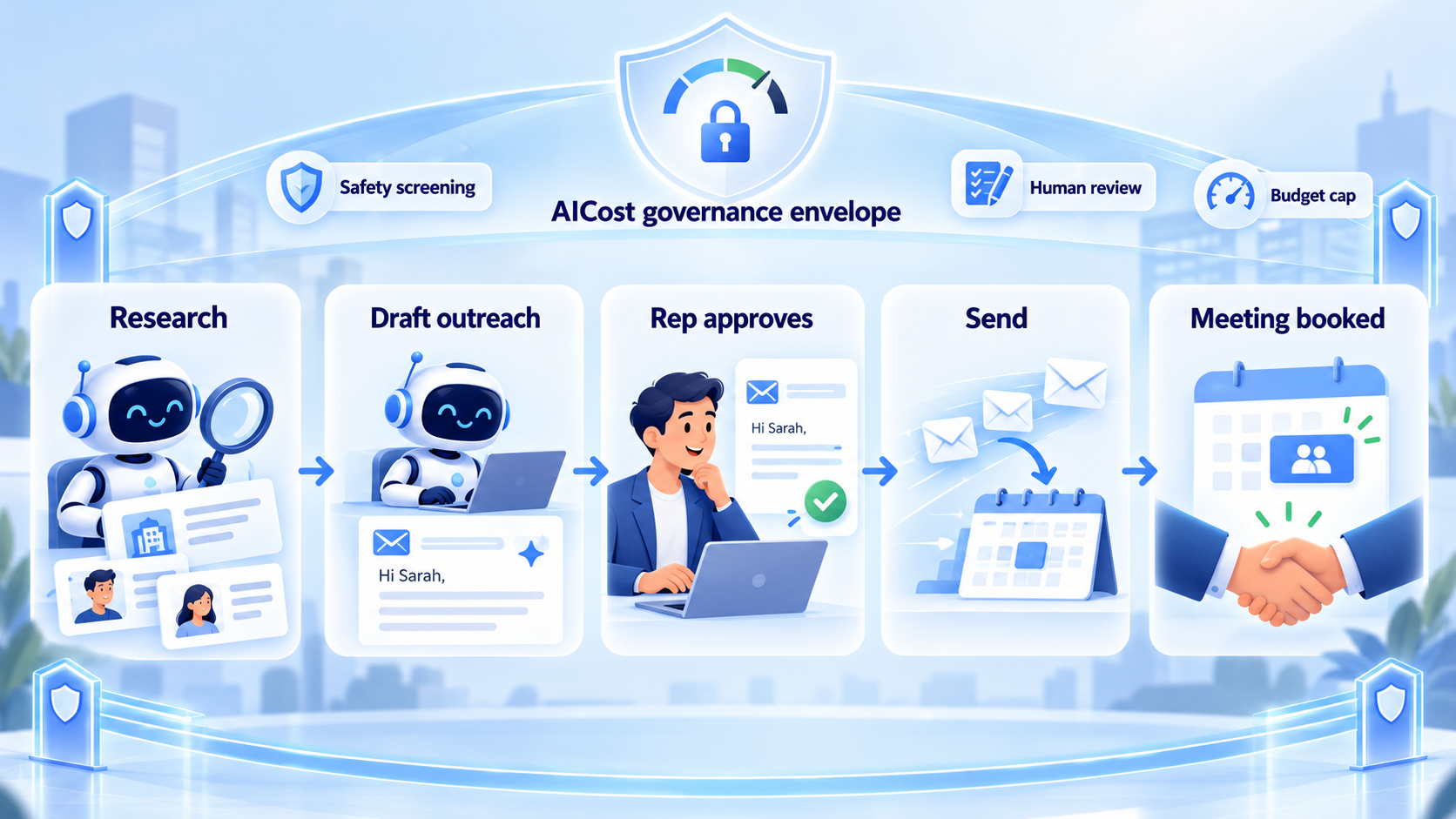
An AI SDR researches target accounts, writes personalized outreach, answers replies and qualifies inbound leads before booking meetings for the sales team.
1 · cost
Research, write and send, per lead
$1,788
$537
2 · gate
Shorter prompts per email
3 · gate
Cheap model for drafts, strong model for replies
4 · cost
CRM, email and calendar connections
$1,472
5 · governance
Brand and claims guardrails
$7
6 · governance
Rep approves drafts before send
$1,875
$1,000
7 · gate
Cost per booked meeting
Without AICost
$5,142/mo
$1.71 per qualified lead
With AICost
$3,016/mo
$1.01 per qualified lead 41% lower
Monthly saving
$2,126/mo
6 cost levers applied
Governance controls
4
Monthly budget $600
Cost cutLoop cap → Research, write and send, per lead −$601Prompt caching → Research, write and send, per lead −$75Context compaction → Research, write and send, per lead −$107Model routing → Research, write and send, per lead −$109Shorter prompts → Research, write and send, per lead −$359Better grounding → Rep approves drafts before send −$875
Governance✓ Guardrail screening → Brand and claims guardrails✓ Human review → Rep approves drafts before send✓ Cost firewall at the gateway✓ Data-class model allowlist
Flow, picture, cost levers, governance and policy envelope
How the work flows today
1RevOps loads a target list or segment (lapsed customers, past attendees, cold accounts)
2Agent researches each account and contact
3Agent writes and sends personalized email sequences, or chats with website visitors
4Agent handles replies and books meetings on rep calendars
5Hot or complex replies go to a human rep
6Results reviewed weekly and messaging tuned
AICost engine chain (blue: cost, purple: governance)
Cost levers and the step they act on
Loop cap on step Research, write and send, per lead −$60116 turns, 60k tokens, enforced by cost-firewall (combined with the other knobs on this step) · Agent LoopA ceiling on turns and tokens per agent run, so a stuck agent cannot run up the bill.
How it works: Each agent run gets a maximum number of turns and tokens. A run that hits the ceiling stops and hands off instead of looping.
How AICost prices it: The Agent Loop engine prices the runs with and without the ceiling, including the runaway tail.
Governance: The cap is enforced by the cost firewall at your gateway, with an alert when it trips.
Prompt caching on step Research, write and send, per lead −$7560% cacheable, 75% hit (applied to every eligible workflow) (combined with the other knobs on this step) · Prompt CachingRepeated instructions and documents are cached, so you pay less for the same prompt text.
How it works: The stable part of each prompt (system instructions, tool definitions, reference text) is cached by the model provider and billed at the cached rate.
How AICost prices it: The Prompt Caching engine prices cacheable share and hit rate against the provider's cached-input price.
Governance: No change to answers, models or data. Only the billing of repeated text changes.
* Cacheable share and hit rate are typical values; your logs give the real ones.
Context compaction on step Research, write and send, per lead −$107trim history 60%, net of overhead (applied to every eligible workflow) (combined with the other knobs on this step) · Context TrimLong histories are trimmed each turn, so every call carries less text.
How it works: Older turns and long documents are summarized or trimmed before each call, keeping what the model needs.
How AICost prices it: The Context Trim engine prices the smaller context net of the cost of trimming.
Governance: Quality is checked before rollout; nothing reaches the model that it was not allowed to see.
* The trim size is an input; your evals confirm it keeps answer quality.
Model routing on step Research, write and send, per lead −$10940% of calls (planning, tool calls and lookups) to Claude Haiku 5.5; critical work (actions that change records) stays on Claude Sonnet 5.5 (combined with the other knobs on this step) · Model RouterRoutine steps run on a cheaper model; critical steps stay on the primary model.
How it works: Each workflow type has routine work (triage, lookups, extraction, summaries, drafts) and critical work (the final answer, code changes, clinical or legal output, decisions). Routine calls go to the economy model; critical work stays on the primary model.
How AICost prices it: The Model Router engine prices the split between the economy and primary model on the workflow's own volume.
Governance: Only approved models for the data class are used. For patient and privileged legal data the share is capped and calls stay with the primary model's vendor and route, so the BAA still covers every call.
* The share of routine calls per workflow type is a starting assumption; your traffic sets the real split.
Shorter prompts on step Research, write and send, per lead −$359prompt and output trimming levers (combined with the other knobs on this step) · Token ReductionTrimmed prompts and tighter outputs cut tokens on every call.
How it works: Instructions, examples and output formats are tightened so each call uses fewer tokens.
How AICost prices it: The Token Reduction engine prices the trimmed prompt and output sizes.
Governance: Changes are tested against your quality set before release.
Better grounding on step Rep approves drafts before send −$875escalation 15% to 8% · Human ReviewAnswers come only from your approved sources, so fewer cases go to a person.
How it works: The assistant answers from your own approved content with the source attached, and says it does not know instead of guessing. Teams get there with cleaner knowledge-base articles, better retrieval (tighter chunks, reranking) and an answer check before the reply goes out.
How AICost prices it: Fewer low-confidence answers means fewer escalations. The Human Review engine prices reviewer minutes at the lower escalation rate; the saving is the difference.
Governance: Human review stays on for refunds, policy exceptions and anything still low-confidence. Only the share of cases that needed a person goes down.
* The demo assumes escalations fall by half (for example 12% to 6%). Your number comes from your own evaluation results.
Governance controls and the step they act on
Guardrail screening on step Brand and claims guardrails $7
PII, prompt-attack and policy screening before the model acts.
Human review on step Rep approves drafts before send $1,875
Low-confidence, high-value or regulated cases go to a person.
Cost firewall at the gateway policy only, no cost
Monthly budget, daily cap, per-run ceiling, turn cap, spike rule, kill switch.
Data-class model allowlist policy only, no cost
Only models cleared for this data class are routable; others are refused at the gateway.
Policy envelope
Monthly budget$600
Daily hard cap$26
Per-run ceiling$2.38
Turn cap16
See the policy your gateway enforces
{
  "workload_id": "ai-sdr-for-outbound-prospecting-and-inbound-lead-qualificati",
  "scope": "workload",
  "monthly_budget_usd": 600,
  "daily_warning_usd": 18.2,
  "daily_hard_limit_usd": 26,
  "max_cost_per_run_usd": 2.38,
  "max_model_calls_per_run": 16,
  "max_retries": 2,
  "max_output_tokens": 1200,
  "requests_per_min": 60,
  "anomaly": {
    "rolling_window": "7d",
    "spike_multiplier": 3,
    "rule": "flag any hour/day exceeding 3x the rolling average, or any single day above the daily hard limit"
  },
  "actions": {
    "warning_threshold": "notify",
    "soft_limit": "route_to:claude-haiku-5-5",
    "hard_limit": "block_noncritical_requests",
    "anomaly": "throttle_and_alert",
    "emergency": "block_all_and_require_approval"
  },
  "emergency_stop": {
    "enabled": true,
    "requires_approval_to_resume": true
  }
}
Where the cost runs away
- Research step re-run on every contact on every send
- Platform licences of roughly $50k-100k+ per year each, with overlap across vendors (SaaStr)
- 15-20 hours/week of human management that is not budgeted (SaaStr)
Talk to us about this workflow →
📈 Sales · Business solutions
Call notes, CRM auto-update and deal risk alerts
AI records sales calls, writes the notes, updates CRM fields and flags deals that show risk signals.
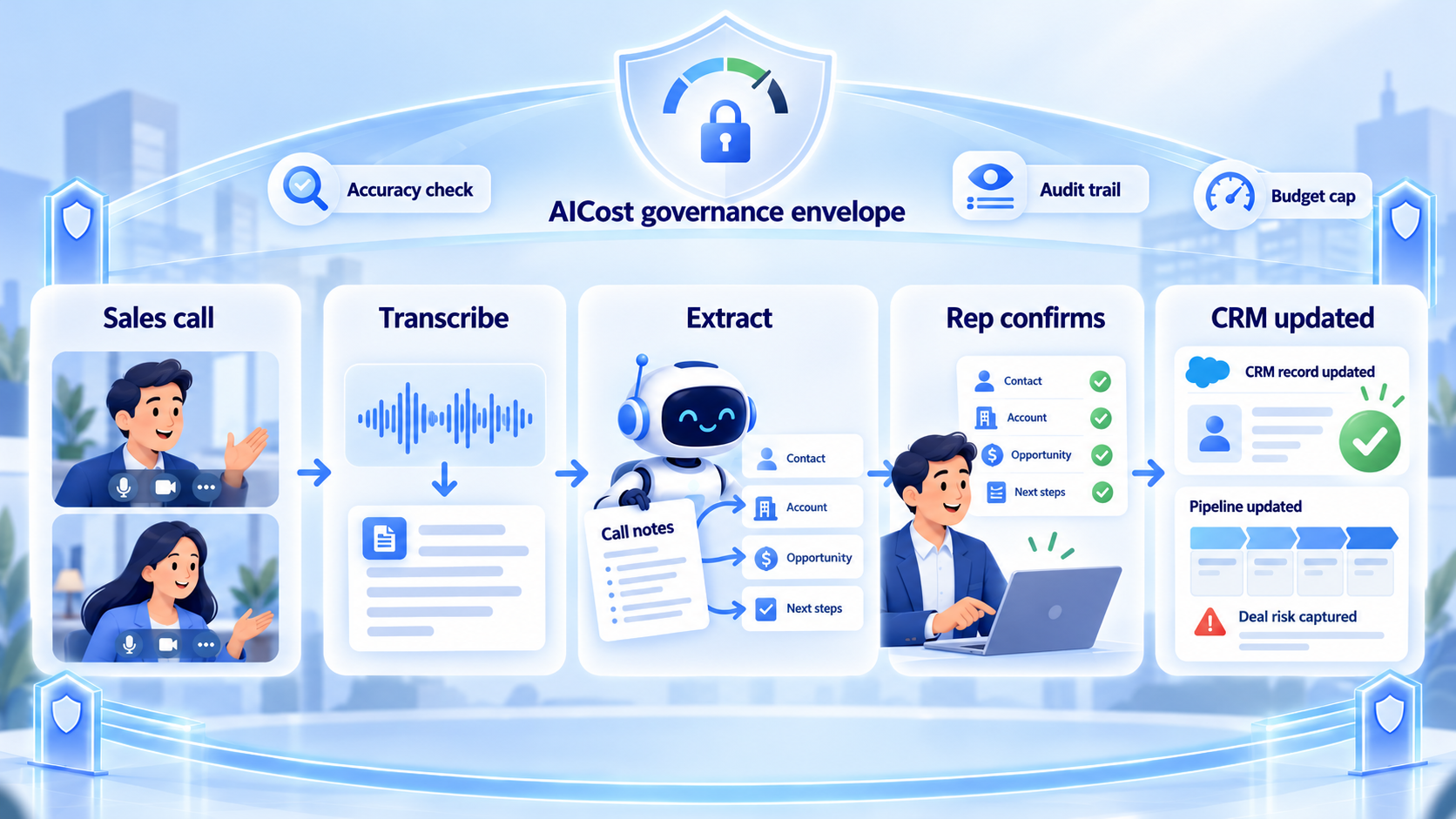
1 · cost
Transcribe sales calls
$720
2 · cost
Summary and field extraction per call
$224
$97
3 · gate
Reuse the CRM field prompt
4 · gate
Batch the wrap-up after the call
5 · cost
Write back to the CRM
$1,472
6 · governance
Catch wrong fields and invented commitments
$93
7 · governance
Keep an audit trail
$0
8 · gate
Return per rep seat
Without AICost
$2,509/mo
$0.63 per sales call
With AICost
$2,383/mo
$0.60 per sales call 5% lower
Monthly saving
$126/mo
3 cost levers applied
Governance controls
4
Monthly budget $300
Cost cutPrompt caching → Summary and field extraction per call −$50Context compaction → Summary and field extraction per call −$45Model routing → Summary and field extraction per call −$32
Governance✓ Accuracy and hallucination checks → Catch wrong fields and invented commitments✓ Tracing and audit log → Keep an audit trail✓ Cost firewall at the gateway✓ Data-class model allowlist
Flow, picture, cost levers, governance and policy envelope
How the work flows today
1Rep runs a customer call or meeting
2AI records, transcribes and summarizes next steps
3AI fills CRM fields (stage, contacts, MEDDICC items) for the rep to confirm
4AI flags deals at risk and drafts the follow-up email
5Manager reviews pipeline and forecast with AI commentary
AICost engine chain (blue: cost, purple: governance)
Cost levers and the step they act on
Prompt caching on step Summary and field extraction per call −$5060% cacheable, 75% hit · Prompt CachingRepeated instructions and documents are cached, so you pay less for the same prompt text.
How it works: The stable part of each prompt (system instructions, tool definitions, reference text) is cached by the model provider and billed at the cached rate.
How AICost prices it: The Prompt Caching engine prices cacheable share and hit rate against the provider's cached-input price.
Governance: No change to answers, models or data. Only the billing of repeated text changes.
* Cacheable share and hit rate are typical values; your logs give the real ones.
Context compaction on step Summary and field extraction per call −$45trim history 60%, net of overhead (applied to every eligible workflow) · Context TrimLong histories are trimmed each turn, so every call carries less text.
How it works: Older turns and long documents are summarized or trimmed before each call, keeping what the model needs.
How AICost prices it: The Context Trim engine prices the smaller context net of the cost of trimming.
Governance: Quality is checked before rollout; nothing reaches the model that it was not allowed to see.
* The trim size is an input; your evals confirm it keeps answer quality.
Model routing on step Summary and field extraction per call −$3215% of calls (transcript cleanup and coding hints) to Claude Haiku 5.5; critical work (the clinical note itself) stays on Claude Sonnet 5.5 (applied to every eligible workflow) · Model RouterRoutine steps run on a cheaper model; critical steps stay on the primary model.
How it works: Each workflow type has routine work (triage, lookups, extraction, summaries, drafts) and critical work (the final answer, code changes, clinical or legal output, decisions). Routine calls go to the economy model; critical work stays on the primary model.
How AICost prices it: The Model Router engine prices the split between the economy and primary model on the workflow's own volume.
Governance: Only approved models for the data class are used. For patient and privileged legal data the share is capped and calls stay with the primary model's vendor and route, so the BAA still covers every call.
* The share of routine calls per workflow type is a starting assumption; your traffic sets the real split.
Governance controls and the step they act on
Accuracy and hallucination checks on step Catch wrong fields and invented commitments $93
Golden-set and live-traffic scoring catch silent regressions.
Tracing and audit log on step Keep an audit trail
Every call logged with principal, model, tokens and spend state.
Cost firewall at the gateway policy only, no cost
Monthly budget, daily cap, per-run ceiling, turn cap, spike rule, kill switch.
Data-class model allowlist policy only, no cost
Only models cleared for this data class are routable; others are refused at the gateway.
Policy envelope
Monthly budget$300
Daily hard cap$13
Per-run ceiling$0.22
Turn cap6
See the policy your gateway enforces
{
  "workload_id": "call-notes-crm-auto-update-and-deal-risk-alerts",
  "scope": "workload",
  "monthly_budget_usd": 300,
  "daily_warning_usd": 9.1,
  "daily_hard_limit_usd": 13,
  "max_cost_per_run_usd": 0.22,
  "max_model_calls_per_run": 6,
  "max_retries": 2,
  "max_output_tokens": 1200,
  "requests_per_min": 60,
  "anomaly": {
    "rolling_window": "7d",
    "spike_multiplier": 3,
    "rule": "flag any hour/day exceeding 3x the rolling average, or any single day above the daily hard limit"
  },
  "actions": {
    "warning_threshold": "notify",
    "soft_limit": "route_to:claude-haiku-5-5",
    "hard_limit": "block_noncritical_requests",
    "anomaly": "throttle_and_alert",
    "emergency": "block_all_and_require_approval"
  },
  "emergency_stop": {
    "enabled": true,
    "requires_approval_to_resume": true
  }
}
Where the cost runs away
- Every internal and external meeting transcribed and summarized, not just deal calls
- Per-seat conversation intelligence licences for every rep plus add-ons
- Re-summarizing the full deal history each time a forecast is refreshed
Talk to us about this workflow →
📈 Sales · Business solutions
RFP and security questionnaire answering
AI drafts answers to RFPs and security questionnaires from approved past answers and policy documents, and routes the gaps to subject experts.
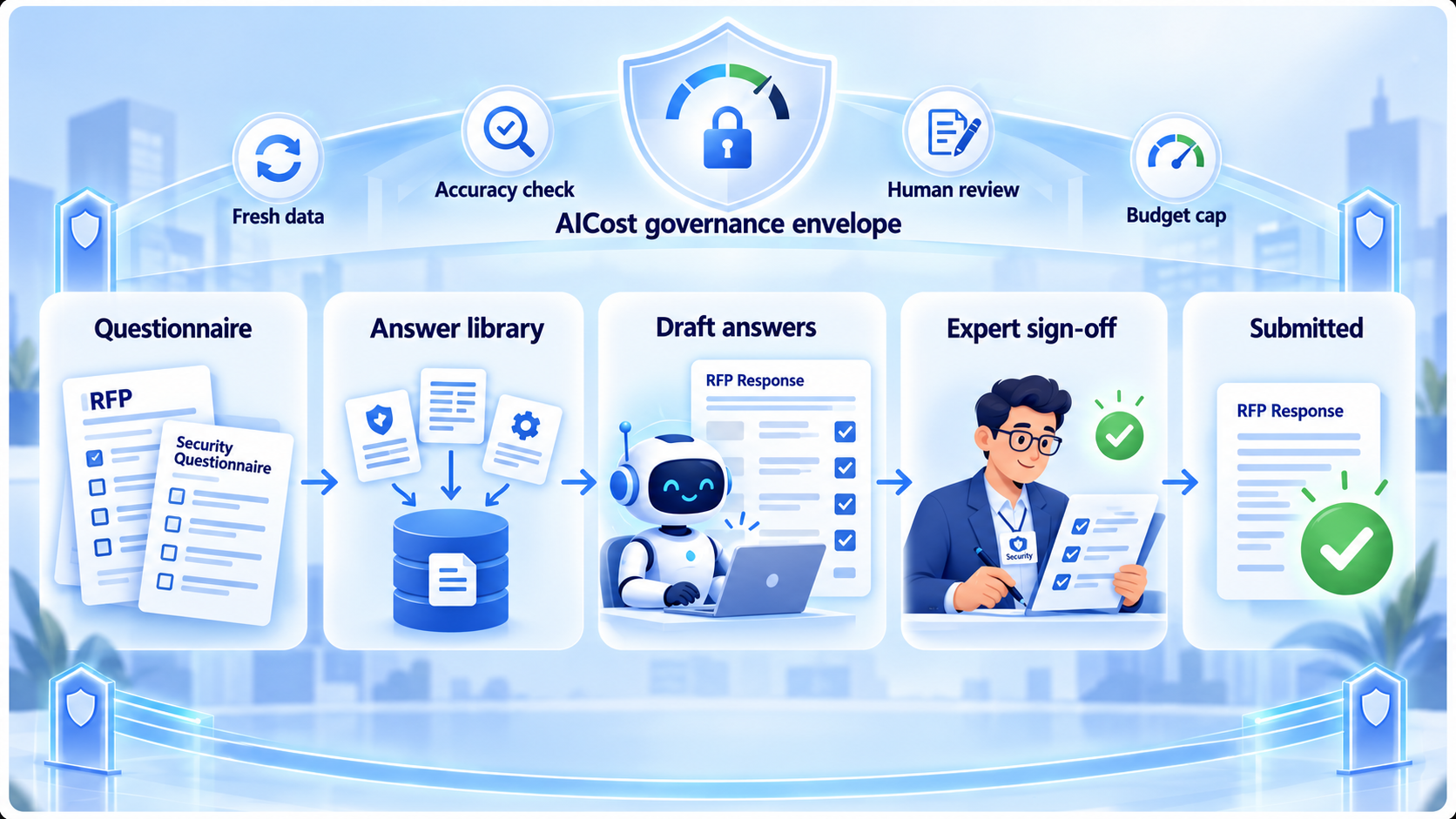
1 · cost
Read incoming questionnaires
$11
2 · cost
Index the approved answer library
$0
3 · cost
Draft answers from approved content
$46
$16
4 · gate
Reuse the answer-library prompt
5 · gate
Draft long questionnaires in batch
6 · cost
Keep the answer library current
$1,700
7 · governance
Flag answers with no source
$92
8 · governance
Expert sign-off
$3,000
$2,400
9 · gate
Cost per questionnaire vs hours saved
Without AICost
$4,851/mo
$121.27 per questionnaire
With AICost
$4,220/mo
$105.49 per questionnaire 13% lower
Monthly saving
$631/mo
5 cost levers applied
Governance controls
4
Monthly budget $200
Cost cutPrompt caching → Draft answers from approved content −$9Context compaction → Draft answers from approved content −$8Model routing → Draft answers from approved content −$6Batch the non-urgent work → Draft answers from approved content −$7Shorter review with pre-checked drafts* → Expert sign-off −$600
Governance✓ Accuracy and hallucination checks → Flag answers with no source✓ Human review → Expert sign-off✓ Cost firewall at the gateway✓ Data-class model allowlist
Flow, picture, cost levers, governance and policy envelope
How the work flows today
1RFP or security questionnaire arrives
2AI splits it into questions and assigns owners
3AI drafts answers from the approved answer library and past bids
4Subject-matter experts review and edit low-confidence answers
5Final response exported and approved answers saved back to the library
AICost engine chain (blue: cost, purple: governance)
Cost levers and the step they act on
Prompt caching on step Draft answers from approved content −$960% cacheable, 75% hit · Prompt CachingRepeated instructions and documents are cached, so you pay less for the same prompt text.
How it works: The stable part of each prompt (system instructions, tool definitions, reference text) is cached by the model provider and billed at the cached rate.
How AICost prices it: The Prompt Caching engine prices cacheable share and hit rate against the provider's cached-input price.
Governance: No change to answers, models or data. Only the billing of repeated text changes.
* Cacheable share and hit rate are typical values; your logs give the real ones.
Context compaction on step Draft answers from approved content −$8trim history 60%, net of overhead (applied to every eligible workflow) · Context TrimLong histories are trimmed each turn, so every call carries less text.
How it works: Older turns and long documents are summarized or trimmed before each call, keeping what the model needs.
How AICost prices it: The Context Trim engine prices the smaller context net of the cost of trimming.
Governance: Quality is checked before rollout; nothing reaches the model that it was not allowed to see.
* The trim size is an input; your evals confirm it keeps answer quality.
Model routing on step Draft answers from approved content −$620% of calls (outlines and section summaries) to Claude Haiku 5.5; critical work (the drafted document) stays on Claude Sonnet 5.5 (applied to every eligible workflow) · Model RouterRoutine steps run on a cheaper model; critical steps stay on the primary model.
How it works: Each workflow type has routine work (triage, lookups, extraction, summaries, drafts) and critical work (the final answer, code changes, clinical or legal output, decisions). Routine calls go to the economy model; critical work stays on the primary model.
How AICost prices it: The Model Router engine prices the split between the economy and primary model on the workflow's own volume.
Governance: Only approved models for the data class are used. For patient and privileged legal data the share is capped and calls stay with the primary model's vendor and route, so the BAA still covers every call.
* The share of routine calls per workflow type is a starting assumption; your traffic sets the real split.
Batch the non-urgent work on step Draft answers from approved content −$740% of calls through the batch API · Batch or RealtimeWork that can wait runs in the provider's batch mode at a lower price.
How it works: Requests that do not need an instant answer are queued and sent through the batch API.
How AICost prices it: The Batch or Realtime engine prices the batch-tolerant share at batch rates.
Governance: Urgent and customer-facing requests stay realtime.
* The batch-tolerant share is an input.
Shorter review with pre-checked drafts* on step Expert sign-off −$600*assumption: 20% less edit time per questionnaire when evals catch errors before the reviewer sees the draft; every questionnaire is still reviewed · Human ReviewEvery item is still reviewed, but automated checks catch errors first, so review takes less time.
How it works: An evaluation step checks each draft before the reviewer sees it, so the reviewer edits less.
How AICost prices it: The Human Review engine prices reviewer time at the shorter review time.
Governance: Every item is still reviewed by a person.
* The time saved per review is an assumption, marked with an asterisk.
Governance controls and the step they act on
Accuracy and hallucination checks on step Flag answers with no source $92
Golden-set and live-traffic scoring catch silent regressions.
Human review on step Expert sign-off $3,000
Low-confidence, high-value or regulated cases go to a person.
Cost firewall at the gateway policy only, no cost
Monthly budget, daily cap, per-run ceiling, turn cap, spike rule, kill switch.
Data-class model allowlist policy only, no cost
Only models cleared for this data class are routable; others are refused at the gateway.
Policy envelope
Monthly budget$200
Daily hard cap$9
Per-run ceiling$4.63
Turn cap20
See the policy your gateway enforces
{
  "workload_id": "rfp-and-security-questionnaire-answering",
  "scope": "workload",
  "monthly_budget_usd": 200,
  "daily_warning_usd": 6.07,
  "daily_hard_limit_usd": 8.67,
  "max_cost_per_run_usd": 4.63,
  "max_model_calls_per_run": 20,
  "max_retries": 2,
  "max_output_tokens": 1200,
  "requests_per_min": 60,
  "anomaly": {
    "rolling_window": "7d",
    "spike_multiplier": 3,
    "rule": "flag any hour/day exceeding 3x the rolling average, or any single day above the daily hard limit"
  },
  "actions": {
    "warning_threshold": "notify",
    "soft_limit": "route_to:claude-haiku-5-5",
    "hard_limit": "block_noncritical_requests",
    "anomaly": "throttle_and_alert",
    "emergency": "block_all_and_require_approval"
  },
  "emergency_stop": {
    "enabled": true,
    "requires_approval_to_resume": true
  }
}
Where the cost runs away
- Very long documents processed in full with large context on every redraft
- Re-generating whole sections after small edits
- Separate tools for RFP and security questionnaires with overlapping licences
Talk to us about this workflow →
📣 Marketing · Business solutions
Content and creative production at scale (copy and image variants)
2,000 approved asset a month
From a campaign brief, AI produces copy and image variants for each channel, checks them against brand rules and sends them for approval.
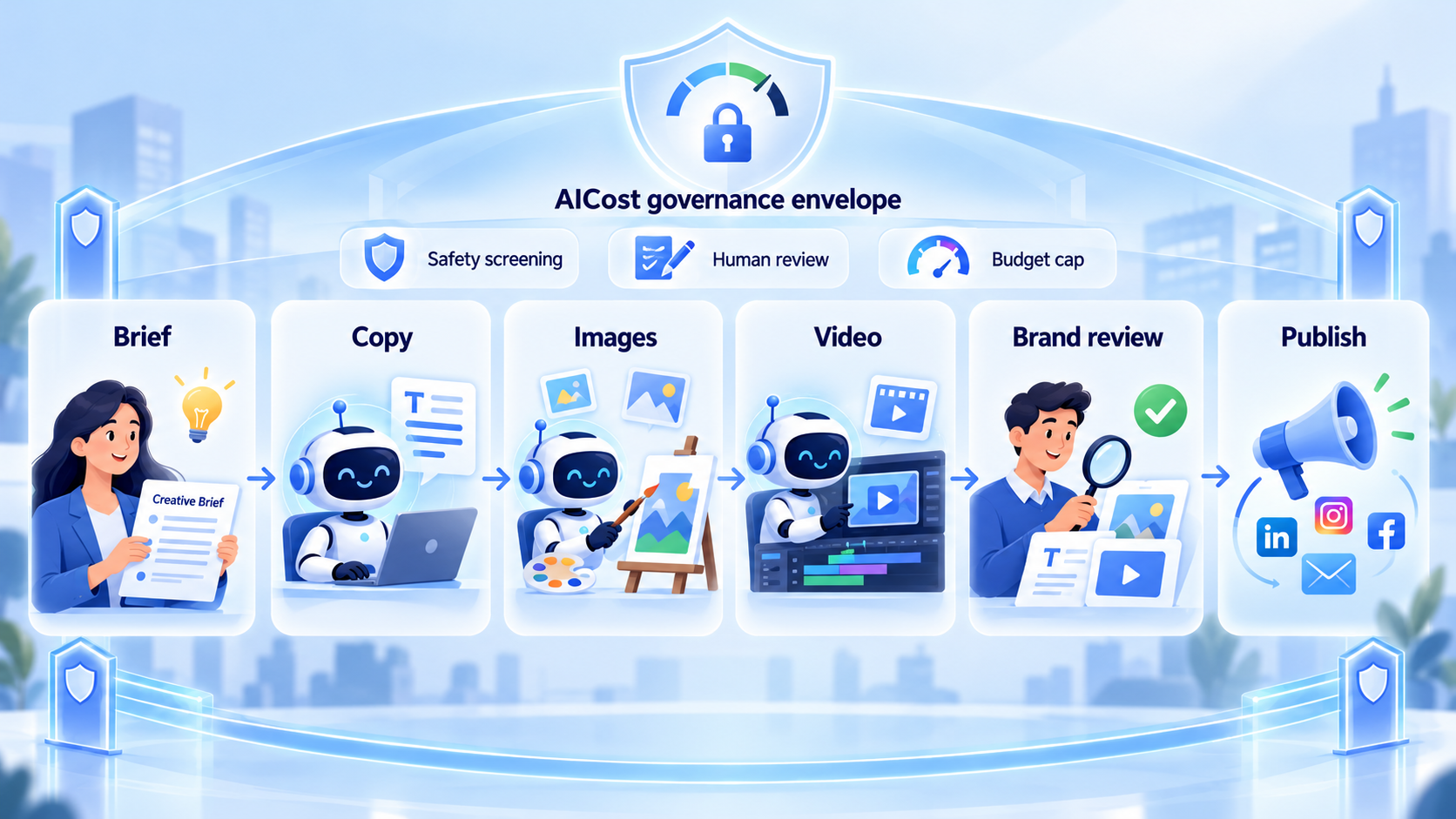
1 · cost
Copy variants per campaign
$210
$63
2 · gate
Reuse the brand voice prompt
3 · cost
Image variants and edits
$634
4 · cost
Short video cuts
$1,280
5 · cost
Brand voice and approved claims
$107
6 · governance
Brand, IP and claim checks
$3
7 · governance
Approval before publishing
$12,000
$4,200
8 · gate
Monthly creative budget
Without AICost
$14,234/mo
$7.12 per approved asset
With AICost
$6,287/mo
$3.14 per approved asset 56% lower
Monthly saving
$7,947/mo
4 cost levers applied
Governance controls
4
Monthly budget $200
Cost cutPrompt caching → Copy variants per campaign −$20Model routing → Copy variants per campaign −$83Batch the non-urgent work → Copy variants per campaign −$44Policy-based review sampling → Approval before publishing −$7,800
Governance✓ Guardrail screening → Brand, IP and claim checks✓ Human review → Approval before publishing✓ Cost firewall at the gateway✓ Data-class model allowlist
Flow, picture, cost levers, governance and policy envelope
How the work flows today
1Marketer writes a campaign brief
2AI drafts copy for each channel and audience
3AI generates or edits images and resizes variants
4Brand and legal review checks tone, claims and image rights
5Approved assets published and tagged in the asset library
AICost engine chain (blue: cost, purple: governance)
Cost levers and the step they act on
Prompt caching on step Copy variants per campaign −$2060% cacheable, 75% hit (combined with the other knobs on this step) · Prompt CachingRepeated instructions and documents are cached, so you pay less for the same prompt text.
How it works: The stable part of each prompt (system instructions, tool definitions, reference text) is cached by the model provider and billed at the cached rate.
How AICost prices it: The Prompt Caching engine prices cacheable share and hit rate against the provider's cached-input price.
Governance: No change to answers, models or data. Only the billing of repeated text changes.
* Cacheable share and hit rate are typical values; your logs give the real ones.
Model routing on step Copy variants per campaign −$8350% of calls (variants, rewrites and translations) to Claude Haiku 5.5; critical work (final approved copy) stays on Claude Sonnet 5.5 (applied to every eligible workflow) (combined with the other knobs on this step) · Model RouterRoutine steps run on a cheaper model; critical steps stay on the primary model.
How it works: Each workflow type has routine work (triage, lookups, extraction, summaries, drafts) and critical work (the final answer, code changes, clinical or legal output, decisions). Routine calls go to the economy model; critical work stays on the primary model.
How AICost prices it: The Model Router engine prices the split between the economy and primary model on the workflow's own volume.
Governance: Only approved models for the data class are used. For patient and privileged legal data the share is capped and calls stay with the primary model's vendor and route, so the BAA still covers every call.
* The share of routine calls per workflow type is a starting assumption; your traffic sets the real split.
Batch the non-urgent work on step Copy variants per campaign −$4450% of calls through the batch API (applied to every eligible workflow) (combined with the other knobs on this step) · Batch or RealtimeWork that can wait runs in the provider's batch mode at a lower price.
How it works: Requests that do not need an instant answer are queued and sent through the batch API.
How AICost prices it: The Batch or Realtime engine prices the batch-tolerant share at batch rates.
Governance: Urgent and customer-facing requests stay realtime.
* The batch-tolerant share is an input.
Policy-based review sampling on step Approval before publishing −$7,80035% reviewed, the rest cleared by policy and evals · Human ReviewPeople review a sample set by policy, not every item, where the rules allow it.
How it works: Low-risk items that pass automated checks are cleared by policy; people review a sample plus everything above the risk threshold.
How AICost prices it: The Human Review engine prices reviewer time at the sampled rate.
Governance: Used only where review is not required by law or policy. Required reviews are never sampled.
* The sample rate is an input set by your policy.
Governance controls and the step they act on
Guardrail screening on step Brand, IP and claim checks $3
PII, prompt-attack and policy screening before the model acts.
Human review on step Approval before publishing $12,000
Low-confidence, high-value or regulated cases go to a person.
Cost firewall at the gateway policy only, no cost
Monthly budget, daily cap, per-run ceiling, turn cap, spike rule, kill switch.
Data-class model allowlist policy only, no cost
Only models cleared for this data class are routable; others are refused at the gateway.
Policy envelope
Monthly budget$200
Daily hard cap$9
Per-run ceiling$0.42
Turn cap10
See the policy your gateway enforces
{
  "workload_id": "content-and-creative-production-at-scale-copy-and-image-vari",
  "scope": "workload",
  "monthly_budget_usd": 200,
  "daily_warning_usd": 6.07,
  "daily_hard_limit_usd": 8.67,
  "max_cost_per_run_usd": 0.42,
  "max_model_calls_per_run": 10,
  "max_retries": 2,
  "max_output_tokens": 1200,
  "requests_per_min": 60,
  "anomaly": {
    "rolling_window": "7d",
    "spike_multiplier": 3,
    "rule": "flag any hour/day exceeding 3x the rolling average, or any single day above the daily hard limit"
  },
  "actions": {
    "warning_threshold": "notify",
    "soft_limit": "route_to:claude-haiku-5-5",
    "hard_limit": "block_noncritical_requests",
    "anomaly": "throttle_and_alert",
    "emergency": "block_all_and_require_approval"
  },
  "emergency_stop": {
    "enabled": true,
    "requires_approval_to_resume": true
  }
}
Where the cost runs away
- Many regenerations per approved image or headline
- High-resolution image and video generation priced per output
- Overlapping seats across several creative AI tools
Talk to us about this workflow →
📣 Marketing · Business solutions
Personalized campaigns and 1:1 email/journey content
50,000 personalized email a month
AI writes personalized email and journey content for each audience segment or person, based on the goal and the customer data the team is allowed to use.
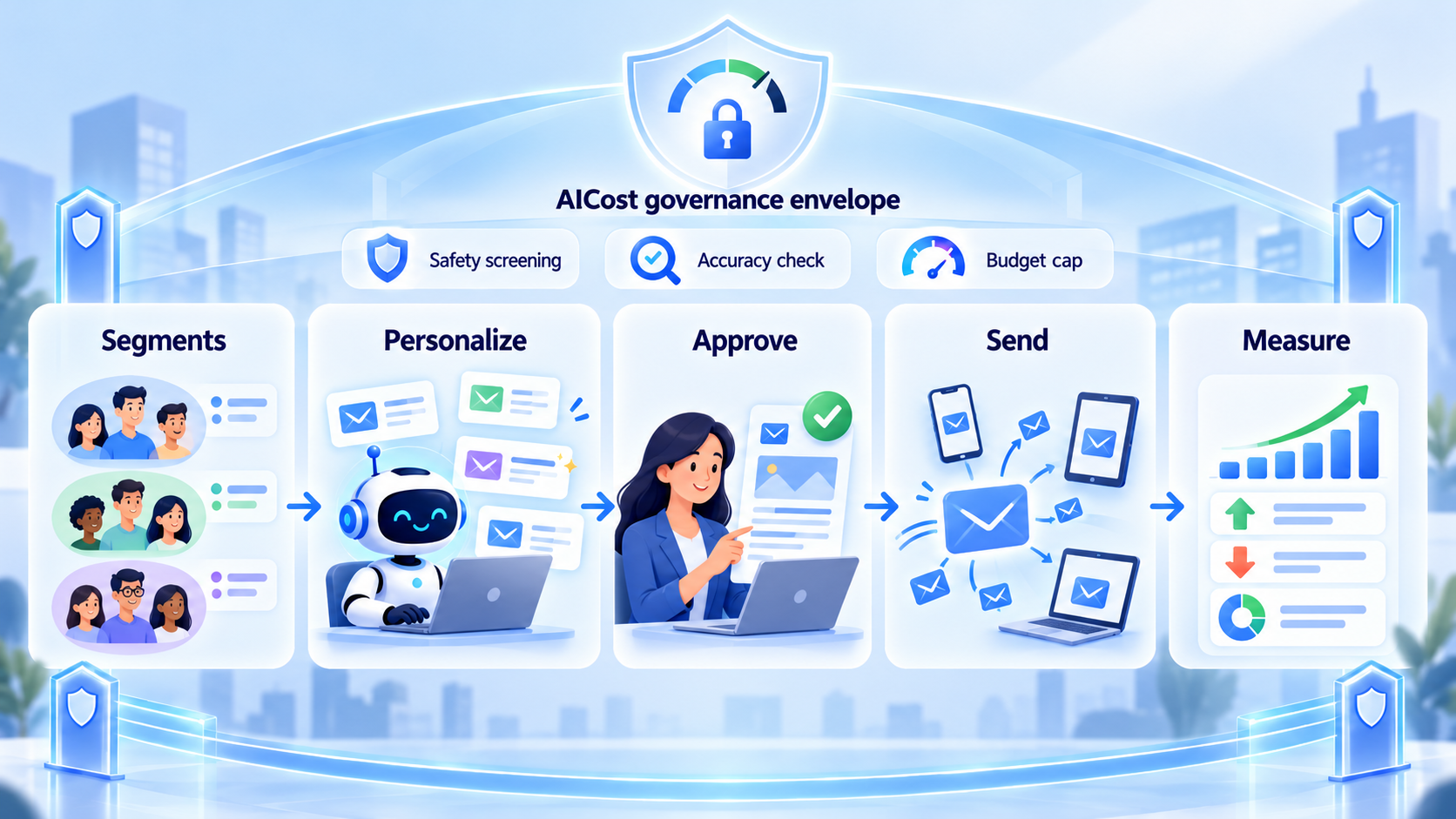
1 · cost
Match products to segments
$1
2 · cost
Model calls
$2,100
$630
3 · gate
Reuse the brand prompt
4 · gate
Generate journey content in batch
5 · gate
Cost as the list grows
6 · governance
Consent and PII filters
$31
7 · governance
Check offers and prices are real
$99
Without AICost
$2,231/mo
$0.04 per personalized email
With AICost
$761/mo
$0.02 per personalized email 66% lower
Monthly saving
$1,470/mo
3 cost levers applied
Governance controls
4
Monthly budget $900
Cost cutPrompt caching → Model calls −$196Model routing → Model calls −$835Batch the non-urgent work → Model calls −$439
Governance✓ Guardrail screening → Consent and PII filters✓ Accuracy and hallucination checks → Check offers and prices are real✓ Cost firewall at the gateway✓ Data-class model allowlist
Flow, picture, cost levers, governance and policy envelope
How the work flows today
1Marketer defines the audience and goal
2AI builds segments and picks send time and channel
3AI writes subject lines and message variants per segment or person
4AI picks product recommendations for each customer
5Campaign runs with automatic testing
6Results feed back into the next send
AICost engine chain (blue: cost, purple: governance)
Cost levers and the step they act on
Prompt caching on step Model calls −$19660% cacheable, 75% hit (combined with the other knobs on this step) · Prompt CachingRepeated instructions and documents are cached, so you pay less for the same prompt text.
How it works: The stable part of each prompt (system instructions, tool definitions, reference text) is cached by the model provider and billed at the cached rate.
How AICost prices it: The Prompt Caching engine prices cacheable share and hit rate against the provider's cached-input price.
Governance: No change to answers, models or data. Only the billing of repeated text changes.
* Cacheable share and hit rate are typical values; your logs give the real ones.
Model routing on step Model calls −$83550% of calls (variants, rewrites and translations) to Claude Haiku 5.5; critical work (final approved copy) stays on Claude Sonnet 5.5 (applied to every eligible workflow) (combined with the other knobs on this step) · Model RouterRoutine steps run on a cheaper model; critical steps stay on the primary model.
How it works: Each workflow type has routine work (triage, lookups, extraction, summaries, drafts) and critical work (the final answer, code changes, clinical or legal output, decisions). Routine calls go to the economy model; critical work stays on the primary model.
How AICost prices it: The Model Router engine prices the split between the economy and primary model on the workflow's own volume.
Governance: Only approved models for the data class are used. For patient and privileged legal data the share is capped and calls stay with the primary model's vendor and route, so the BAA still covers every call.
* The share of routine calls per workflow type is a starting assumption; your traffic sets the real split.
Batch the non-urgent work on step Model calls −$43950% of calls through the batch API (combined with the other knobs on this step) · Batch or RealtimeWork that can wait runs in the provider's batch mode at a lower price.
How it works: Requests that do not need an instant answer are queued and sent through the batch API.
How AICost prices it: The Batch or Realtime engine prices the batch-tolerant share at batch rates.
Governance: Urgent and customer-facing requests stay realtime.
* The batch-tolerant share is an input.
Governance controls and the step they act on
Guardrail screening on step Consent and PII filters $31
PII, prompt-attack and policy screening before the model acts.
Accuracy and hallucination checks on step Check offers and prices are real $99
Golden-set and live-traffic scoring catch silent regressions.
Cost firewall at the gateway policy only, no cost
Monthly budget, daily cap, per-run ceiling, turn cap, spike rule, kill switch.
Data-class model allowlist policy only, no cost
Only models cleared for this data class are routable; others are refused at the gateway.
Policy envelope
Monthly budget$900
Daily hard cap$39
Per-run ceiling$0.17
Turn cap6
See the policy your gateway enforces
{
  "workload_id": "personalized-campaigns-and-1-1-email-journey-content",
  "scope": "workload",
  "monthly_budget_usd": 900,
  "daily_warning_usd": 27.3,
  "daily_hard_limit_usd": 39,
  "max_cost_per_run_usd": 0.17,
  "max_model_calls_per_run": 6,
  "max_retries": 2,
  "max_output_tokens": 1200,
  "requests_per_min": 470,
  "anomaly": {
    "rolling_window": "7d",
    "spike_multiplier": 3,
    "rule": "flag any hour/day exceeding 3x the rolling average, or any single day above the daily hard limit"
  },
  "actions": {
    "warning_threshold": "notify",
    "soft_limit": "route_to:claude-haiku-5-5",
    "hard_limit": "block_noncritical_requests",
    "anomaly": "throttle_and_alert",
    "emergency": "block_all_and_require_approval"
  },
  "emergency_stop": {
    "enabled": true,
    "requires_approval_to_resume": true
  }
}
Where the cost runs away
- Generating a unique message per recipient on very large lists
- Re-generating variants for every test cycle
- Platform AI credits charged per message or per contact
Talk to us about this workflow →
📣 Marketing · Business solutions
SEO and AI-search (GEO) content optimization
200 published article a month
AI tracks how the brand appears in search and AI answers, finds content gaps and drafts pages to close them.

1 · cost
Find topic gaps
$12
2 · cost
Drafting cost per article
$34
$11
3 · cost
Track answers in AI assistants
$99
$49
4 · governance
Fact-check before publishing
$92
5 · governance
Editor pass
$1,200
$420
6 · gate
Monthly content budget
Without AICost
$1,437/mo
$7.18 per published article
With AICost
$583/mo
$2.92 per published article 59% lower
Monthly saving
$854/mo
6 cost levers applied
Governance controls
4
Monthly budget $200
Cost cutLoop cap → Track answers in AI assistants −$50Prompt caching → Drafting cost per article −$2Context compaction → Drafting cost per article −$6Model routing → Drafting cost per article −$10Batch the non-urgent work → Drafting cost per article −$5Policy-based review sampling → Editor pass −$780
Governance✓ Accuracy and hallucination checks → Fact-check before publishing✓ Human review → Editor pass✓ Cost firewall at the gateway✓ Data-class model allowlist
Flow, picture, cost levers, governance and policy envelope
How the work flows today
1Team tracks how the brand shows up in Google AI Overviews and AI assistants
2AI finds keyword and question gaps
3AI drafts or refreshes pages and FAQs
4Editor fact-checks and adds expert input
5Pages published and visibility re-measured
AICost engine chain (blue: cost, purple: governance)
Cost levers and the step they act on
Loop cap on step Track answers in AI assistants −$5016 turns, 60k tokens, enforced by cost-firewall · Agent LoopA ceiling on turns and tokens per agent run, so a stuck agent cannot run up the bill.
How it works: Each agent run gets a maximum number of turns and tokens. A run that hits the ceiling stops and hands off instead of looping.
How AICost prices it: The Agent Loop engine prices the runs with and without the ceiling, including the runaway tail.
Governance: The cap is enforced by the cost firewall at your gateway, with an alert when it trips.
Prompt caching on step Drafting cost per article −$260% cacheable, 75% hit (applied to every eligible workflow) (combined with the other knobs on this step) · Prompt CachingRepeated instructions and documents are cached, so you pay less for the same prompt text.
How it works: The stable part of each prompt (system instructions, tool definitions, reference text) is cached by the model provider and billed at the cached rate.
How AICost prices it: The Prompt Caching engine prices cacheable share and hit rate against the provider's cached-input price.
Governance: No change to answers, models or data. Only the billing of repeated text changes.
* Cacheable share and hit rate are typical values; your logs give the real ones.
Context compaction on step Drafting cost per article −$6trim history 60%, net of overhead (applied to every eligible workflow) (combined with the other knobs on this step) · Context TrimLong histories are trimmed each turn, so every call carries less text.
How it works: Older turns and long documents are summarized or trimmed before each call, keeping what the model needs.
How AICost prices it: The Context Trim engine prices the smaller context net of the cost of trimming.
Governance: Quality is checked before rollout; nothing reaches the model that it was not allowed to see.
* The trim size is an input; your evals confirm it keeps answer quality.
Model routing on step Drafting cost per article −$1050% of calls (variants, rewrites and translations) to Claude Haiku 5.5; critical work (final approved copy) stays on Claude Sonnet 5.5 (applied to every eligible workflow) (combined with the other knobs on this step) · Model RouterRoutine steps run on a cheaper model; critical steps stay on the primary model.
How it works: Each workflow type has routine work (triage, lookups, extraction, summaries, drafts) and critical work (the final answer, code changes, clinical or legal output, decisions). Routine calls go to the economy model; critical work stays on the primary model.
How AICost prices it: The Model Router engine prices the split between the economy and primary model on the workflow's own volume.
Governance: Only approved models for the data class are used. For patient and privileged legal data the share is capped and calls stay with the primary model's vendor and route, so the BAA still covers every call.
* The share of routine calls per workflow type is a starting assumption; your traffic sets the real split.
Batch the non-urgent work on step Drafting cost per article −$550% of calls through the batch API (applied to every eligible workflow) (combined with the other knobs on this step) · Batch or RealtimeWork that can wait runs in the provider's batch mode at a lower price.
How it works: Requests that do not need an instant answer are queued and sent through the batch API.
How AICost prices it: The Batch or Realtime engine prices the batch-tolerant share at batch rates.
Governance: Urgent and customer-facing requests stay realtime.
* The batch-tolerant share is an input.
Policy-based review sampling on step Editor pass −$78035% reviewed, the rest cleared by policy and evals · Human ReviewPeople review a sample set by policy, not every item, where the rules allow it.
How it works: Low-risk items that pass automated checks are cleared by policy; people review a sample plus everything above the risk threshold.
How AICost prices it: The Human Review engine prices reviewer time at the sampled rate.
Governance: Used only where review is not required by law or policy. Required reviews are never sampled.
* The sample rate is an input set by your policy.
Governance controls and the step they act on
Accuracy and hallucination checks on step Fact-check before publishing $92
Golden-set and live-traffic scoring catch silent regressions.
Human review on step Editor pass $1,200
Low-confidence, high-value or regulated cases go to a person.
Cost firewall at the gateway policy only, no cost
Monthly budget, daily cap, per-run ceiling, turn cap, spike rule, kill switch.
Data-class model allowlist policy only, no cost
Only models cleared for this data class are routable; others are refused at the gateway.
Policy envelope
Monthly budget$200
Daily hard cap$9
Per-run ceiling$0.67
Turn cap16
See the policy your gateway enforces
{
  "workload_id": "seo-and-ai-search-geo-content-optimization",
  "scope": "workload",
  "monthly_budget_usd": 200,
  "daily_warning_usd": 6.07,
  "daily_hard_limit_usd": 8.67,
  "max_cost_per_run_usd": 0.67,
  "max_model_calls_per_run": 16,
  "max_retries": 2,
  "max_output_tokens": 1200,
  "requests_per_min": 60,
  "anomaly": {
    "rolling_window": "7d",
    "spike_multiplier": 3,
    "rule": "flag any hour/day exceeding 3x the rolling average, or any single day above the daily hard limit"
  },
  "actions": {
    "warning_threshold": "notify",
    "soft_limit": "route_to:claude-haiku-5-5",
    "hard_limit": "block_noncritical_requests",
    "anomaly": "throttle_and_alert",
    "emergency": "block_all_and_require_approval"
  },
  "emergency_stop": {
    "enabled": true,
    "requires_approval_to_resume": true
  }
}
Where the cost runs away
- Large numbers of monitoring prompts run daily across several AI assistants
- Mass page generation that later needs rewriting
- Stacking several SEO AI subscriptions
Talk to us about this workflow →
🛠️ Engineering and DevOps · Business solutions
AI coding assistant and ticket-to-pull-request coding agent
4,400 completed task a month
Developers hand tickets to a coding agent that reads the repository, writes the change, runs the tests and opens a pull request for review.
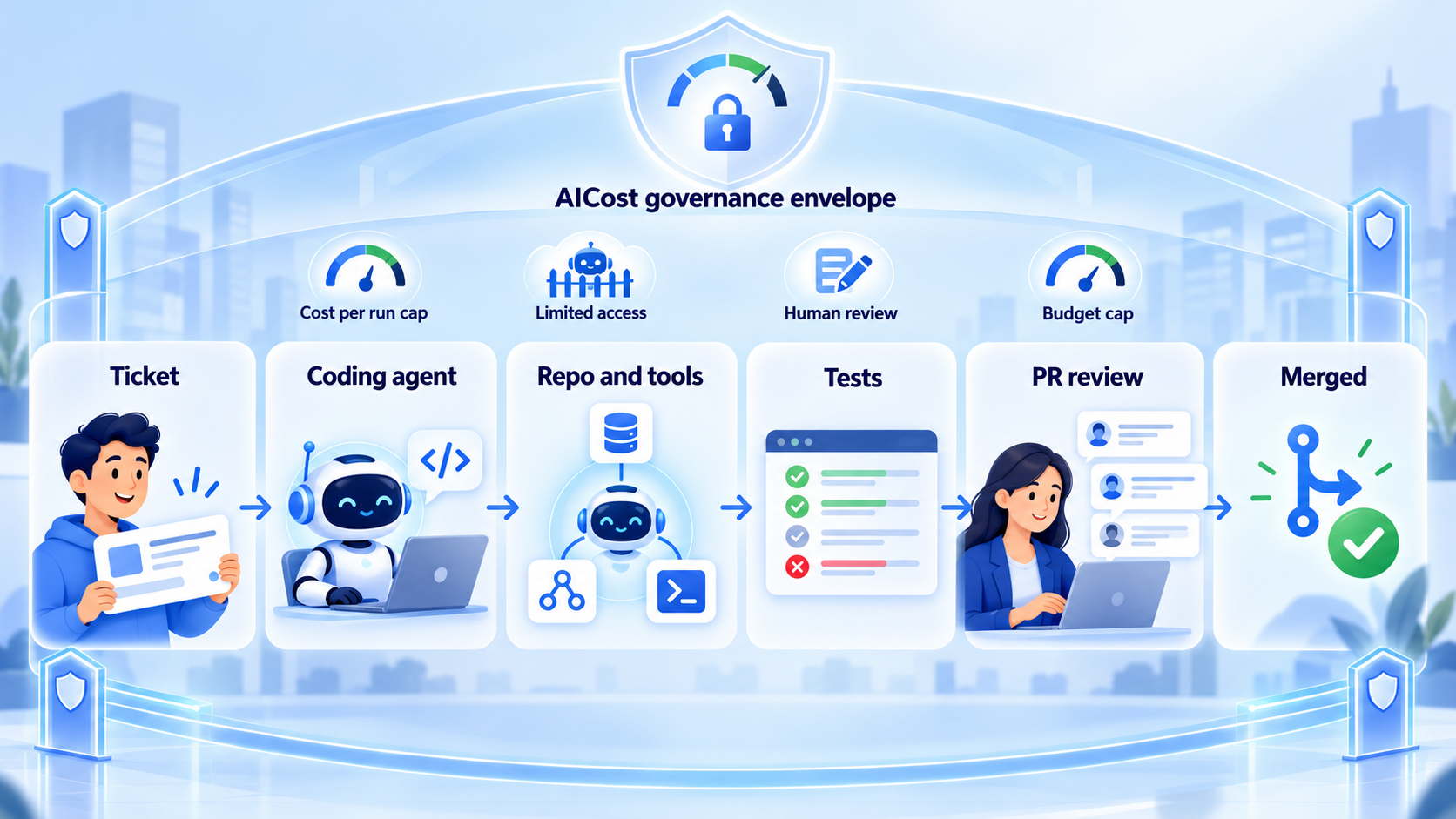
1 · cost
Steps and retries per ticket
$6,840
$3,986
2 · cost
Repo context sent per run
$616
3 · gate
Cache the repo context
4 · cost
Thinking tokens on hard tasks
$383
5 · gate
Cheaper model for easy tickets
6 · gate
Max spend per agent run
7 · gate
What the agent can touch
8 · governance
Tests run before human review
$769
9 · governance
Human review before merge
$66,000
$52,800
10 · gate
Return per developer seat
Without AICost
$74,608/mo
$16.96 per completed task
With AICost
$58,555/mo
$13.31 per completed task 22% lower
Monthly saving
$16,053/mo
6 cost levers applied
Governance controls
4
Monthly budget $6,400
Cost cutLoop cap → Steps and retries per ticket −$1,114Prompt caching → Steps and retries per ticket −$549Context compaction → Steps and retries per ticket −$493Model routing → Steps and retries per ticket −$491Batch the non-urgent work → Steps and retries per ticket −$207Shorter review with pre-checked drafts* → Human review before merge −$13,200
Governance✓ Accuracy and hallucination checks → Tests run before human review✓ Human review✓ Cost firewall at the gateway✓ Data-class model allowlist
Flow, picture, cost levers, governance and policy envelope
How the work flows today
1Developer or PM assigns a ticket or issue to the coding agent
2Agent reads the codebase and plans the change
3Agent writes code and tests and runs the build
4Agent opens a pull request
5Developer reviews, asks for changes and merges
AICost engine chain (blue: cost, purple: governance)
Cost levers and the step they act on
Loop cap on step Steps and retries per ticket −$1,11420 turns, 60k tokens, enforced by cost-firewall · Agent LoopA ceiling on turns and tokens per agent run, so a stuck agent cannot run up the bill.
How it works: Each agent run gets a maximum number of turns and tokens. A run that hits the ceiling stops and hands off instead of looping.
How AICost prices it: The Agent Loop engine prices the runs with and without the ceiling, including the runaway tail.
Governance: The cap is enforced by the cost firewall at your gateway, with an alert when it trips.
Prompt caching on step Steps and retries per ticket −$54960% cacheable, 75% hit · Prompt CachingRepeated instructions and documents are cached, so you pay less for the same prompt text.
How it works: The stable part of each prompt (system instructions, tool definitions, reference text) is cached by the model provider and billed at the cached rate.
How AICost prices it: The Prompt Caching engine prices cacheable share and hit rate against the provider's cached-input price.
Governance: No change to answers, models or data. Only the billing of repeated text changes.
* Cacheable share and hit rate are typical values; your logs give the real ones.
Context compaction on step Steps and retries per ticket −$493trim history 60%, net of overhead (applied to every eligible workflow) · Context TrimLong histories are trimmed each turn, so every call carries less text.
How it works: Older turns and long documents are summarized or trimmed before each call, keeping what the model needs.
How AICost prices it: The Context Trim engine prices the smaller context net of the cost of trimming.
Governance: Quality is checked before rollout; nothing reaches the model that it was not allowed to see.
* The trim size is an input; your evals confirm it keeps answer quality.
Model routing on step Steps and retries per ticket −$49125% of calls (file reading, test triage and summaries) to Claude Haiku 5.5; critical work (code changes) stays on Claude Sonnet 5.5 · Model RouterRoutine steps run on a cheaper model; critical steps stay on the primary model.
How it works: Each workflow type has routine work (triage, lookups, extraction, summaries, drafts) and critical work (the final answer, code changes, clinical or legal output, decisions). Routine calls go to the economy model; critical work stays on the primary model.
How AICost prices it: The Model Router engine prices the split between the economy and primary model on the workflow's own volume.
Governance: Only approved models for the data class are used. For patient and privileged legal data the share is capped and calls stay with the primary model's vendor and route, so the BAA still covers every call.
* The share of routine calls per workflow type is a starting assumption; your traffic sets the real split.
Batch the non-urgent work on step Steps and retries per ticket −$20720% of calls through the batch API (applied to every eligible workflow) · Batch or RealtimeWork that can wait runs in the provider's batch mode at a lower price.
How it works: Requests that do not need an instant answer are queued and sent through the batch API.
How AICost prices it: The Batch or Realtime engine prices the batch-tolerant share at batch rates.
Governance: Urgent and customer-facing requests stay realtime.
* The batch-tolerant share is an input.
Shorter review with pre-checked drafts* on step Human review before merge −$13,200*assumption: 20% less edit time per completed task when evals catch errors before the reviewer sees the draft; every completed task is still reviewed · Human ReviewEvery item is still reviewed, but automated checks catch errors first, so review takes less time.
How it works: An evaluation step checks each draft before the reviewer sees it, so the reviewer edits less.
How AICost prices it: The Human Review engine prices reviewer time at the shorter review time.
Governance: Every item is still reviewed by a person.
* The time saved per review is an assumption, marked with an asterisk.
Governance controls and the step they act on
Accuracy and hallucination checks on step Tests run before human review $769
Golden-set and live-traffic scoring catch silent regressions.
Human review on step Human review before merge $66,000
Low-confidence, high-value or regulated cases go to a person.
Cost firewall at the gateway policy only, no cost
Monthly budget, daily cap, per-run ceiling, turn cap, spike rule, kill switch.
Data-class model allowlist policy only, no cost
Only models cleared for this data class are routable; others are refused at the gateway.
Policy envelope
Monthly budget$6,400
Daily hard cap$277
Per-run ceiling$6.22
Turn cap20
See the policy your gateway enforces
{
  "workload_id": "ai-coding-assistant-and-ticket-to-pull-request-coding-agent",
  "scope": "workload",
  "monthly_budget_usd": 6400,
  "daily_warning_usd": 194.13,
  "daily_hard_limit_usd": 277.33,
  "max_cost_per_run_usd": 6.22,
  "max_model_calls_per_run": 20,
  "max_retries": 2,
  "max_output_tokens": 1200,
  "requests_per_min": 60,
  "anomaly": {
    "rolling_window": "7d",
    "spike_multiplier": 3,
    "rule": "flag any hour/day exceeding 3x the rolling average, or any single day above the daily hard limit"
  },
  "actions": {
    "warning_threshold": "notify",
    "soft_limit": "route_to:claude-haiku-5-5",
    "hard_limit": "block_noncritical_requests",
    "anomaly": "throttle_and_alert",
    "emergency": "block_all_and_require_approval"
  },
  "emergency_stop": {
    "enabled": true,
    "requires_approval_to_resume": true
  }
}
Where the cost runs away
- Agent loops that retry builds and tests many times on one task
- Whole-repo context sent on each step
- Premium-request or usage overages on top of per-seat plans
Talk to us about this workflow →
🛠️ Engineering and DevOps · Business solutions
AI code review on every pull request
6,000 reviewed pull request a month
AI reviews every pull request for bugs, security issues and style before a person approves it.
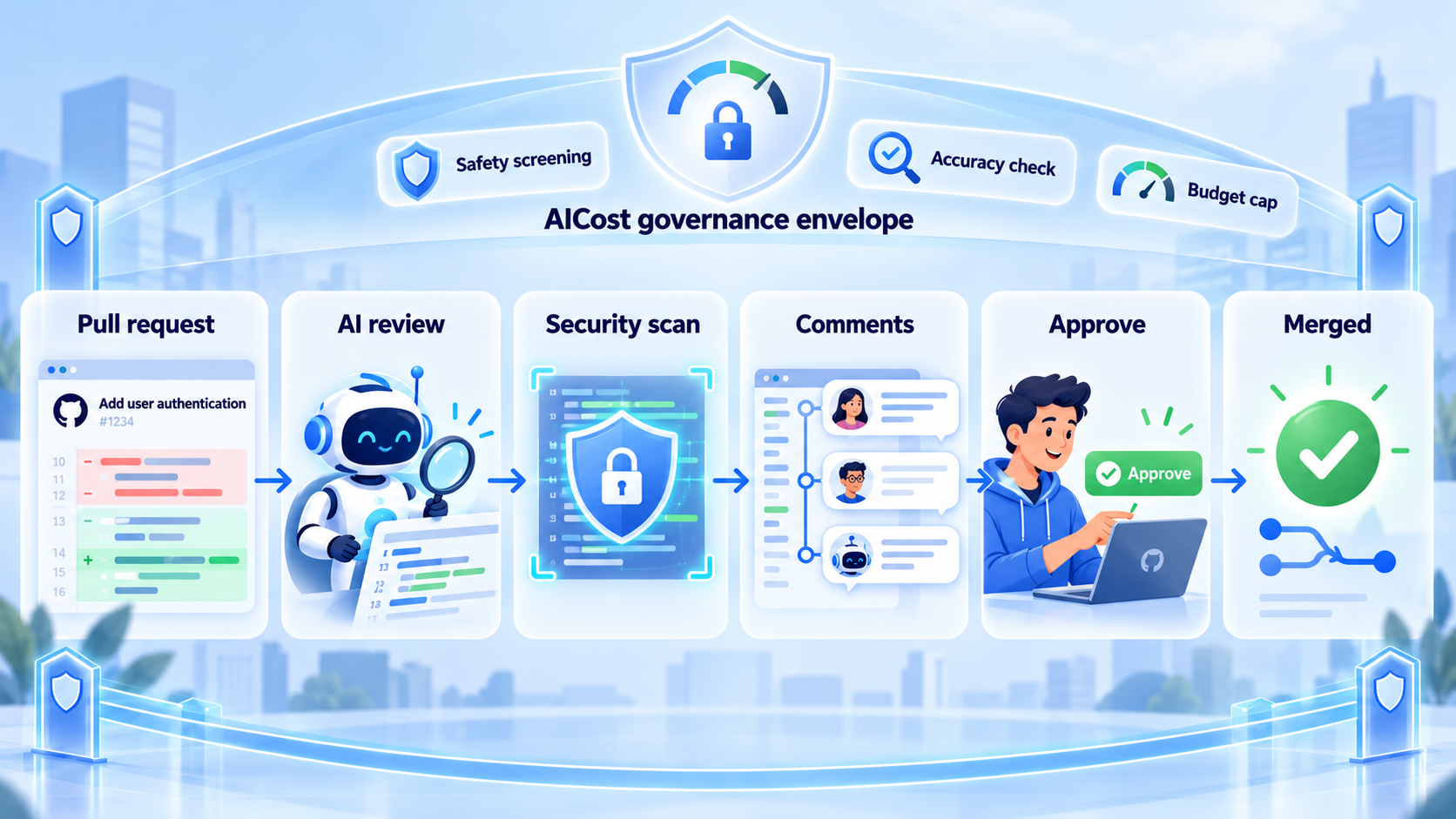
1 · cost
Review cost per pull request
$990
$298
2 · gate
Send the diff, not the whole repo
3 · gate
Cache repo rules and style guide
4 · governance
Security scanning
$6
5 · governance
False-alarm rate of comments
$93
6 · gate
Seat plan vs API pricing
Without AICost
$1,089/mo
$0.18 per reviewed pull request
With AICost
$396/mo
$0.07 per reviewed pull request 64% lower
Monthly saving
$693/mo
4 cost levers applied
Governance controls
4
Monthly budget $500
Cost cutPrompt caching → Review cost per pull request −$224Context compaction → Review cost per pull request −$201Model routing → Review cost per pull request −$188Batch the non-urgent work → Review cost per pull request −$79
Governance✓ Guardrail screening → Security scanning✓ Accuracy and hallucination checks → False-alarm rate of comments✓ Cost firewall at the gateway✓ Data-class model allowlist
Flow, picture, cost levers, governance and policy envelope
How the work flows today
1Developer opens a pull request
2AI reviews the diff for bugs, security issues and style
3AI posts comments and suggested fixes
4Developer accepts or dismisses suggestions
5Human reviewer approves and merges
AICost engine chain (blue: cost, purple: governance)
Cost levers and the step they act on
Prompt caching on step Review cost per pull request −$22460% cacheable, 75% hit (combined with the other knobs on this step) · Prompt CachingRepeated instructions and documents are cached, so you pay less for the same prompt text.
How it works: The stable part of each prompt (system instructions, tool definitions, reference text) is cached by the model provider and billed at the cached rate.
How AICost prices it: The Prompt Caching engine prices cacheable share and hit rate against the provider's cached-input price.
Governance: No change to answers, models or data. Only the billing of repeated text changes.
* Cacheable share and hit rate are typical values; your logs give the real ones.
Context compaction on step Review cost per pull request −$201trim history 60%, net of overhead (combined with the other knobs on this step) · Context TrimLong histories are trimmed each turn, so every call carries less text.
How it works: Older turns and long documents are summarized or trimmed before each call, keeping what the model needs.
How AICost prices it: The Context Trim engine prices the smaller context net of the cost of trimming.
Governance: Quality is checked before rollout; nothing reaches the model that it was not allowed to see.
* The trim size is an input; your evals confirm it keeps answer quality.
Model routing on step Review cost per pull request −$18825% of calls (file reading, test triage and summaries) to Claude Haiku 5.5; critical work (code changes) stays on Claude Sonnet 5.5 (applied to every eligible workflow) (combined with the other knobs on this step) · Model RouterRoutine steps run on a cheaper model; critical steps stay on the primary model.
How it works: Each workflow type has routine work (triage, lookups, extraction, summaries, drafts) and critical work (the final answer, code changes, clinical or legal output, decisions). Routine calls go to the economy model; critical work stays on the primary model.
How AICost prices it: The Model Router engine prices the split between the economy and primary model on the workflow's own volume.
Governance: Only approved models for the data class are used. For patient and privileged legal data the share is capped and calls stay with the primary model's vendor and route, so the BAA still covers every call.
* The share of routine calls per workflow type is a starting assumption; your traffic sets the real split.
Batch the non-urgent work on step Review cost per pull request −$7920% of calls through the batch API (applied to every eligible workflow) (combined with the other knobs on this step) · Batch or RealtimeWork that can wait runs in the provider's batch mode at a lower price.
How it works: Requests that do not need an instant answer are queued and sent through the batch API.
How AICost prices it: The Batch or Realtime engine prices the batch-tolerant share at batch rates.
Governance: Urgent and customer-facing requests stay realtime.
* The batch-tolerant share is an input.
Governance controls and the step they act on
Guardrail screening on step Security scanning $6
PII, prompt-attack and policy screening before the model acts.
Accuracy and hallucination checks on step False-alarm rate of comments $93
Golden-set and live-traffic scoring catch silent regressions.
Cost firewall at the gateway policy only, no cost
Monthly budget, daily cap, per-run ceiling, turn cap, spike rule, kill switch.
Data-class model allowlist policy only, no cost
Only models cleared for this data class are routable; others are refused at the gateway.
Policy envelope
Monthly budget$500
Daily hard cap$22
Per-run ceiling$0.66
Turn cap6
See the policy your gateway enforces
{
  "workload_id": "ai-code-review-on-every-pull-request",
  "scope": "workload",
  "monthly_budget_usd": 500,
  "daily_warning_usd": 15.17,
  "daily_hard_limit_usd": 21.67,
  "max_cost_per_run_usd": 0.66,
  "max_model_calls_per_run": 6,
  "max_retries": 2,
  "max_output_tokens": 1200,
  "requests_per_min": 60,
  "anomaly": {
    "rolling_window": "7d",
    "spike_multiplier": 3,
    "rule": "flag any hour/day exceeding 3x the rolling average, or any single day above the daily hard limit"
  },
  "actions": {
    "warning_threshold": "notify",
    "soft_limit": "route_to:claude-haiku-5-5",
    "hard_limit": "block_noncritical_requests",
    "anomaly": "throttle_and_alert",
    "emergency": "block_all_and_require_approval"
  },
  "emergency_stop": {
    "enabled": true,
    "requires_approval_to_resume": true
  }
}
Where the cost runs away
- Re-reviewing the whole PR on every new commit
- Large diffs plus repo context per review
- Paying for reviews on bot and dependency-update PRs
Talk to us about this workflow →
🛠️ Engineering and DevOps · Business solutions
On-call incident investigation agent (AI SRE)
300 investigated incident a month
When an alert fires, an AI agent gathers logs, metrics and recent changes, proposes the likely cause and suggests the fix to the on-call engineer.
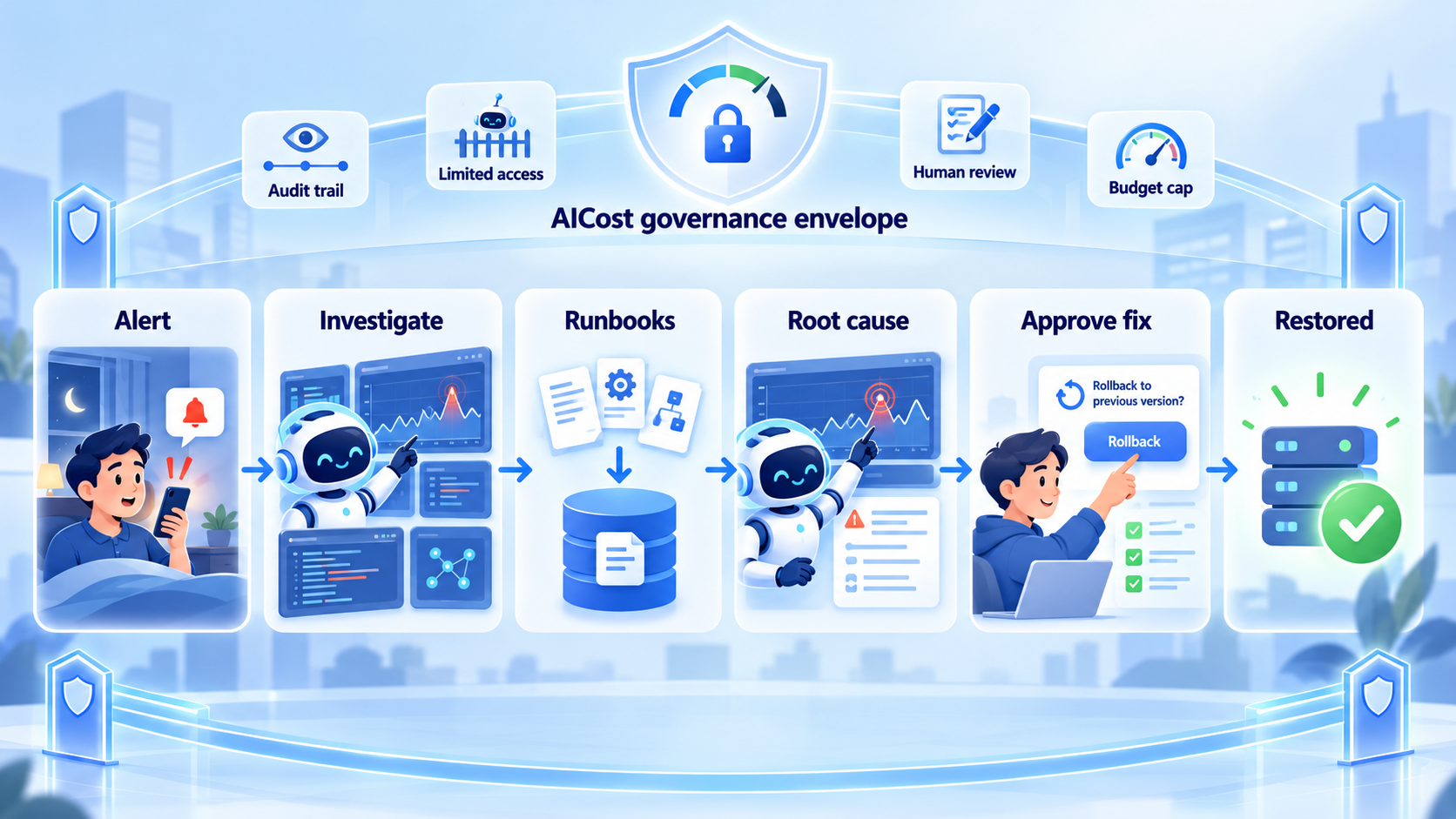
1 · cost
Investigation steps per incident
$358
$261
2 · cost
Runbooks and past incidents
$54
3 · governance
Log and trace reads
$0
4 · cost
Stop runaway investigations
$358
$286
5 · gate
Limit write access to production
6 · governance
Approval before any fix
$3,300
$1,650
7 · gate
Minutes saved per incident
Without AICost
$4,071/mo
$13.57 per investigated incident
With AICost
$2,252/mo
$7.51 per investigated incident 45% lower
Monthly saving
$1,819/mo
6 cost levers applied
Governance controls
4
Monthly budget $700
Cost cutLoop cap → Stop runaway investigations −$72Prompt caching → Investigation steps per incident −$22Context compaction → Investigation steps per incident −$20Model routing → Investigation steps per incident −$33Batch the non-urgent work → Investigation steps per incident −$22Better grounding → Approval before any fix −$1,650
Governance✓ Tracing and audit log → Log and trace reads✓ Human review → Approval before any fix✓ Cost firewall at the gateway✓ Data-class model allowlist
Flow, picture, cost levers, governance and policy envelope
How the work flows today
1Alert fires
2Agent pulls runbooks, logs, metrics and recent deploys
3Agent filters noise and proposes likely root causes
4Agent checks its own findings and posts a summary to Slack or the incident channel
5On-call engineer confirms and fixes
6Agent drafts the post-incident report
AICost engine chain (blue: cost, purple: governance)
Cost levers and the step they act on
Loop cap on step Stop runaway investigations −$7224 turns, 60k tokens, enforced by cost-firewall · Agent LoopA ceiling on turns and tokens per agent run, so a stuck agent cannot run up the bill.
How it works: Each agent run gets a maximum number of turns and tokens. A run that hits the ceiling stops and hands off instead of looping.
How AICost prices it: The Agent Loop engine prices the runs with and without the ceiling, including the runaway tail.
Governance: The cap is enforced by the cost firewall at your gateway, with an alert when it trips.
Prompt caching on step Investigation steps per incident −$2260% cacheable, 75% hit (applied to every eligible workflow) · Prompt CachingRepeated instructions and documents are cached, so you pay less for the same prompt text.
How it works: The stable part of each prompt (system instructions, tool definitions, reference text) is cached by the model provider and billed at the cached rate.
How AICost prices it: The Prompt Caching engine prices cacheable share and hit rate against the provider's cached-input price.
Governance: No change to answers, models or data. Only the billing of repeated text changes.
* Cacheable share and hit rate are typical values; your logs give the real ones.
Context compaction on step Investigation steps per incident −$20trim history 60%, net of overhead (applied to every eligible workflow) · Context TrimLong histories are trimmed each turn, so every call carries less text.
How it works: Older turns and long documents are summarized or trimmed before each call, keeping what the model needs.
How AICost prices it: The Context Trim engine prices the smaller context net of the cost of trimming.
Governance: Quality is checked before rollout; nothing reaches the model that it was not allowed to see.
* The trim size is an input; your evals confirm it keeps answer quality.
Model routing on step Investigation steps per incident −$3340% of calls (evidence gathering and summaries) to Claude Haiku 5.5; critical work (the decision and its rationale) stays on Claude Sonnet 5.5 (applied to every eligible workflow) · Model RouterRoutine steps run on a cheaper model; critical steps stay on the primary model.
How it works: Each workflow type has routine work (triage, lookups, extraction, summaries, drafts) and critical work (the final answer, code changes, clinical or legal output, decisions). Routine calls go to the economy model; critical work stays on the primary model.
How AICost prices it: The Model Router engine prices the split between the economy and primary model on the workflow's own volume.
Governance: Only approved models for the data class are used. For patient and privileged legal data the share is capped and calls stay with the primary model's vendor and route, so the BAA still covers every call.
* The share of routine calls per workflow type is a starting assumption; your traffic sets the real split.
Batch the non-urgent work on step Investigation steps per incident −$2250% of calls through the batch API (applied to every eligible workflow) · Batch or RealtimeWork that can wait runs in the provider's batch mode at a lower price.
How it works: Requests that do not need an instant answer are queued and sent through the batch API.
How AICost prices it: The Batch or Realtime engine prices the batch-tolerant share at batch rates.
Governance: Urgent and customer-facing requests stay realtime.
* The batch-tolerant share is an input.
Better grounding on step Approval before any fix −$1,650escalation 30% to 15% · Human ReviewAnswers come only from your approved sources, so fewer cases go to a person.
How it works: The assistant answers from your own approved content with the source attached, and says it does not know instead of guessing. Teams get there with cleaner knowledge-base articles, better retrieval (tighter chunks, reranking) and an answer check before the reply goes out.
How AICost prices it: Fewer low-confidence answers means fewer escalations. The Human Review engine prices reviewer minutes at the lower escalation rate; the saving is the difference.
Governance: Human review stays on for refunds, policy exceptions and anything still low-confidence. Only the share of cases that needed a person goes down.
* The demo assumes escalations fall by half (for example 12% to 6%). Your number comes from your own evaluation results.
Governance controls and the step they act on
Tracing and audit log on step Log and trace reads
Every call logged with principal, model, tokens and spend state.
Human review on step Approval before any fix $3,300
Low-confidence, high-value or regulated cases go to a person.
Cost firewall at the gateway policy only, no cost
Monthly budget, daily cap, per-run ceiling, turn cap, spike rule, kill switch.
Data-class model allowlist policy only, no cost
Only models cleared for this data class are routable; others are refused at the gateway.
Policy envelope
Monthly budget$700
Daily hard cap$30
Per-run ceiling$4.77
Turn cap24
See the policy your gateway enforces
{
  "workload_id": "on-call-incident-investigation-agent-ai-sre",
  "scope": "workload",
  "monthly_budget_usd": 700,
  "daily_warning_usd": 21.23,
  "daily_hard_limit_usd": 30.33,
  "max_cost_per_run_usd": 4.77,
  "max_model_calls_per_run": 24,
  "max_retries": 2,
  "max_output_tokens": 1200,
  "requests_per_min": 60,
  "anomaly": {
    "rolling_window": "7d",
    "spike_multiplier": 3,
    "rule": "flag any hour/day exceeding 3x the rolling average, or any single day above the daily hard limit"
  },
  "actions": {
    "warning_threshold": "notify",
    "soft_limit": "route_to:claude-haiku-5-5",
    "hard_limit": "block_noncritical_requests",
    "anomaly": "throttle_and_alert",
    "emergency": "block_all_and_require_approval"
  },
  "emergency_stop": {
    "enabled": true,
    "requires_approval_to_resume": true
  }
}
Where the cost runs away
- Investigations started on every noisy alert, not only real incidents
- Large log and trace pulls into model context
- Long investigation loops during alert storms
Talk to us about this workflow →
💻 IT service desk · Business solutions
Employee self-service IT agent (password resets, access, software)
15,000 resolved IT ticket a month
Employees ask an AI agent in Teams, Slack or the portal for password resets, access and software, and it completes approved requests by itself.
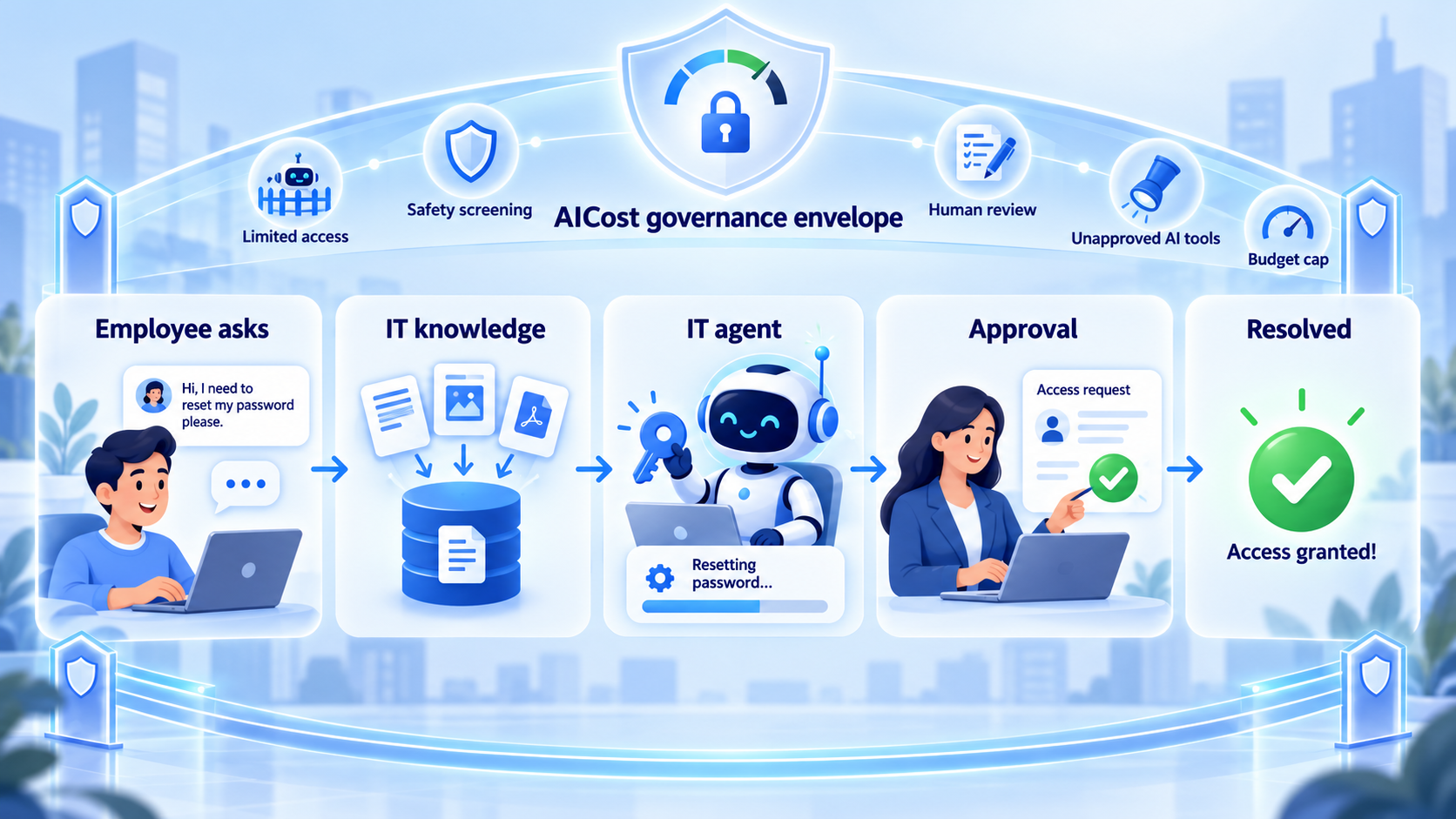
1 · cost
Answer from the IT knowledge base
$510
$153
2 · cost
Cap retries before handoff
$7,261
$3,387
3 · cost
Identity and ITSM actions
$1,472
4 · gate
Limit what resets and grants can do
5 · governance
Access request checks
$28
6 · governance
Manager approval for access
$5,400
$2,700
7 · gate
Cost per ticket vs the service desk
8 · gate
Find unapproved AI tools in use
Without AICost
$14,672/mo
$0.98 per resolved IT ticket
With AICost
$7,741/mo
$0.52 per resolved IT ticket 47% lower
Monthly saving
$6,931/mo
5 cost levers applied
Governance controls
4
Monthly budget $4,000
Cost cutLoop cap → Cap retries before handoff −$3,874Prompt caching → Answer from the IT knowledge base −$86Context compaction → Answer from the IT knowledge base −$124Model routing → Answer from the IT knowledge base −$147Better grounding → Manager approval for access −$2,700
Governance✓ Guardrail screening → Access request checks✓ Human review → Manager approval for access✓ Cost firewall at the gateway✓ Data-class model allowlist
Flow, picture, cost levers, governance and policy envelope
How the work flows today
1Employee asks in Teams, Slack or the portal
2Agent understands the request and checks policy
3Agent resets the password, unlocks the account, grants access or installs software
4Approvals routed to the manager when needed
5Hard cases become a ticket with a summary
6Ticket auto-closed and logged
AICost engine chain (blue: cost, purple: governance)
Cost levers and the step they act on
Loop cap on step Cap retries before handoff −$3,87412 turns, 60k tokens, enforced by cost-firewall · Agent LoopA ceiling on turns and tokens per agent run, so a stuck agent cannot run up the bill.
How it works: Each agent run gets a maximum number of turns and tokens. A run that hits the ceiling stops and hands off instead of looping.
How AICost prices it: The Agent Loop engine prices the runs with and without the ceiling, including the runaway tail.
Governance: The cap is enforced by the cost firewall at your gateway, with an alert when it trips.
Prompt caching on step Answer from the IT knowledge base −$8660% cacheable, 75% hit (applied to every eligible workflow) (combined with the other knobs on this step) · Prompt CachingRepeated instructions and documents are cached, so you pay less for the same prompt text.
How it works: The stable part of each prompt (system instructions, tool definitions, reference text) is cached by the model provider and billed at the cached rate.
How AICost prices it: The Prompt Caching engine prices cacheable share and hit rate against the provider's cached-input price.
Governance: No change to answers, models or data. Only the billing of repeated text changes.
* Cacheable share and hit rate are typical values; your logs give the real ones.
Context compaction on step Answer from the IT knowledge base −$124trim history 60%, net of overhead (applied to every eligible workflow) (combined with the other knobs on this step) · Context TrimLong histories are trimmed each turn, so every call carries less text.
How it works: Older turns and long documents are summarized or trimmed before each call, keeping what the model needs.
How AICost prices it: The Context Trim engine prices the smaller context net of the cost of trimming.
Governance: Quality is checked before rollout; nothing reaches the model that it was not allowed to see.
* The trim size is an input; your evals confirm it keeps answer quality.
Model routing on step Answer from the IT knowledge base −$14750% of calls (intent detection, lookups and short answers) to Claude Haiku 5.5; critical work (policy, refund and account answers) stays on Claude Sonnet 5.5 (applied to every eligible workflow) (combined with the other knobs on this step) · Model RouterRoutine steps run on a cheaper model; critical steps stay on the primary model.
How it works: Each workflow type has routine work (triage, lookups, extraction, summaries, drafts) and critical work (the final answer, code changes, clinical or legal output, decisions). Routine calls go to the economy model; critical work stays on the primary model.
How AICost prices it: The Model Router engine prices the split between the economy and primary model on the workflow's own volume.
Governance: Only approved models for the data class are used. For patient and privileged legal data the share is capped and calls stay with the primary model's vendor and route, so the BAA still covers every call.
* The share of routine calls per workflow type is a starting assumption; your traffic sets the real split.
Better grounding on step Manager approval for access −$2,700escalation 12% to 6% · Human ReviewAnswers come only from your approved sources, so fewer cases go to a person.
How it works: The assistant answers from your own approved content with the source attached, and says it does not know instead of guessing. Teams get there with cleaner knowledge-base articles, better retrieval (tighter chunks, reranking) and an answer check before the reply goes out.
How AICost prices it: Fewer low-confidence answers means fewer escalations. The Human Review engine prices reviewer minutes at the lower escalation rate; the saving is the difference.
Governance: Human review stays on for refunds, policy exceptions and anything still low-confidence. Only the share of cases that needed a person goes down.
* The demo assumes escalations fall by half (for example 12% to 6%). Your number comes from your own evaluation results.
Governance controls and the step they act on
Guardrail screening on step Access request checks $28
PII, prompt-attack and policy screening before the model acts.
Human review on step Manager approval for access $5,400
Low-confidence, high-value or regulated cases go to a person.
Cost firewall at the gateway policy only, no cost
Monthly budget, daily cap, per-run ceiling, turn cap, spike rule, kill switch.
Data-class model allowlist policy only, no cost
Only models cleared for this data class are routable; others are refused at the gateway.
Policy envelope
Monthly budget$4,000
Daily hard cap$173
Per-run ceiling$0.14
Turn cap12
See the policy your gateway enforces
{
  "workload_id": "employee-self-service-it-agent-password-resets-access-softwa",
  "scope": "workload",
  "monthly_budget_usd": 4000,
  "daily_warning_usd": 121.33,
  "daily_hard_limit_usd": 173.33,
  "max_cost_per_run_usd": 0.14,
  "max_model_calls_per_run": 12,
  "max_retries": 2,
  "max_output_tokens": 1200,
  "requests_per_min": 140,
  "anomaly": {
    "rolling_window": "7d",
    "spike_multiplier": 3,
    "rule": "flag any hour/day exceeding 3x the rolling average, or any single day above the daily hard limit"
  },
  "actions": {
    "warning_threshold": "notify",
    "soft_limit": "route_to:claude-haiku-5-5",
    "hard_limit": "block_noncritical_requests",
    "anomaly": "throttle_and_alert",
    "emergency": "block_all_and_require_approval"
  },
  "emergency_stop": {
    "enabled": true,
    "requires_approval_to_resume": true
  }
}
Where the cost runs away
- Every chat message routed through a large model, even simple ones
- Per-employee platform licences for staff who rarely use it
- Repeat conversations when actions fail and users ask again
Talk to us about this workflow →
💻 IT service desk · Business solutions
Ticket triage, routing and summarization for IT agents
25,000 routed ticket a month
AI reads each incoming IT ticket, sets the category and priority, routes it to the right team and summarizes it for the agent.
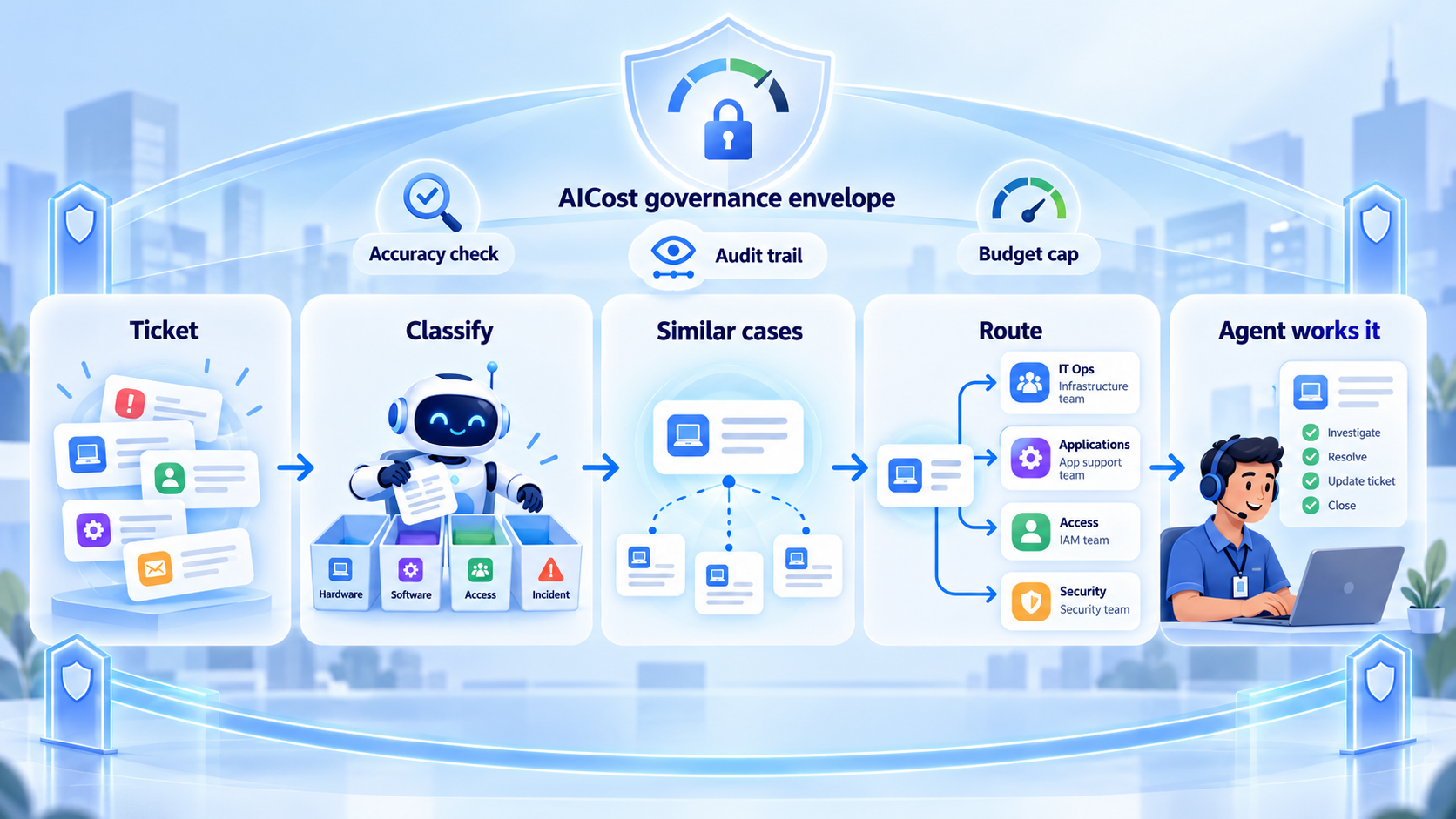
1 · cost
Find similar past tickets
$1
2 · gate
Small model for routing
3 · cost
Summary per ticket
$375
$112
4 · governance
Sample routing accuracy
$96
5 · governance
Trace and sample for QA
$2
Without AICost
$474/mo
$0.02 per routed ticket
With AICost
$211/mo
$0.01 per routed ticket 55% lower
Monthly saving
$263/mo
2 cost levers applied
Governance controls
4
Monthly budget $300
Cost cutPrompt caching → Summary per ticket −$74Model routing → Summary per ticket −$189
Governance✓ Accuracy and hallucination checks → Sample routing accuracy✓ Tracing and audit log → Trace and sample for QA✓ Cost firewall at the gateway✓ Data-class model allowlist
Flow, picture, cost levers, governance and policy envelope
How the work flows today
1Ticket comes in by email, portal or chat
2AI classifies category, priority and assignment group
3AI links similar tickets and known issues
4AI summarizes the history for the assigned agent
5Agent works the ticket with suggested fixes
AICost engine chain (blue: cost, purple: governance)
Cost levers and the step they act on
Prompt caching on step Summary per ticket −$7460% cacheable, 75% hit (applied to every eligible workflow) (combined with the other knobs on this step) · Prompt CachingRepeated instructions and documents are cached, so you pay less for the same prompt text.
How it works: The stable part of each prompt (system instructions, tool definitions, reference text) is cached by the model provider and billed at the cached rate.
How AICost prices it: The Prompt Caching engine prices cacheable share and hit rate against the provider's cached-input price.
Governance: No change to answers, models or data. Only the billing of repeated text changes.
* Cacheable share and hit rate are typical values; your logs give the real ones.
Model routing on step Summary per ticket −$18970% of calls (classification and routing) to Claude Haiku 5.5; critical work (edge cases) stays on Claude Sonnet 5.5 (combined with the other knobs on this step) · Model RouterRoutine steps run on a cheaper model; critical steps stay on the primary model.
How it works: Each workflow type has routine work (triage, lookups, extraction, summaries, drafts) and critical work (the final answer, code changes, clinical or legal output, decisions). Routine calls go to the economy model; critical work stays on the primary model.
How AICost prices it: The Model Router engine prices the split between the economy and primary model on the workflow's own volume.
Governance: Only approved models for the data class are used. For patient and privileged legal data the share is capped and calls stay with the primary model's vendor and route, so the BAA still covers every call.
* The share of routine calls per workflow type is a starting assumption; your traffic sets the real split.
Governance controls and the step they act on
Accuracy and hallucination checks on step Sample routing accuracy $96
Golden-set and live-traffic scoring catch silent regressions.
Tracing and audit log on step Trace and sample for QA $2
Every call logged with principal, model, tokens and spend state.
Cost firewall at the gateway policy only, no cost
Monthly budget, daily cap, per-run ceiling, turn cap, spike rule, kill switch.
Data-class model allowlist policy only, no cost
Only models cleared for this data class are routable; others are refused at the gateway.
Policy envelope
Monthly budget$300
Daily hard cap$13
Per-run ceiling$0.06
Turn cap6
See the policy your gateway enforces
{
  "workload_id": "ticket-triage-routing-and-summarization-for-it-agents",
  "scope": "workload",
  "monthly_budget_usd": 300,
  "daily_warning_usd": 9.1,
  "daily_hard_limit_usd": 13,
  "max_cost_per_run_usd": 0.06,
  "max_model_calls_per_run": 6,
  "max_retries": 2,
  "max_output_tokens": 1200,
  "requests_per_min": 240,
  "anomaly": {
    "rolling_window": "7d",
    "spike_multiplier": 3,
    "rule": "flag any hour/day exceeding 3x the rolling average, or any single day above the daily hard limit"
  },
  "actions": {
    "warning_threshold": "notify",
    "soft_limit": "route_to:claude-haiku-5-5",
    "hard_limit": "block_noncritical_requests",
    "anomaly": "throttle_and_alert",
    "emergency": "block_all_and_require_approval"
  },
  "emergency_stop": {
    "enabled": true,
    "requires_approval_to_resume": true
  }
}
Where the cost runs away
- Summarizing long ticket threads repeatedly on every update
- Large models used where a small classifier would do
- Per-agent AI add-on licences
Talk to us about this workflow →
💻 IT service desk · Business solutions
Resolution notes and knowledge article drafting
400 knowledge article a month
When a ticket is resolved, AI writes the resolution notes and drafts a knowledge article for review.
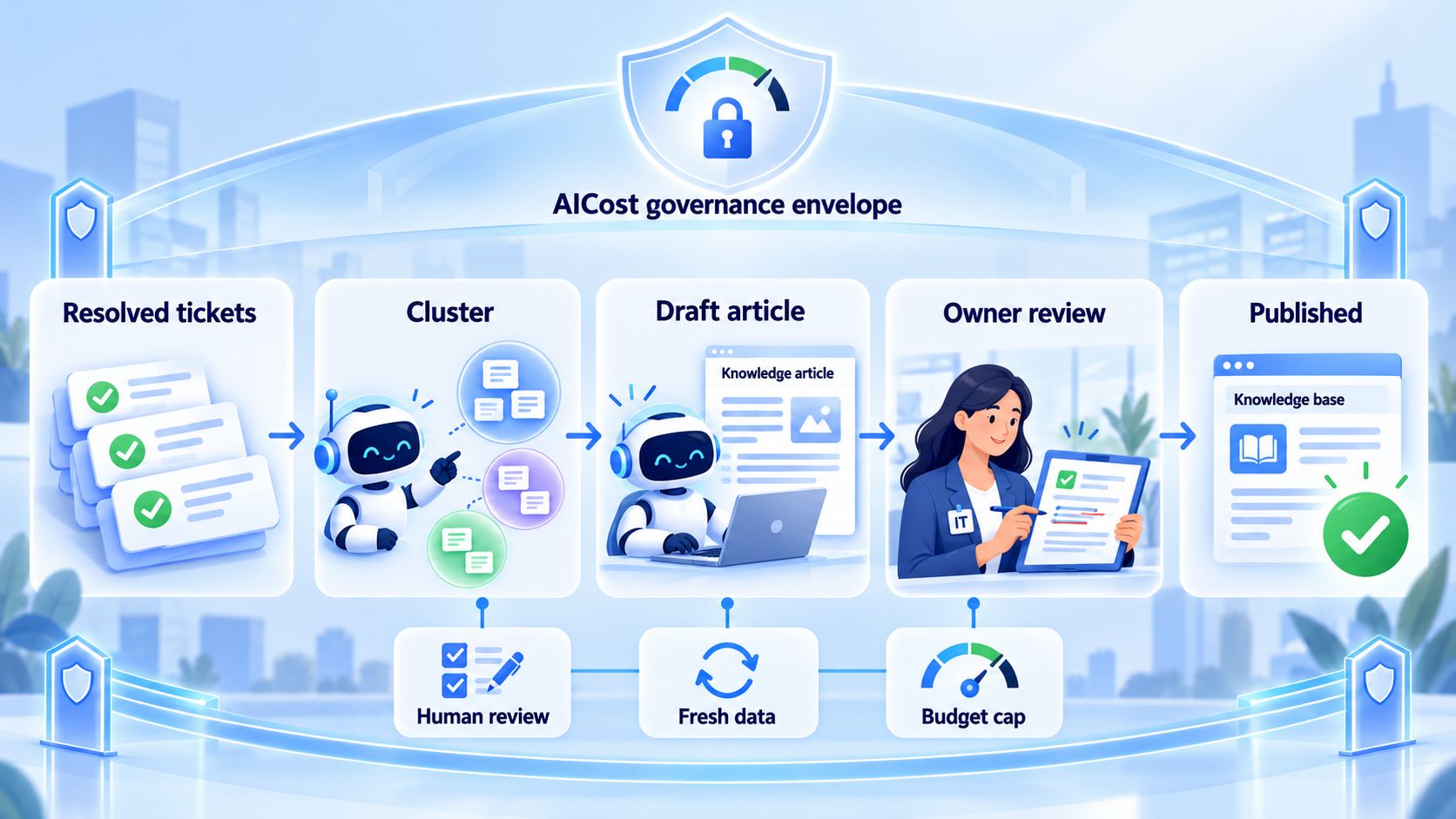
1 · cost
Cluster repeat issues
$1
2 · gate
Draft articles in batch
3 · cost
Drafting cost per article
$37
$11
4 · governance
Owner review before publishing
$3,667
$1,284
5 · cost
Re-index after publishing
$1,703
Without AICost
$5,407/mo
$13.52 per knowledge article
With AICost
$2,998/mo
$7.50 per knowledge article 45% lower
Monthly saving
$2,409/mo
4 cost levers applied
Governance controls
3
Monthly budget $100
Cost cutPrompt caching → Drafting cost per article −$5Context compaction → Drafting cost per article −$4Model routing → Drafting cost per article −$17Policy-based review sampling → Owner review before publishing −$2,383
Governance✓ Human review → Owner review before publishing✓ Cost firewall at the gateway✓ Data-class model allowlist
Flow, picture, cost levers, governance and policy envelope
How the work flows today
1Agent resolves a ticket
2AI writes the resolution notes
3AI spots repeat issues with no article
4AI drafts a knowledge article from resolved tickets
5Knowledge owner reviews and publishes
6Article used by the self-service agent
AICost engine chain (blue: cost, purple: governance)
Cost levers and the step they act on
Prompt caching on step Drafting cost per article −$560% cacheable, 75% hit (applied to every eligible workflow) (combined with the other knobs on this step) · Prompt CachingRepeated instructions and documents are cached, so you pay less for the same prompt text.
How it works: The stable part of each prompt (system instructions, tool definitions, reference text) is cached by the model provider and billed at the cached rate.
How AICost prices it: The Prompt Caching engine prices cacheable share and hit rate against the provider's cached-input price.
Governance: No change to answers, models or data. Only the billing of repeated text changes.
* Cacheable share and hit rate are typical values; your logs give the real ones.
Context compaction on step Drafting cost per article −$4trim history 60%, net of overhead (applied to every eligible workflow) (combined with the other knobs on this step) · Context TrimLong histories are trimmed each turn, so every call carries less text.
How it works: Older turns and long documents are summarized or trimmed before each call, keeping what the model needs.
How AICost prices it: The Context Trim engine prices the smaller context net of the cost of trimming.
Governance: Quality is checked before rollout; nothing reaches the model that it was not allowed to see.
* The trim size is an input; your evals confirm it keeps answer quality.
Model routing on step Drafting cost per article −$1770% of calls (classification and routing) to Claude Haiku 5.5; critical work (edge cases) stays on Claude Sonnet 5.5 (applied to every eligible workflow) (combined with the other knobs on this step) · Model RouterRoutine steps run on a cheaper model; critical steps stay on the primary model.
How it works: Each workflow type has routine work (triage, lookups, extraction, summaries, drafts) and critical work (the final answer, code changes, clinical or legal output, decisions). Routine calls go to the economy model; critical work stays on the primary model.
How AICost prices it: The Model Router engine prices the split between the economy and primary model on the workflow's own volume.
Governance: Only approved models for the data class are used. For patient and privileged legal data the share is capped and calls stay with the primary model's vendor and route, so the BAA still covers every call.
* The share of routine calls per workflow type is a starting assumption; your traffic sets the real split.
Policy-based review sampling on step Owner review before publishing −$2,38335% reviewed, the rest cleared by policy and evals · Human ReviewPeople review a sample set by policy, not every item, where the rules allow it.
How it works: Low-risk items that pass automated checks are cleared by policy; people review a sample plus everything above the risk threshold.
How AICost prices it: The Human Review engine prices reviewer time at the sampled rate.
Governance: Used only where review is not required by law or policy. Required reviews are never sampled.
* The sample rate is an input set by your policy.
Governance controls and the step they act on
Human review on step Owner review before publishing $3,667
Low-confidence, high-value or regulated cases go to a person.
Cost firewall at the gateway policy only, no cost
Monthly budget, daily cap, per-run ceiling, turn cap, spike rule, kill switch.
Data-class model allowlist policy only, no cost
Only models cleared for this data class are routable; others are refused at the gateway.
Policy envelope
Monthly budget$100
Daily hard cap$4
Per-run ceiling$0.37
Turn cap6
See the policy your gateway enforces
{
  "workload_id": "resolution-notes-and-knowledge-article-drafting",
  "scope": "workload",
  "monthly_budget_usd": 100,
  "daily_warning_usd": 3.03,
  "daily_hard_limit_usd": 4.33,
  "max_cost_per_run_usd": 0.37,
  "max_model_calls_per_run": 6,
  "max_retries": 2,
  "max_output_tokens": 1200,
  "requests_per_min": 60,
  "anomaly": {
    "rolling_window": "7d",
    "spike_multiplier": 3,
    "rule": "flag any hour/day exceeding 3x the rolling average, or any single day above the daily hard limit"
  },
  "actions": {
    "warning_threshold": "notify",
    "soft_limit": "route_to:claude-haiku-5-5",
    "hard_limit": "block_noncritical_requests",
    "anomaly": "throttle_and_alert",
    "emergency": "block_all_and_require_approval"
  },
  "emergency_stop": {
    "enabled": true,
    "requires_approval_to_resume": true
  }
}
Where the cost runs away
- Regenerating articles that already exist
- Processing all closed tickets instead of a sample
- Review time for low-quality drafts
Talk to us about this workflow →
🧾 Finance · Business solutions
Touchless invoice processing in accounts payable
20,000 processed invoice a month
AI reads supplier invoices from any channel, matches them to purchase orders and receipts, and sends only exceptions to AP staff.
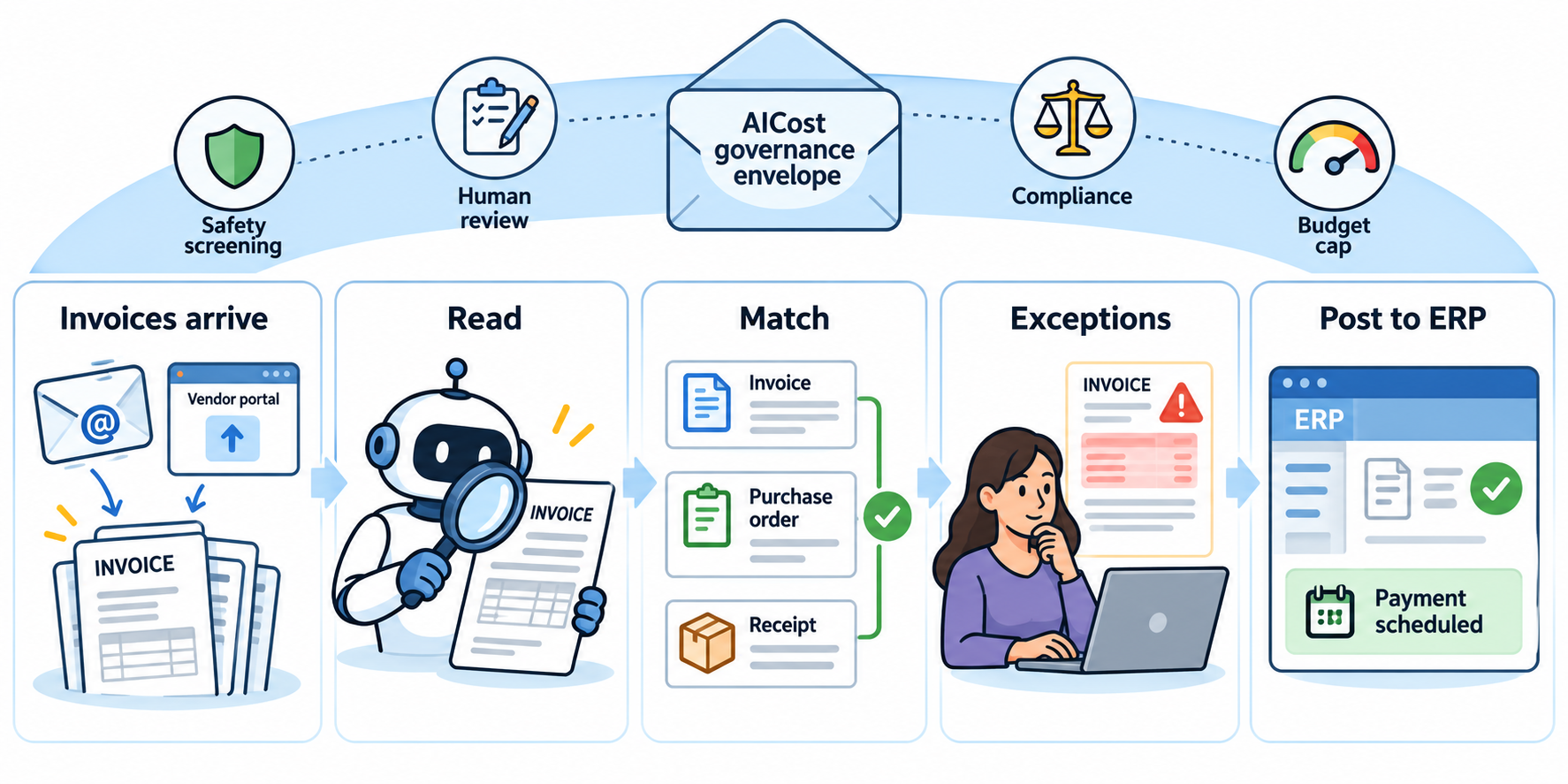
1 · cost
Read invoices
$1,420
2 · cost
Coding and matching per invoice
$840
$253
3 · gate
Small model for clean invoices
4 · governance
Bank-detail change and fraud checks
$19
5 · governance
Exceptions to an AP clerk
$7,500
$4,000
6 · governance
SOX controls and audit trail
$3,654
Without AICost
$13,432/mo
$0.67 per processed invoice
With AICost
$9,344/mo
$0.47 per processed invoice 30% lower
Monthly saving
$4,088/mo
4 cost levers applied
Governance controls
5
Monthly budget $300
Cost cutPrompt caching → Coding and matching per invoice −$145Model routing → Coding and matching per invoice −$247Batch the non-urgent work → Coding and matching per invoice −$195Better grounding → Exceptions to an AP clerk −$3,500
Governance✓ Guardrail screening → Bank-detail change and fraud checks✓ Human review → Exceptions to an AP clerk✓ Compliance evidence → SOX controls and audit trail✓ Cost firewall at the gateway✓ Data-class model allowlist
Flow, picture, cost levers, governance and policy envelope
How the work flows today
1Supplier invoice arrives by email, portal or EDI
2AI reads the invoice and pulls header and line data
3AI matches to PO and receipt and codes GL and tax
4Exceptions (price, quantity, missing PO) go to an AP clerk with a suggested fix
5Invoice posted to the ERP and scheduled for payment
AICost engine chain (blue: cost, purple: governance)
Cost levers and the step they act on
Prompt caching on step Coding and matching per invoice −$14560% cacheable, 75% hit (applied to every eligible workflow) (combined with the other knobs on this step) · Prompt CachingRepeated instructions and documents are cached, so you pay less for the same prompt text.
How it works: The stable part of each prompt (system instructions, tool definitions, reference text) is cached by the model provider and billed at the cached rate.
How AICost prices it: The Prompt Caching engine prices cacheable share and hit rate against the provider's cached-input price.
Governance: No change to answers, models or data. Only the billing of repeated text changes.
* Cacheable share and hit rate are typical values; your logs give the real ones.
Model routing on step Coding and matching per invoice −$24740% of calls (extraction and field checks) to Claude Haiku 5.5; critical work (exceptions) stays on Claude Sonnet 5.5; financial data: routine steps only, approved models for this data class (combined with the other knobs on this step) · Model RouterRoutine steps run on a cheaper model; critical steps stay on the primary model.
How it works: Each workflow type has routine work (triage, lookups, extraction, summaries, drafts) and critical work (the final answer, code changes, clinical or legal output, decisions). Routine calls go to the economy model; critical work stays on the primary model.
How AICost prices it: The Model Router engine prices the split between the economy and primary model on the workflow's own volume.
Governance: Only approved models for the data class are used. For patient and privileged legal data the share is capped and calls stay with the primary model's vendor and route, so the BAA still covers every call.
* The share of routine calls per workflow type is a starting assumption; your traffic sets the real split.
Batch the non-urgent work on step Coding and matching per invoice −$19560% of calls through the batch API (applied to every eligible workflow) (combined with the other knobs on this step) · Batch or RealtimeWork that can wait runs in the provider's batch mode at a lower price.
How it works: Requests that do not need an instant answer are queued and sent through the batch API.
How AICost prices it: The Batch or Realtime engine prices the batch-tolerant share at batch rates.
Governance: Urgent and customer-facing requests stay realtime.
* The batch-tolerant share is an input.
Better grounding on step Exceptions to an AP clerk −$3,500escalation 15% to 8% · Human ReviewAnswers come only from your approved sources, so fewer cases go to a person.
How it works: The assistant answers from your own approved content with the source attached, and says it does not know instead of guessing. Teams get there with cleaner knowledge-base articles, better retrieval (tighter chunks, reranking) and an answer check before the reply goes out.
How AICost prices it: Fewer low-confidence answers means fewer escalations. The Human Review engine prices reviewer minutes at the lower escalation rate; the saving is the difference.
Governance: Human review stays on for refunds, policy exceptions and anything still low-confidence. Only the share of cases that needed a person goes down.
* The demo assumes escalations fall by half (for example 12% to 6%). Your number comes from your own evaluation results.
Governance controls and the step they act on
Guardrail screening on step Bank-detail change and fraud checks $19
PII, prompt-attack and policy screening before the model acts.
Human review on step Exceptions to an AP clerk $7,500
Low-confidence, high-value or regulated cases go to a person.
Compliance evidence on step SOX controls and audit trail $3,654
Audit logs, retention and assessments for the rules that apply.
Cost firewall at the gateway policy only, no cost
Monthly budget, daily cap, per-run ceiling, turn cap, spike rule, kill switch.
Data-class model allowlist policy only, no cost
Only models cleared for this data class are routable; others are refused at the gateway.
Policy envelope
Monthly budget$300
Daily hard cap$13
Per-run ceiling$0.17
Turn cap6
See the policy your gateway enforces
{
  "workload_id": "touchless-invoice-processing-in-accounts-payable",
  "scope": "workload",
  "monthly_budget_usd": 300,
  "daily_warning_usd": 9.1,
  "daily_hard_limit_usd": 13,
  "max_cost_per_run_usd": 0.17,
  "max_model_calls_per_run": 6,
  "max_retries": 2,
  "max_output_tokens": 1200,
  "requests_per_min": 190,
  "anomaly": {
    "rolling_window": "7d",
    "spike_multiplier": 3,
    "rule": "flag any hour/day exceeding 3x the rolling average, or any single day above the daily hard limit"
  },
  "actions": {
    "warning_threshold": "notify",
    "soft_limit": "route_to:claude-haiku-5-5",
    "hard_limit": "block_noncritical_requests",
    "anomaly": "throttle_and_alert",
    "emergency": "block_all_and_require_approval"
  },
  "emergency_stop": {
    "enabled": true,
    "requires_approval_to_resume": true
  }
}
Where the cost runs away
- Re-processing the same invoice on every exception round
- Multi-page invoices sent in full to vision models
- Human review time on low-confidence extractions
Talk to us about this workflow →
🧾 Finance · Business solutions
Month-end close: reconciliations, journal entries and variance commentary
2,000 reconciled account a month
During close, AI prepares reconciliations, proposes journal entries and drafts variance commentary for the accounting team to review.
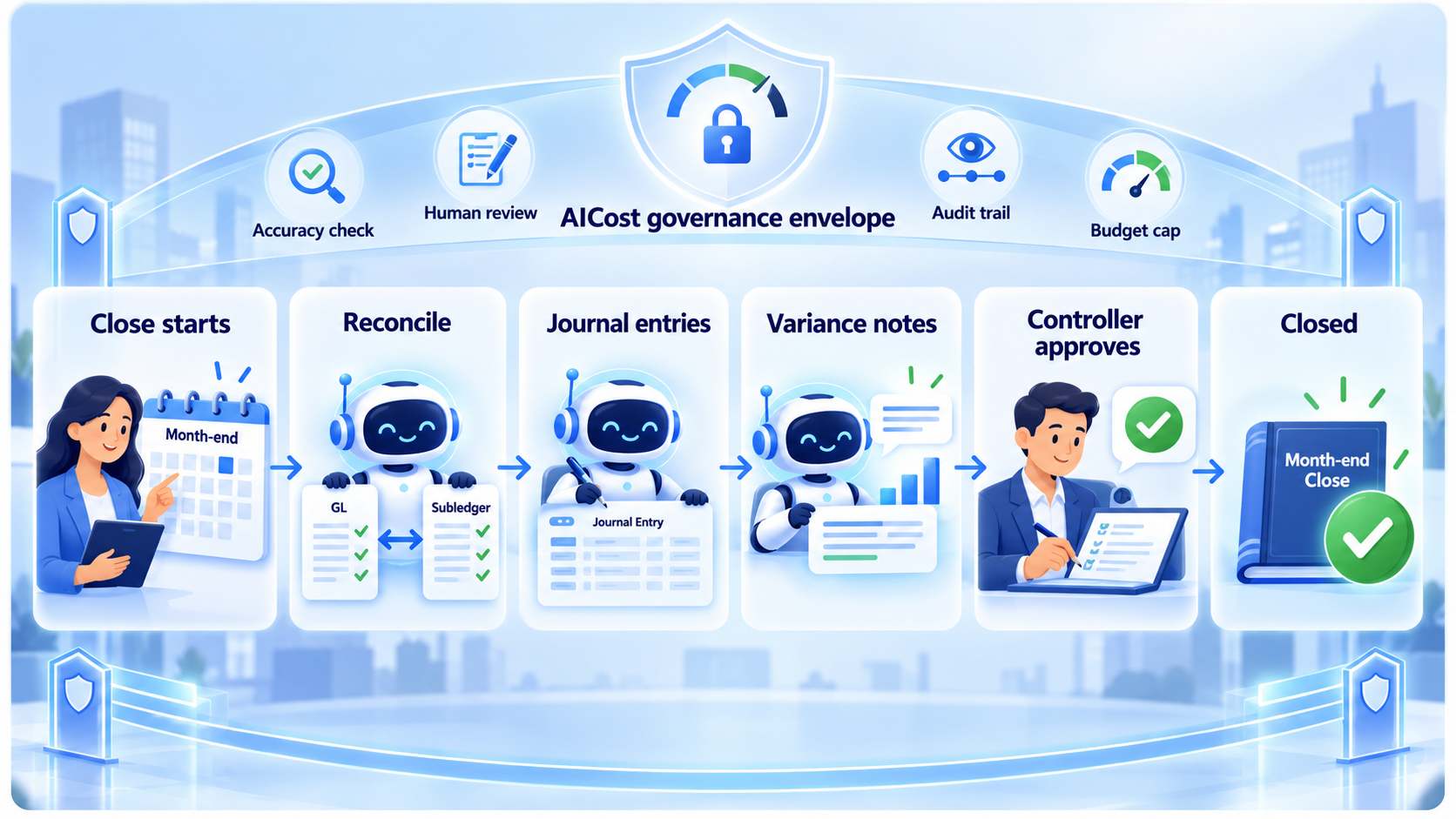
1 · cost
Reconciliation and entry agent
$2,387
$1,262
2 · gate
Cache the chart of accounts
3 · cost
Variance analysis
$128
4 · governance
Tie-out checks
$93
5 · governance
Controller approval
$13,333
$10,666
6 · governance
Evidence for auditors
$1
7 · gate
AI spend per close cycle
Without AICost
$15,942/mo
$7.97 per reconciled account
With AICost
$12,150/mo
$6.07 per reconciled account 24% lower
Monthly saving
$3,792/mo
6 cost levers applied
Governance controls
5
Monthly budget $1,700
Cost cutLoop cap → Reconciliation and entry agent −$478Prompt caching → Reconciliation and entry agent −$150Context compaction → Reconciliation and entry agent −$134Model routing → Reconciliation and entry agent −$219Batch the non-urgent work → Reconciliation and entry agent −$144Shorter review with pre-checked drafts* → Controller approval −$2,667
Governance✓ Accuracy and hallucination checks → Tie-out checks✓ Human review → Controller approval✓ Tracing and audit log → Evidence for auditors✓ Cost firewall at the gateway✓ Data-class model allowlist
Flow, picture, cost levers, governance and policy envelope
How the work flows today
1Close checklist kicks off
2AI matches bank and sub-ledger items and flags breaks
3AI prepares recurring and accrual journal entries for approval
4AI drafts flux and budget-vs-actual commentary
5Accountant and FP&A review, edit and sign off
6Package goes to CFO and auditors
AICost engine chain (blue: cost, purple: governance)
Cost levers and the step they act on
Loop cap on step Reconciliation and entry agent −$47824 turns, 60k tokens, enforced by cost-firewall · Agent LoopA ceiling on turns and tokens per agent run, so a stuck agent cannot run up the bill.
How it works: Each agent run gets a maximum number of turns and tokens. A run that hits the ceiling stops and hands off instead of looping.
How AICost prices it: The Agent Loop engine prices the runs with and without the ceiling, including the runaway tail.
Governance: The cap is enforced by the cost firewall at your gateway, with an alert when it trips.
Prompt caching on step Reconciliation and entry agent −$15060% cacheable, 75% hit · Prompt CachingRepeated instructions and documents are cached, so you pay less for the same prompt text.
How it works: The stable part of each prompt (system instructions, tool definitions, reference text) is cached by the model provider and billed at the cached rate.
How AICost prices it: The Prompt Caching engine prices cacheable share and hit rate against the provider's cached-input price.
Governance: No change to answers, models or data. Only the billing of repeated text changes.
* Cacheable share and hit rate are typical values; your logs give the real ones.
Context compaction on step Reconciliation and entry agent −$134trim history 60%, net of overhead (applied to every eligible workflow) · Context TrimLong histories are trimmed each turn, so every call carries less text.
How it works: Older turns and long documents are summarized or trimmed before each call, keeping what the model needs.
How AICost prices it: The Context Trim engine prices the smaller context net of the cost of trimming.
Governance: Quality is checked before rollout; nothing reaches the model that it was not allowed to see.
* The trim size is an input; your evals confirm it keeps answer quality.
Model routing on step Reconciliation and entry agent −$21940% of calls (evidence gathering and summaries) to Claude Haiku 5.5; critical work (the decision and its rationale) stays on Claude Sonnet 5.5; financial data: routine steps only, approved models for this data class (applied to every eligible workflow) · Model RouterRoutine steps run on a cheaper model; critical steps stay on the primary model.
How it works: Each workflow type has routine work (triage, lookups, extraction, summaries, drafts) and critical work (the final answer, code changes, clinical or legal output, decisions). Routine calls go to the economy model; critical work stays on the primary model.
How AICost prices it: The Model Router engine prices the split between the economy and primary model on the workflow's own volume.
Governance: Only approved models for the data class are used. For patient and privileged legal data the share is capped and calls stay with the primary model's vendor and route, so the BAA still covers every call.
* The share of routine calls per workflow type is a starting assumption; your traffic sets the real split.
Batch the non-urgent work on step Reconciliation and entry agent −$14450% of calls through the batch API (applied to every eligible workflow) · Batch or RealtimeWork that can wait runs in the provider's batch mode at a lower price.
How it works: Requests that do not need an instant answer are queued and sent through the batch API.
How AICost prices it: The Batch or Realtime engine prices the batch-tolerant share at batch rates.
Governance: Urgent and customer-facing requests stay realtime.
* The batch-tolerant share is an input.
Shorter review with pre-checked drafts* on step Controller approval −$2,667*assumption: 20% less edit time per reconciled account when evals catch errors before the reviewer sees the draft; every reconciled account is still reviewed · Human ReviewEvery item is still reviewed, but automated checks catch errors first, so review takes less time.
How it works: An evaluation step checks each draft before the reviewer sees it, so the reviewer edits less.
How AICost prices it: The Human Review engine prices reviewer time at the shorter review time.
Governance: Every item is still reviewed by a person.
* The time saved per review is an assumption, marked with an asterisk.
Governance controls and the step they act on
Accuracy and hallucination checks on step Tie-out checks $93
Golden-set and live-traffic scoring catch silent regressions.
Human review on step Controller approval $13,333
Low-confidence, high-value or regulated cases go to a person.
Tracing and audit log on step Evidence for auditors $1
Every call logged with principal, model, tokens and spend state.
Cost firewall at the gateway policy only, no cost
Monthly budget, daily cap, per-run ceiling, turn cap, spike rule, kill switch.
Data-class model allowlist policy only, no cost
Only models cleared for this data class are routable; others are refused at the gateway.
Policy envelope
Monthly budget$1,700
Daily hard cap$74
Per-run ceiling$4.77
Turn cap24
See the policy your gateway enforces
{
  "workload_id": "month-end-close-reconciliations-journal-entries-and-variance",
  "scope": "workload",
  "monthly_budget_usd": 1700,
  "daily_warning_usd": 51.57,
  "daily_hard_limit_usd": 73.67,
  "max_cost_per_run_usd": 4.77,
  "max_model_calls_per_run": 24,
  "max_retries": 2,
  "max_output_tokens": 1200,
  "requests_per_min": 60,
  "anomaly": {
    "rolling_window": "7d",
    "spike_multiplier": 3,
    "rule": "flag any hour/day exceeding 3x the rolling average, or any single day above the daily hard limit"
  },
  "actions": {
    "warning_threshold": "notify",
    "soft_limit": "route_to:claude-haiku-5-5",
    "hard_limit": "block_noncritical_requests",
    "anomaly": "throttle_and_alert",
    "emergency": "block_all_and_require_approval"
  },
  "emergency_stop": {
    "enabled": true,
    "requires_approval_to_resume": true
  }
}
Where the cost runs away
- Full trial balance and transaction detail sent to the model for every commentary draft
- Commentary regenerated many times during review
- Close add-on licences priced per entity or per user
Talk to us about this workflow →
🧾 Finance · Business solutions
Collections and cash application in accounts receivable
10,000 applied payment a month
AI ranks overdue accounts by risk, drafts collection messages and matches incoming payments to open invoices.
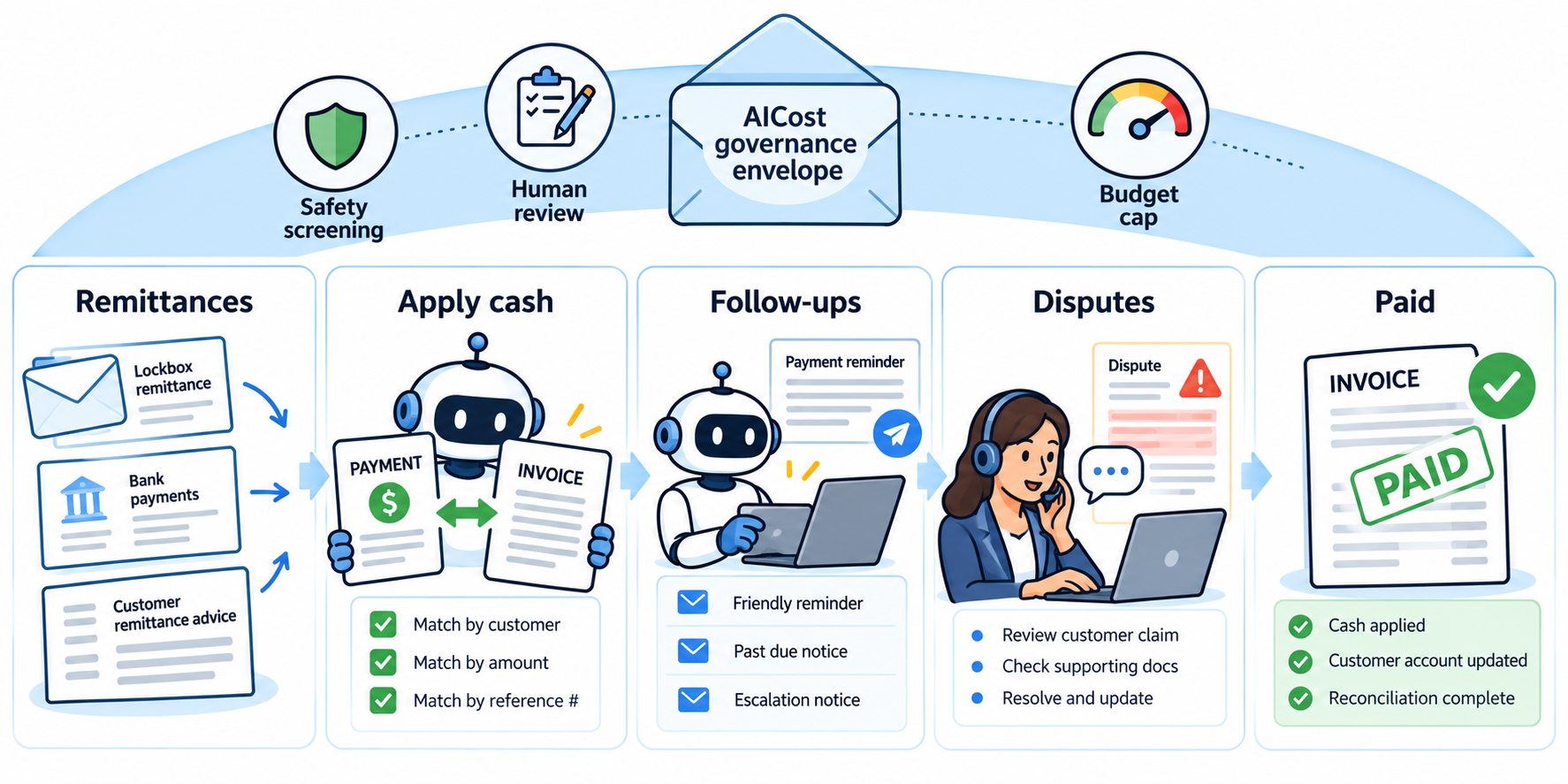
1 · cost
Read remittances
$284
2 · cost
Emails drafted and replies read
$420
$125
3 · gate
Batch the daily run
4 · governance
Tone and fair-collection rules
$9
5 · governance
Disputes to a person
$3,750
$2,000
6 · gate
Days sales outstanding vs AI cost
Without AICost
$4,463/mo
$0.45 per applied payment
With AICost
$2,419/mo
$0.24 per applied payment 46% lower
Monthly saving
$2,044/mo
4 cost levers applied
Governance controls
4
Monthly budget $200
Cost cutPrompt caching → Emails drafted and replies read −$73Model routing → Emails drafted and replies read −$124Batch the non-urgent work → Emails drafted and replies read −$98Better grounding → Disputes to a person −$1,750
Governance✓ Guardrail screening → Tone and fair-collection rules✓ Human review → Disputes to a person✓ Cost firewall at the gateway✓ Data-class model allowlist
Flow, picture, cost levers, governance and policy envelope
How the work flows today
1AI ranks overdue accounts by risk
2AI drafts and sends dunning emails and answers customer replies
3AI matches incoming payments and remittances to open invoices
4Disputes and short-pays routed to a collector
5Cash posted in the ERP and DSO tracked
AICost engine chain (blue: cost, purple: governance)
Cost levers and the step they act on
Prompt caching on step Emails drafted and replies read −$7360% cacheable, 75% hit (applied to every eligible workflow) (combined with the other knobs on this step) · Prompt CachingRepeated instructions and documents are cached, so you pay less for the same prompt text.
How it works: The stable part of each prompt (system instructions, tool definitions, reference text) is cached by the model provider and billed at the cached rate.
How AICost prices it: The Prompt Caching engine prices cacheable share and hit rate against the provider's cached-input price.
Governance: No change to answers, models or data. Only the billing of repeated text changes.
* Cacheable share and hit rate are typical values; your logs give the real ones.
Model routing on step Emails drafted and replies read −$12440% of calls (extraction and field checks) to Claude Haiku 5.5; critical work (exceptions) stays on Claude Sonnet 5.5; financial data: routine steps only, approved models for this data class (applied to every eligible workflow) (combined with the other knobs on this step) · Model RouterRoutine steps run on a cheaper model; critical steps stay on the primary model.
How it works: Each workflow type has routine work (triage, lookups, extraction, summaries, drafts) and critical work (the final answer, code changes, clinical or legal output, decisions). Routine calls go to the economy model; critical work stays on the primary model.
How AICost prices it: The Model Router engine prices the split between the economy and primary model on the workflow's own volume.
Governance: Only approved models for the data class are used. For patient and privileged legal data the share is capped and calls stay with the primary model's vendor and route, so the BAA still covers every call.
* The share of routine calls per workflow type is a starting assumption; your traffic sets the real split.
Batch the non-urgent work on step Emails drafted and replies read −$9860% of calls through the batch API (combined with the other knobs on this step) · Batch or RealtimeWork that can wait runs in the provider's batch mode at a lower price.
How it works: Requests that do not need an instant answer are queued and sent through the batch API.
How AICost prices it: The Batch or Realtime engine prices the batch-tolerant share at batch rates.
Governance: Urgent and customer-facing requests stay realtime.
* The batch-tolerant share is an input.
Better grounding on step Disputes to a person −$1,750escalation 15% to 8% · Human ReviewAnswers come only from your approved sources, so fewer cases go to a person.
How it works: The assistant answers from your own approved content with the source attached, and says it does not know instead of guessing. Teams get there with cleaner knowledge-base articles, better retrieval (tighter chunks, reranking) and an answer check before the reply goes out.
How AICost prices it: Fewer low-confidence answers means fewer escalations. The Human Review engine prices reviewer minutes at the lower escalation rate; the saving is the difference.
Governance: Human review stays on for refunds, policy exceptions and anything still low-confidence. Only the share of cases that needed a person goes down.
* The demo assumes escalations fall by half (for example 12% to 6%). Your number comes from your own evaluation results.
Governance controls and the step they act on
Guardrail screening on step Tone and fair-collection rules $9
PII, prompt-attack and policy screening before the model acts.
Human review on step Disputes to a person $3,750
Low-confidence, high-value or regulated cases go to a person.
Cost firewall at the gateway policy only, no cost
Monthly budget, daily cap, per-run ceiling, turn cap, spike rule, kill switch.
Data-class model allowlist policy only, no cost
Only models cleared for this data class are routable; others are refused at the gateway.
Policy envelope
Monthly budget$200
Daily hard cap$9
Per-run ceiling$0.17
Turn cap6
See the policy your gateway enforces
{
  "workload_id": "collections-and-cash-application-in-accounts-receivable",
  "scope": "workload",
  "monthly_budget_usd": 200,
  "daily_warning_usd": 6.07,
  "daily_hard_limit_usd": 8.67,
  "max_cost_per_run_usd": 0.17,
  "max_model_calls_per_run": 6,
  "max_retries": 2,
  "max_output_tokens": 1200,
  "requests_per_min": 90,
  "anomaly": {
    "rolling_window": "7d",
    "spike_multiplier": 3,
    "rule": "flag any hour/day exceeding 3x the rolling average, or any single day above the daily hard limit"
  },
  "actions": {
    "warning_threshold": "notify",
    "soft_limit": "route_to:claude-haiku-5-5",
    "hard_limit": "block_noncritical_requests",
    "anomaly": "throttle_and_alert",
    "emergency": "block_all_and_require_approval"
  },
  "emergency_stop": {
    "enabled": true,
    "requires_approval_to_resume": true
  }
}
Where the cost runs away
- Reading every customer email thread in full on each pass
- Remittance PDFs processed repeatedly
- Platform pricing tied to invoice or payment volume
Talk to us about this workflow →
👥 HR and talent · Business solutions
Candidate screening and interview scheduling assistant
8,000 screened candidate a month
AI answers candidate questions, screens applications against the role and schedules interviews with the hiring team.
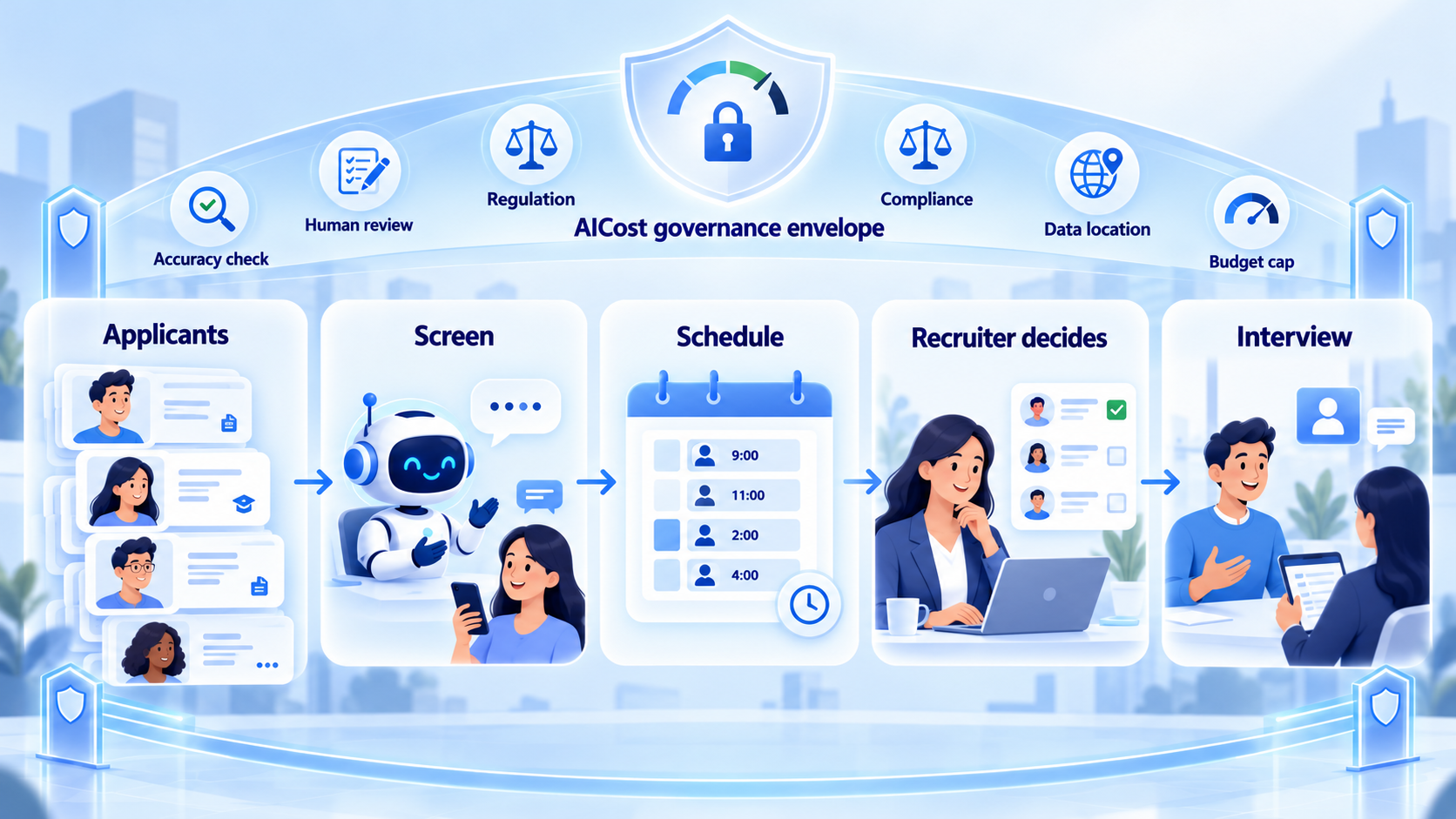
1 · cost
Screen, chat and schedule, per candidate
$4,767
$1,785
2 · gate
Small model for scheduling chats
3 · gate
Cost at hiring peaks
4 · governance
Bias and accuracy testing
$93
5 · governance
Recruiter makes the decision
$20,000
$16,000
6 · gate
High-risk use under the EU AI Act
7 · governance
Bias audits and notices
$3,654
8 · gate
Where candidate data is processed
Without AICost
$28,514/mo
$3.56 per screened candidate
With AICost
$21,532/mo
$2.69 per screened candidate 24% lower
Monthly saving
$6,982/mo
5 cost levers applied
Governance controls
5
Monthly budget $2,100
Cost cutLoop cap → Screen, chat and schedule, per candidate −$2,009Prompt caching → Screen, chat and schedule, per candidate −$250Context compaction → Screen, chat and schedule, per candidate −$358Model routing → Screen, chat and schedule, per candidate −$365Shorter review with pre-checked drafts* → Recruiter makes the decision −$4,000
Governance✓ Accuracy and hallucination checks → Bias and accuracy testing✓ Human review → Recruiter makes the decision✓ Compliance evidence → Bias audits and notices✓ Cost firewall at the gateway✓ Data-class model allowlist
Flow, picture, cost levers, governance and policy envelope
How the work flows today
1Candidate applies or chats on the careers site
2Assistant answers questions and asks screening questions
3AI matches the candidate to suitable roles
4Assistant schedules or reschedules interviews and sends reminders
5Recruiter reviews the shortlist and decides
6Status updated in the ATS
AICost engine chain (blue: cost, purple: governance)
Cost levers and the step they act on
Loop cap on step Screen, chat and schedule, per candidate −$2,00916 turns, 60k tokens, enforced by cost-firewall · Agent LoopA ceiling on turns and tokens per agent run, so a stuck agent cannot run up the bill.
How it works: Each agent run gets a maximum number of turns and tokens. A run that hits the ceiling stops and hands off instead of looping.
How AICost prices it: The Agent Loop engine prices the runs with and without the ceiling, including the runaway tail.
Governance: The cap is enforced by the cost firewall at your gateway, with an alert when it trips.
Prompt caching on step Screen, chat and schedule, per candidate −$25060% cacheable, 75% hit (applied to every eligible workflow) · Prompt CachingRepeated instructions and documents are cached, so you pay less for the same prompt text.
How it works: The stable part of each prompt (system instructions, tool definitions, reference text) is cached by the model provider and billed at the cached rate.
How AICost prices it: The Prompt Caching engine prices cacheable share and hit rate against the provider's cached-input price.
Governance: No change to answers, models or data. Only the billing of repeated text changes.
* Cacheable share and hit rate are typical values; your logs give the real ones.
Context compaction on step Screen, chat and schedule, per candidate −$358trim history 60%, net of overhead (applied to every eligible workflow) · Context TrimLong histories are trimmed each turn, so every call carries less text.
How it works: Older turns and long documents are summarized or trimmed before each call, keeping what the model needs.
How AICost prices it: The Context Trim engine prices the smaller context net of the cost of trimming.
Governance: Quality is checked before rollout; nothing reaches the model that it was not allowed to see.
* The trim size is an input; your evals confirm it keeps answer quality.
Model routing on step Screen, chat and schedule, per candidate −$36540% of calls (planning, tool calls and lookups) to Claude Haiku 5.5; critical work (actions that change records) stays on Claude Sonnet 5.5 · Model RouterRoutine steps run on a cheaper model; critical steps stay on the primary model.
How it works: Each workflow type has routine work (triage, lookups, extraction, summaries, drafts) and critical work (the final answer, code changes, clinical or legal output, decisions). Routine calls go to the economy model; critical work stays on the primary model.
How AICost prices it: The Model Router engine prices the split between the economy and primary model on the workflow's own volume.
Governance: Only approved models for the data class are used. For patient and privileged legal data the share is capped and calls stay with the primary model's vendor and route, so the BAA still covers every call.
* The share of routine calls per workflow type is a starting assumption; your traffic sets the real split.
Shorter review with pre-checked drafts* on step Recruiter makes the decision −$4,000*assumption: 20% less edit time per screened candidate when evals catch errors before the reviewer sees the draft; every screened candidate is still reviewed · Human ReviewEvery item is still reviewed, but automated checks catch errors first, so review takes less time.
How it works: An evaluation step checks each draft before the reviewer sees it, so the reviewer edits less.
How AICost prices it: The Human Review engine prices reviewer time at the shorter review time.
Governance: Every item is still reviewed by a person.
* The time saved per review is an assumption, marked with an asterisk.
Governance controls and the step they act on
Accuracy and hallucination checks on step Bias and accuracy testing $93
Golden-set and live-traffic scoring catch silent regressions.
Human review on step Recruiter makes the decision $20,000
Low-confidence, high-value or regulated cases go to a person.
Compliance evidence on step Bias audits and notices $3,654
Audit logs, retention and assessments for the rules that apply.
Cost firewall at the gateway policy only, no cost
Monthly budget, daily cap, per-run ceiling, turn cap, spike rule, kill switch.
Data-class model allowlist policy only, no cost
Only models cleared for this data class are routable; others are refused at the gateway.
Policy envelope
Monthly budget$2,100
Daily hard cap$91
Per-run ceiling$2.38
Turn cap16
See the policy your gateway enforces
{
  "workload_id": "candidate-screening-and-interview-scheduling-assistant",
  "scope": "workload",
  "monthly_budget_usd": 2100,
  "daily_warning_usd": 63.7,
  "daily_hard_limit_usd": 91,
  "max_cost_per_run_usd": 2.38,
  "max_model_calls_per_run": 16,
  "max_retries": 2,
  "max_output_tokens": 1200,
  "requests_per_min": 80,
  "anomaly": {
    "rolling_window": "7d",
    "spike_multiplier": 3,
    "rule": "flag any hour/day exceeding 3x the rolling average, or any single day above the daily hard limit"
  },
  "actions": {
    "warning_threshold": "notify",
    "soft_limit": "route_to:claude-haiku-5-5",
    "hard_limit": "block_noncritical_requests",
    "anomaly": "throttle_and_alert",
    "emergency": "block_all_and_require_approval"
  },
  "emergency_stop": {
    "enabled": true,
    "requires_approval_to_resume": true
  }
}
Where the cost runs away
- Every application scored by a large model, including clearly unqualified ones
- Long SMS/chat threads per candidate
- Per-hire or per-employee licence pricing
Talk to us about this workflow →
👥 HR and talent · Business solutions
HR help assistant for employee questions and requests
6,000 answered HR question a month
An HR assistant answers employee questions on pay, leave, benefits and policy, and opens cases for anything that needs a person.
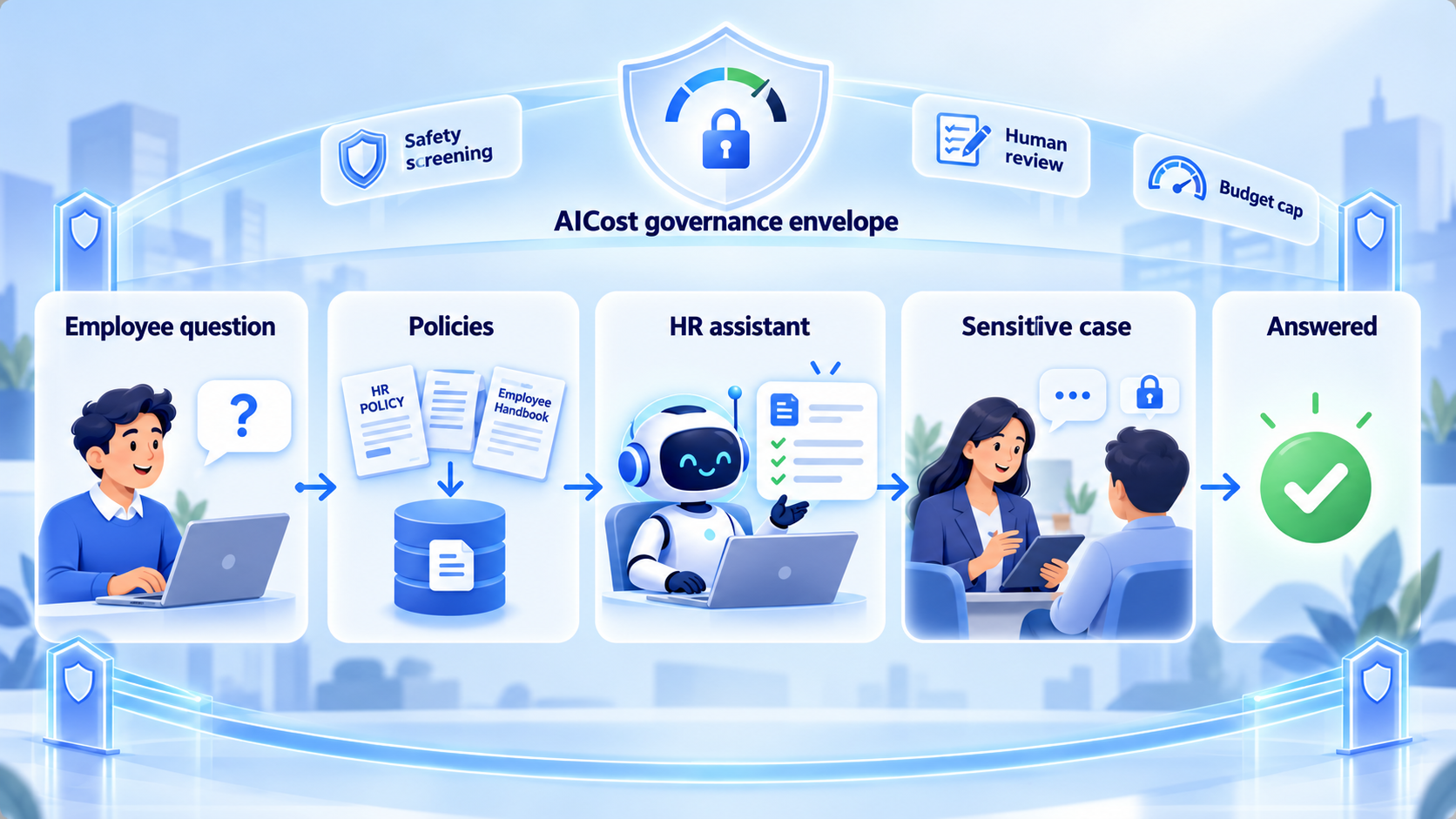
1 · cost
Answer from policy documents
$231
$69
2 · gate
Reuse the policy prompt
3 · governance
Keep personal records private
$11
4 · governance
Sensitive cases to HR
$2,160
$1,080
5 · gate
Cost per question vs HR staff
Without AICost
$2,402/mo
$0.40 per answered HR question
With AICost
$1,161/mo
$0.19 per answered HR question 52% lower
Monthly saving
$1,241/mo
4 cost levers applied
Governance controls
4
Monthly budget $100
Cost cutPrompt caching → Answer from policy documents −$39Context compaction → Answer from policy documents −$56Model routing → Answer from policy documents −$67Better grounding → Sensitive cases to HR −$1,080
Governance✓ Guardrail screening → Keep personal records private✓ Human review → Sensitive cases to HR✓ Cost firewall at the gateway✓ Data-class model allowlist
Flow, picture, cost levers, governance and policy envelope
How the work flows today
1Employee asks about pay, leave, benefits or policy
2Assistant finds the answer in policies and the employee's own records
3Assistant completes simple tasks (letters, address change, leave request)
4Sensitive or complex cases go to an HR partner
5Conversation logged and gaps fed to policy owners
AICost engine chain (blue: cost, purple: governance)
Cost levers and the step they act on
Prompt caching on step Answer from policy documents −$3960% cacheable, 75% hit (combined with the other knobs on this step) · Prompt CachingRepeated instructions and documents are cached, so you pay less for the same prompt text.
How it works: The stable part of each prompt (system instructions, tool definitions, reference text) is cached by the model provider and billed at the cached rate.
How AICost prices it: The Prompt Caching engine prices cacheable share and hit rate against the provider's cached-input price.
Governance: No change to answers, models or data. Only the billing of repeated text changes.
* Cacheable share and hit rate are typical values; your logs give the real ones.
Context compaction on step Answer from policy documents −$56trim history 60%, net of overhead (applied to every eligible workflow) (combined with the other knobs on this step) · Context TrimLong histories are trimmed each turn, so every call carries less text.
How it works: Older turns and long documents are summarized or trimmed before each call, keeping what the model needs.
How AICost prices it: The Context Trim engine prices the smaller context net of the cost of trimming.
Governance: Quality is checked before rollout; nothing reaches the model that it was not allowed to see.
* The trim size is an input; your evals confirm it keeps answer quality.
Model routing on step Answer from policy documents −$6750% of calls (intent detection, lookups and short answers) to Claude Haiku 5.5; critical work (policy, refund and account answers) stays on Claude Sonnet 5.5 (applied to every eligible workflow) (combined with the other knobs on this step) · Model RouterRoutine steps run on a cheaper model; critical steps stay on the primary model.
How it works: Each workflow type has routine work (triage, lookups, extraction, summaries, drafts) and critical work (the final answer, code changes, clinical or legal output, decisions). Routine calls go to the economy model; critical work stays on the primary model.
How AICost prices it: The Model Router engine prices the split between the economy and primary model on the workflow's own volume.
Governance: Only approved models for the data class are used. For patient and privileged legal data the share is capped and calls stay with the primary model's vendor and route, so the BAA still covers every call.
* The share of routine calls per workflow type is a starting assumption; your traffic sets the real split.
Better grounding on step Sensitive cases to HR −$1,080escalation 12% to 6% · Human ReviewAnswers come only from your approved sources, so fewer cases go to a person.
How it works: The assistant answers from your own approved content with the source attached, and says it does not know instead of guessing. Teams get there with cleaner knowledge-base articles, better retrieval (tighter chunks, reranking) and an answer check before the reply goes out.
How AICost prices it: Fewer low-confidence answers means fewer escalations. The Human Review engine prices reviewer minutes at the lower escalation rate; the saving is the difference.
Governance: Human review stays on for refunds, policy exceptions and anything still low-confidence. Only the share of cases that needed a person goes down.
* The demo assumes escalations fall by half (for example 12% to 6%). Your number comes from your own evaluation results.
Governance controls and the step they act on
Guardrail screening on step Keep personal records private $11
PII, prompt-attack and policy screening before the model acts.
Human review on step Sensitive cases to HR $2,160
Low-confidence, high-value or regulated cases go to a person.
Cost firewall at the gateway policy only, no cost
Monthly budget, daily cap, per-run ceiling, turn cap, spike rule, kill switch.
Data-class model allowlist policy only, no cost
Only models cleared for this data class are routable; others are refused at the gateway.
Policy envelope
Monthly budget$100
Daily hard cap$4
Per-run ceiling$0.15
Turn cap12
See the policy your gateway enforces
{
  "workload_id": "hr-help-assistant-for-employee-questions-and-requests",
  "scope": "workload",
  "monthly_budget_usd": 100,
  "daily_warning_usd": 3.03,
  "daily_hard_limit_usd": 4.33,
  "max_cost_per_run_usd": 0.15,
  "max_model_calls_per_run": 12,
  "max_retries": 2,
  "max_output_tokens": 1200,
  "requests_per_min": 60,
  "anomaly": {
    "rolling_window": "7d",
    "spike_multiplier": 3,
    "rule": "flag any hour/day exceeding 3x the rolling average, or any single day above the daily hard limit"
  },
  "actions": {
    "warning_threshold": "notify",
    "soft_limit": "route_to:claude-haiku-5-5",
    "hard_limit": "block_noncritical_requests",
    "anomaly": "throttle_and_alert",
    "emergency": "block_all_and_require_approval"
  },
  "emergency_stop": {
    "enabled": true,
    "requires_approval_to_resume": true
  }
}
Where the cost runs away
- Long policy documents loaded into context for each question
- High chat volume around open enrolment and payroll dates
- Per-employee licences
Talk to us about this workflow →
👥 HR and talent · Business solutions
New-hire onboarding assistant
150 onboarded hire a month
Once an offer is accepted, AI coordinates paperwork, accounts, equipment and first-week tasks, and answers new-hire questions.
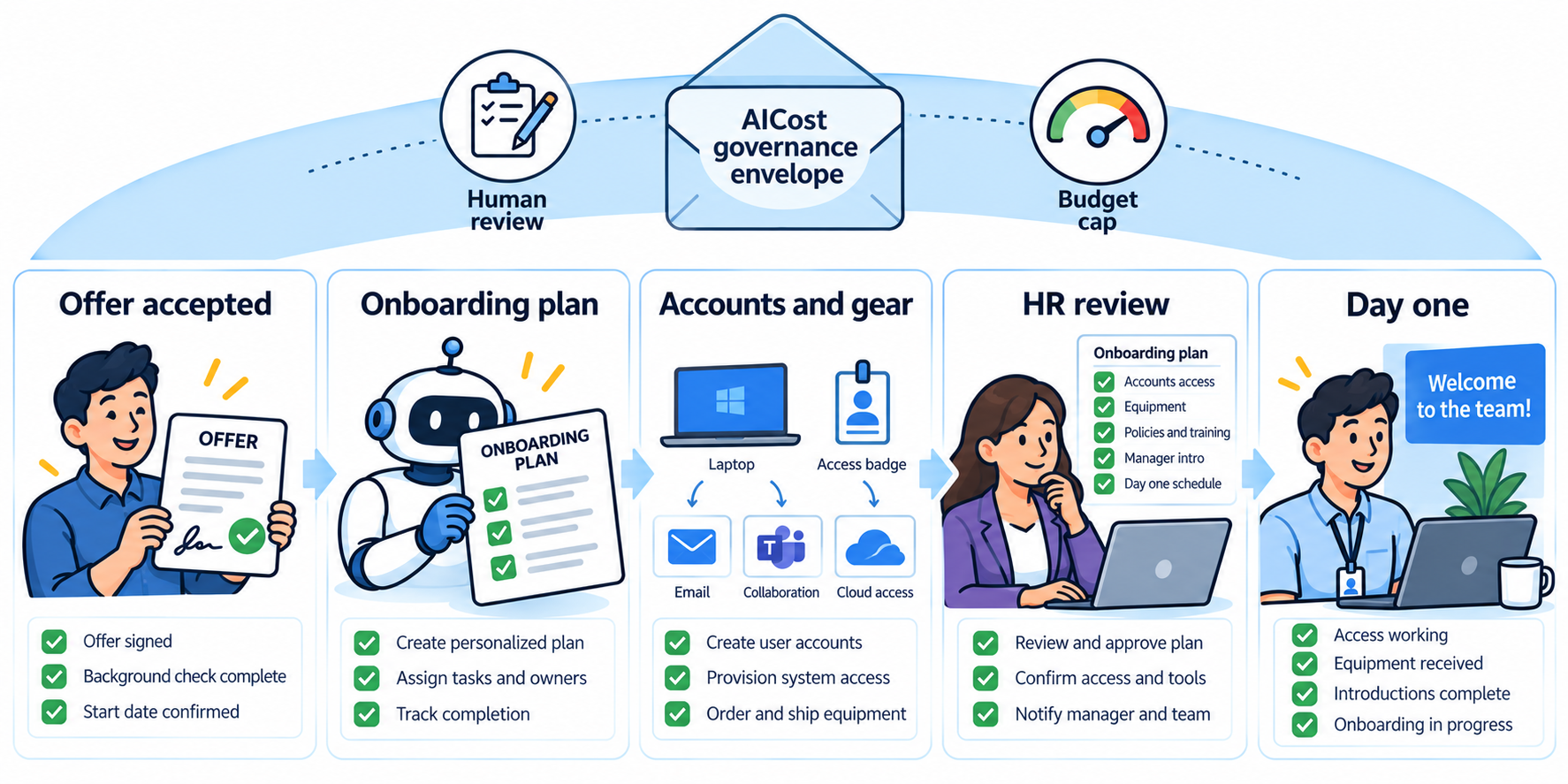
1 · cost
Onboarding tasks per hire
$259
$182
2 · cost
HRIS and IT system tasks
$1,472
3 · cost
Documents and welcome packs
$45
4 · governance
HR review
$1,875
$656
5 · gate
Cost as hiring grows
Without AICost
$3,651/mo
$24.34 per onboarded hire
With AICost
$2,355/mo
$15.70 per onboarded hire 35% lower
Monthly saving
$1,296/mo
5 cost levers applied
Governance controls
3
Monthly budget $300
Cost cutLoop cap → Onboarding tasks per hire −$31Prompt caching → Onboarding tasks per hire −$12Context compaction → Onboarding tasks per hire −$17Model routing → Onboarding tasks per hire −$17Policy-based review sampling → HR review −$1,219
Governance✓ Human review → HR review✓ Cost firewall at the gateway✓ Data-class model allowlist
Flow, picture, cost levers, governance and policy envelope
How the work flows today
1Offer accepted in the ATS
2Assistant creates onboarding tasks for HR, IT and the manager
3Assistant sends paperwork and answers first-week questions
4Accounts and equipment requested automatically
5Manager notified of progress and gaps
AICost engine chain (blue: cost, purple: governance)
Cost levers and the step they act on
Loop cap on step Onboarding tasks per hire −$3140 turns, 60k tokens, enforced by cost-firewall · Agent LoopA ceiling on turns and tokens per agent run, so a stuck agent cannot run up the bill.
How it works: Each agent run gets a maximum number of turns and tokens. A run that hits the ceiling stops and hands off instead of looping.
How AICost prices it: The Agent Loop engine prices the runs with and without the ceiling, including the runaway tail.
Governance: The cap is enforced by the cost firewall at your gateway, with an alert when it trips.
Prompt caching on step Onboarding tasks per hire −$1260% cacheable, 75% hit (applied to every eligible workflow) · Prompt CachingRepeated instructions and documents are cached, so you pay less for the same prompt text.
How it works: The stable part of each prompt (system instructions, tool definitions, reference text) is cached by the model provider and billed at the cached rate.
How AICost prices it: The Prompt Caching engine prices cacheable share and hit rate against the provider's cached-input price.
Governance: No change to answers, models or data. Only the billing of repeated text changes.
* Cacheable share and hit rate are typical values; your logs give the real ones.
Context compaction on step Onboarding tasks per hire −$17trim history 60%, net of overhead (applied to every eligible workflow) · Context TrimLong histories are trimmed each turn, so every call carries less text.
How it works: Older turns and long documents are summarized or trimmed before each call, keeping what the model needs.
How AICost prices it: The Context Trim engine prices the smaller context net of the cost of trimming.
Governance: Quality is checked before rollout; nothing reaches the model that it was not allowed to see.
* The trim size is an input; your evals confirm it keeps answer quality.
Model routing on step Onboarding tasks per hire −$1740% of calls (planning, tool calls and lookups) to Claude Haiku 5.5; critical work (actions that change records) stays on Claude Sonnet 5.5 (applied to every eligible workflow) · Model RouterRoutine steps run on a cheaper model; critical steps stay on the primary model.
How it works: Each workflow type has routine work (triage, lookups, extraction, summaries, drafts) and critical work (the final answer, code changes, clinical or legal output, decisions). Routine calls go to the economy model; critical work stays on the primary model.
How AICost prices it: The Model Router engine prices the split between the economy and primary model on the workflow's own volume.
Governance: Only approved models for the data class are used. For patient and privileged legal data the share is capped and calls stay with the primary model's vendor and route, so the BAA still covers every call.
* The share of routine calls per workflow type is a starting assumption; your traffic sets the real split.
Policy-based review sampling on step HR review −$1,21935% reviewed, the rest cleared by policy and evals · Human ReviewPeople review a sample set by policy, not every item, where the rules allow it.
How it works: Low-risk items that pass automated checks are cleared by policy; people review a sample plus everything above the risk threshold.
How AICost prices it: The Human Review engine prices reviewer time at the sampled rate.
Governance: Used only where review is not required by law or policy. Required reviews are never sampled.
* The sample rate is an input set by your policy.
Governance controls and the step they act on
Human review on step HR review $1,875
Low-confidence, high-value or regulated cases go to a person.
Cost firewall at the gateway policy only, no cost
Monthly budget, daily cap, per-run ceiling, turn cap, spike rule, kill switch.
Data-class model allowlist policy only, no cost
Only models cleared for this data class are routable; others are refused at the gateway.
Policy envelope
Monthly budget$300
Daily hard cap$13
Per-run ceiling$6.90
Turn cap40
See the policy your gateway enforces
{
  "workload_id": "new-hire-onboarding-assistant",
  "scope": "workload",
  "monthly_budget_usd": 300,
  "daily_warning_usd": 9.1,
  "daily_hard_limit_usd": 13,
  "max_cost_per_run_usd": 6.9,
  "max_model_calls_per_run": 40,
  "max_retries": 2,
  "max_output_tokens": 1200,
  "requests_per_min": 60,
  "anomaly": {
    "rolling_window": "7d",
    "spike_multiplier": 3,
    "rule": "flag any hour/day exceeding 3x the rolling average, or any single day above the daily hard limit"
  },
  "actions": {
    "warning_threshold": "notify",
    "soft_limit": "route_to:claude-haiku-5-5",
    "hard_limit": "block_noncritical_requests",
    "anomaly": "throttle_and_alert",
    "emergency": "block_all_and_require_approval"
  },
  "emergency_stop": {
    "enabled": true,
    "requires_approval_to_resume": true
  }
}
Where the cost runs away
- Assistant kept active and chatty for months per hire
- Duplicate tools across HR and IT
- Per-employee licence pricing
Talk to us about this workflow →
⚖️ Legal · Business solutions
First-pass contract review and redlining against the playbook
400 reviewed contract a month
AI reviews incoming contracts against the company playbook, marks deviations and proposes redlines for an attorney to approve.
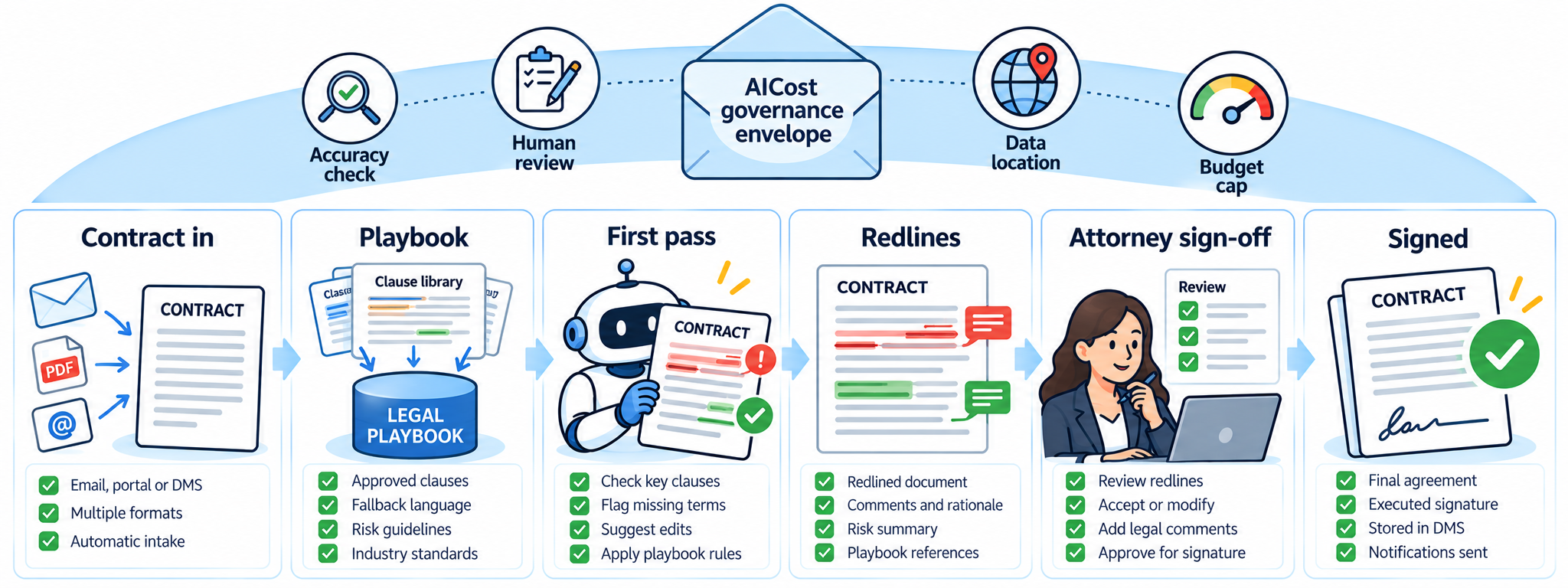
1 · cost
Read the contract
$142
2 · cost
Long contracts in context
$73
$22
3 · gate
Cache the playbook on every contract
4 · cost
Playbook and clause library
$57
5 · cost
Clause risk analysis
$50
6 · governance
Missed or invented clauses
$92
7 · governance
Attorney sign-off
$26,667
$21,334
8 · gate
Where privileged data goes
9 · gate
Cost per contract vs outside counsel
Without AICost
$27,081/mo
$67.70 per reviewed contract
With AICost
$21,697/mo
$54.24 per reviewed contract 20% lower
Monthly saving
$5,384/mo
5 cost levers applied
Governance controls
4
Monthly budget $300
Cost cutPrompt caching → Long contracts in context −$15Context compaction → Long contracts in context −$14Model routing → Long contracts in context −$11Batch the non-urgent work → Long contracts in context −$11Shorter review with pre-checked drafts* → Attorney sign-off −$5,333
Governance✓ Accuracy and hallucination checks → Missed or invented clauses✓ Human review → Attorney sign-off✓ Cost firewall at the gateway✓ Data-class model allowlist
Flow, picture, cost levers, governance and policy envelope
How the work flows today
1Business sends a counterparty contract (NDA, MSA, DPA)
2AI compares each clause to the company playbook
3AI marks risky clauses and suggests fallback language
4Attorney reviews and edits the redline
5Redline sent and final terms saved
AICost engine chain (blue: cost, purple: governance)
Cost levers and the step they act on
Prompt caching on step Long contracts in context −$1560% cacheable, 75% hit (combined with the other knobs on this step) · Prompt CachingRepeated instructions and documents are cached, so you pay less for the same prompt text.
How it works: The stable part of each prompt (system instructions, tool definitions, reference text) is cached by the model provider and billed at the cached rate.
How AICost prices it: The Prompt Caching engine prices cacheable share and hit rate against the provider's cached-input price.
Governance: No change to answers, models or data. Only the billing of repeated text changes.
* Cacheable share and hit rate are typical values; your logs give the real ones.
Context compaction on step Long contracts in context −$14trim history 60%, net of overhead (applied to every eligible workflow) (combined with the other knobs on this step) · Context TrimLong histories are trimmed each turn, so every call carries less text.
How it works: Older turns and long documents are summarized or trimmed before each call, keeping what the model needs.
How AICost prices it: The Context Trim engine prices the smaller context net of the cost of trimming.
Governance: Quality is checked before rollout; nothing reaches the model that it was not allowed to see.
* The trim size is an input; your evals confirm it keeps answer quality.
Model routing on step Long contracts in context −$1120% of calls (outlines and section summaries) to Claude Haiku 5.5; critical work (the drafted document) stays on Claude Sonnet 5.5; privileged documents: routine steps only, same vendor as the primary model (applied to every eligible workflow) (combined with the other knobs on this step) · Model RouterRoutine steps run on a cheaper model; critical steps stay on the primary model.
How it works: Each workflow type has routine work (triage, lookups, extraction, summaries, drafts) and critical work (the final answer, code changes, clinical or legal output, decisions). Routine calls go to the economy model; critical work stays on the primary model.
How AICost prices it: The Model Router engine prices the split between the economy and primary model on the workflow's own volume.
Governance: Only approved models for the data class are used. For patient and privileged legal data the share is capped and calls stay with the primary model's vendor and route, so the BAA still covers every call.
* The share of routine calls per workflow type is a starting assumption; your traffic sets the real split.
Batch the non-urgent work on step Long contracts in context −$1140% of calls through the batch API (applied to every eligible workflow) (combined with the other knobs on this step) · Batch or RealtimeWork that can wait runs in the provider's batch mode at a lower price.
How it works: Requests that do not need an instant answer are queued and sent through the batch API.
How AICost prices it: The Batch or Realtime engine prices the batch-tolerant share at batch rates.
Governance: Urgent and customer-facing requests stay realtime.
* The batch-tolerant share is an input.
Shorter review with pre-checked drafts* on step Attorney sign-off −$5,333*assumption: 20% less edit time per reviewed contract when evals catch errors before the reviewer sees the draft; every reviewed contract is still reviewed · Human ReviewEvery item is still reviewed, but automated checks catch errors first, so review takes less time.
How it works: An evaluation step checks each draft before the reviewer sees it, so the reviewer edits less.
How AICost prices it: The Human Review engine prices reviewer time at the shorter review time.
Governance: Every item is still reviewed by a person.
* The time saved per review is an assumption, marked with an asterisk.
Governance controls and the step they act on
Accuracy and hallucination checks on step Missed or invented clauses $92
Golden-set and live-traffic scoring catch silent regressions.
Human review on step Attorney sign-off $26,667
Low-confidence, high-value or regulated cases go to a person.
Cost firewall at the gateway policy only, no cost
Monthly budget, daily cap, per-run ceiling, turn cap, spike rule, kill switch.
Data-class model allowlist policy only, no cost
Only models cleared for this data class are routable; others are refused at the gateway.
Policy envelope
Monthly budget$300
Daily hard cap$13
Per-run ceiling$0.73
Turn cap20
See the policy your gateway enforces
{
  "workload_id": "first-pass-contract-review-and-redlining-against-the-playboo",
  "scope": "workload",
  "monthly_budget_usd": 300,
  "daily_warning_usd": 9.1,
  "daily_hard_limit_usd": 13,
  "max_cost_per_run_usd": 0.73,
  "max_model_calls_per_run": 20,
  "max_retries": 2,
  "max_output_tokens": 1200,
  "requests_per_min": 60,
  "anomaly": {
    "rolling_window": "7d",
    "spike_multiplier": 3,
    "rule": "flag any hour/day exceeding 3x the rolling average, or any single day above the daily hard limit"
  },
  "actions": {
    "warning_threshold": "notify",
    "soft_limit": "route_to:claude-haiku-5-5",
    "hard_limit": "block_noncritical_requests",
    "anomaly": "throttle_and_alert",
    "emergency": "block_all_and_require_approval"
  },
  "emergency_stop": {
    "enabled": true,
    "requires_approval_to_resume": true
  }
}
Where the cost runs away
- Very long agreements re-analyzed on every version
- Redlines regenerated many times in negotiation
- Premium legal-AI seat pricing
Talk to us about this workflow →
⚖️ Legal · Business solutions
Legal intake triage (legal front door)
1,500 triaged request a month
AI takes legal requests from Slack, email or forms, classifies them, answers the simple ones and routes the rest to the right lawyer.
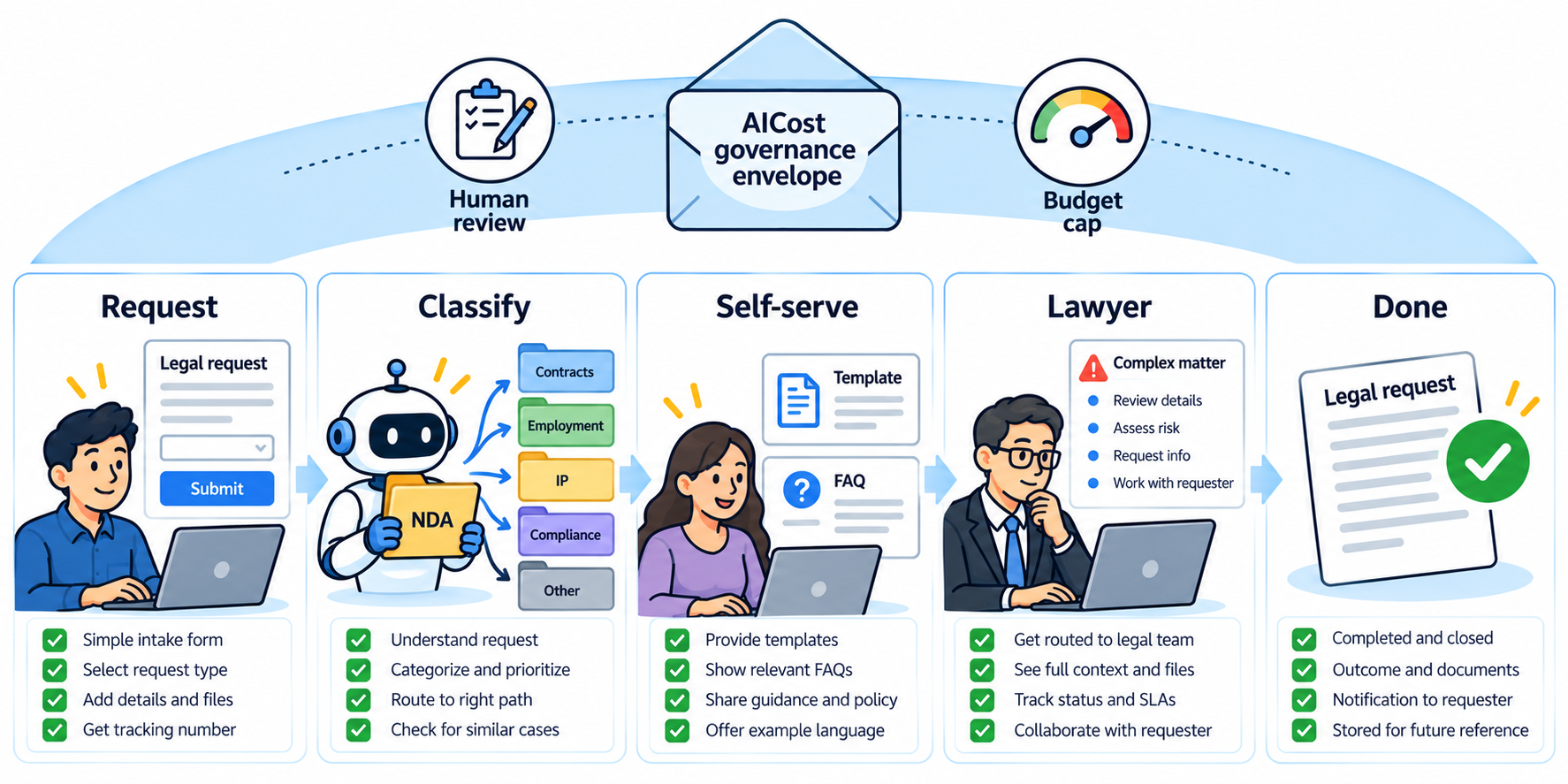
1 · gate
Small model for classification
2 · cost
Answer from FAQs and templates
$92
$80
3 · governance
Lawyer review
$4,500
$2,250
4 · gate
Requests closed without a lawyer
Without AICost
$4,592/mo
$3.06 per triaged request
With AICost
$2,329/mo
$1.55 per triaged request 49% lower
Monthly saving
$2,263/mo
3 cost levers applied
Governance controls
3
Monthly budget $100
Cost cutPrompt caching → Answer from FAQs and templates −$6Model routing → Answer from FAQs and templates −$6Better grounding → Lawyer review −$2,250
Governance✓ Human review → Lawyer review✓ Cost firewall at the gateway✓ Data-class model allowlist
Flow, picture, cost levers, governance and policy envelope
How the work flows today
1Employee submits a legal request in Slack, email or a form
2AI classifies the matter type and urgency
3Standard requests (NDA, simple questions) answered or auto-approved
4Others routed to the right lawyer with a summary
5Matter tracked to closure
AICost engine chain (blue: cost, purple: governance)
Cost levers and the step they act on
Prompt caching on step Answer from FAQs and templates −$660% cacheable, 75% hit (applied to every eligible workflow) · Prompt CachingRepeated instructions and documents are cached, so you pay less for the same prompt text.
How it works: The stable part of each prompt (system instructions, tool definitions, reference text) is cached by the model provider and billed at the cached rate.
How AICost prices it: The Prompt Caching engine prices cacheable share and hit rate against the provider's cached-input price.
Governance: No change to answers, models or data. Only the billing of repeated text changes.
* Cacheable share and hit rate are typical values; your logs give the real ones.
Model routing on step Answer from FAQs and templates −$630% of calls (classification and routing) to Claude Haiku 5.5; critical work (edge cases) stays on Claude Sonnet 5.5; privileged documents: routine steps only, same vendor as the primary model · Model RouterRoutine steps run on a cheaper model; critical steps stay on the primary model.
How it works: Each workflow type has routine work (triage, lookups, extraction, summaries, drafts) and critical work (the final answer, code changes, clinical or legal output, decisions). Routine calls go to the economy model; critical work stays on the primary model.
How AICost prices it: The Model Router engine prices the split between the economy and primary model on the workflow's own volume.
Governance: Only approved models for the data class are used. For patient and privileged legal data the share is capped and calls stay with the primary model's vendor and route, so the BAA still covers every call.
* The share of routine calls per workflow type is a starting assumption; your traffic sets the real split.
Better grounding on step Lawyer review −$2,250escalation 30% to 15% · Human ReviewAnswers come only from your approved sources, so fewer cases go to a person.
How it works: The assistant answers from your own approved content with the source attached, and says it does not know instead of guessing. Teams get there with cleaner knowledge-base articles, better retrieval (tighter chunks, reranking) and an answer check before the reply goes out.
How AICost prices it: Fewer low-confidence answers means fewer escalations. The Human Review engine prices reviewer minutes at the lower escalation rate; the saving is the difference.
Governance: Human review stays on for refunds, policy exceptions and anything still low-confidence. Only the share of cases that needed a person goes down.
* The demo assumes escalations fall by half (for example 12% to 6%). Your number comes from your own evaluation results.
Governance controls and the step they act on
Human review on step Lawyer review $4,500
Low-confidence, high-value or regulated cases go to a person.
Cost firewall at the gateway policy only, no cost
Monthly budget, daily cap, per-run ceiling, turn cap, spike rule, kill switch.
Data-class model allowlist policy only, no cost
Only models cleared for this data class are routable; others are refused at the gateway.
Policy envelope
Monthly budget$100
Daily hard cap$4
Per-run ceiling$0.24
Turn cap6
See the policy your gateway enforces
{
  "workload_id": "legal-intake-triage-legal-front-door",
  "scope": "workload",
  "monthly_budget_usd": 100,
  "daily_warning_usd": 3.03,
  "daily_hard_limit_usd": 4.33,
  "max_cost_per_run_usd": 0.24,
  "max_model_calls_per_run": 6,
  "max_retries": 2,
  "max_output_tokens": 1200,
  "requests_per_min": 60,
  "anomaly": {
    "rolling_window": "7d",
    "spike_multiplier": 3,
    "rule": "flag any hour/day exceeding 3x the rolling average, or any single day above the daily hard limit"
  },
  "actions": {
    "warning_threshold": "notify",
    "soft_limit": "route_to:claude-haiku-5-5",
    "hard_limit": "block_noncritical_requests",
    "anomaly": "throttle_and_alert",
    "emergency": "block_all_and_require_approval"
  },
  "emergency_stop": {
    "enabled": true,
    "requires_approval_to_resume": true
  }
}
Where the cost runs away
- Large models used to classify short requests
- Long email threads fed in full
- Duplicate intake tools across legal and procurement
Talk to us about this workflow →
⚖️ Legal · Business solutions
Contract data extraction and obligation tracking
3,000 abstracted contract a month
AI extracts key terms, dates and obligations from signed and legacy contracts and tracks them in the repository.
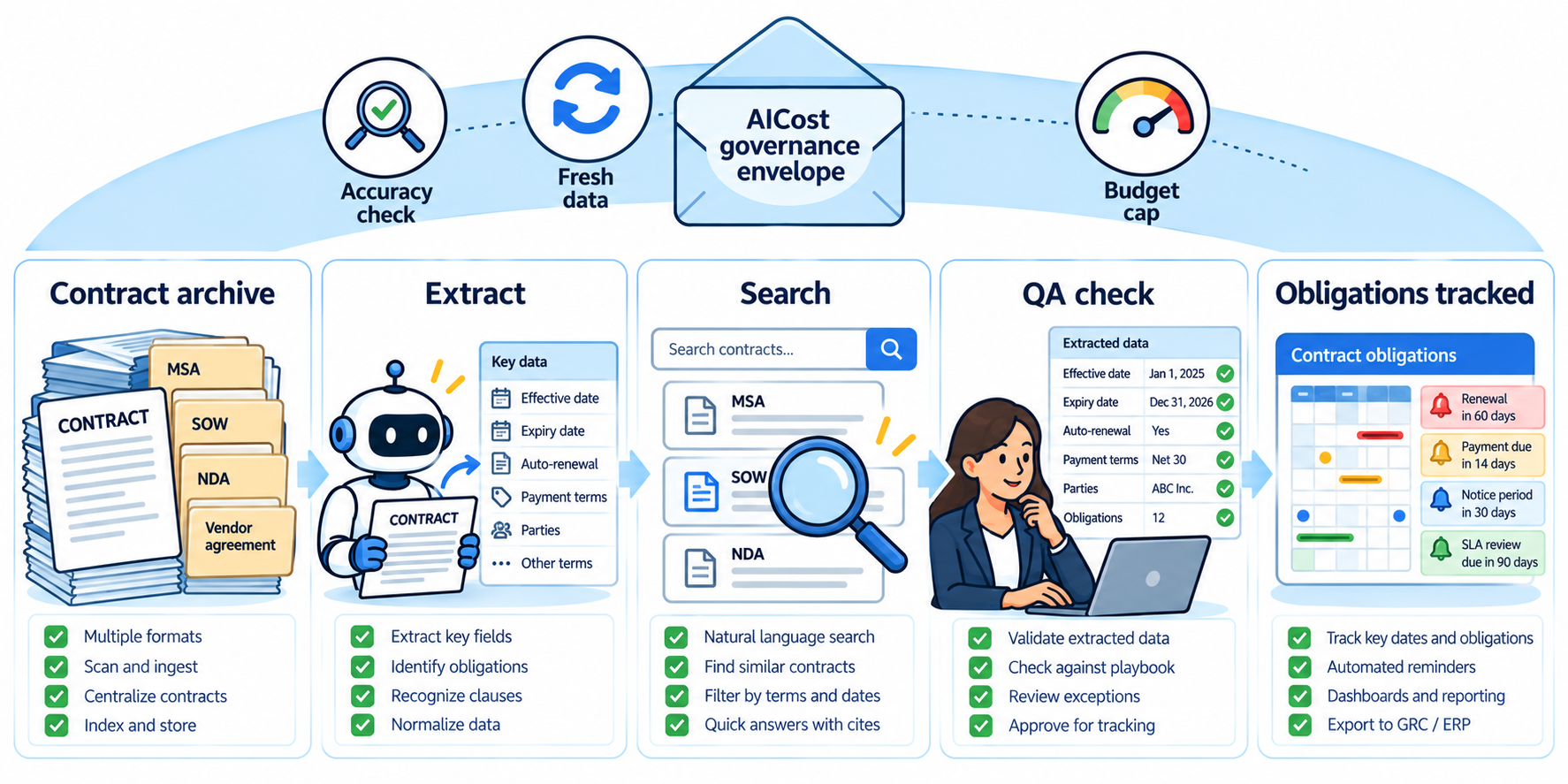
1 · cost
One-time backlog of legacy contracts
$177
2 · cost
Model calls
$126
$38
3 · cost
Read new contracts
$639
4 · gate
Small model for standard clauses
6 · cost
Search across contracts
$1
7 · governance
Field accuracy QA
$93
8 · cost
Keep obligations current
$1,705
Without AICost
$2,740/mo
$0.91 per abstracted contract
With AICost
$2,652/mo
$0.88 per abstracted contract 3% lower
Monthly saving
$88/mo
3 cost levers applied
Governance controls
3
Monthly budget $200
Cost cutPrompt caching → Model calls −$24Model routing → Model calls −$31Batch the non-urgent work → Model calls −$33
Governance✓ Accuracy and hallucination checks → Field accuracy QA✓ Cost firewall at the gateway✓ Data-class model allowlist
Flow, picture, cost levers, governance and policy envelope
How the work flows today
1Signed and legacy contracts loaded into the repository
2AI extracts parties, dates, renewal, pricing and key terms
3Legal ops spot-checks extracted fields
4Renewals and obligations put on a calendar with owners
5Alerts sent before deadlines
AICost engine chain (blue: cost, purple: governance)
Cost levers and the step they act on
Prompt caching on step Model calls −$2460% cacheable, 75% hit (applied to every eligible workflow) (combined with the other knobs on this step) · Prompt CachingRepeated instructions and documents are cached, so you pay less for the same prompt text.
How it works: The stable part of each prompt (system instructions, tool definitions, reference text) is cached by the model provider and billed at the cached rate.
How AICost prices it: The Prompt Caching engine prices cacheable share and hit rate against the provider's cached-input price.
Governance: No change to answers, models or data. Only the billing of repeated text changes.
* Cacheable share and hit rate are typical values; your logs give the real ones.
Model routing on step Model calls −$3130% of calls (extraction and field checks) to Claude Haiku 5.5; critical work (exceptions) stays on Claude Sonnet 5.5; privileged documents: routine steps only, same vendor as the primary model (combined with the other knobs on this step) · Model RouterRoutine steps run on a cheaper model; critical steps stay on the primary model.
How it works: Each workflow type has routine work (triage, lookups, extraction, summaries, drafts) and critical work (the final answer, code changes, clinical or legal output, decisions). Routine calls go to the economy model; critical work stays on the primary model.
How AICost prices it: The Model Router engine prices the split between the economy and primary model on the workflow's own volume.
Governance: Only approved models for the data class are used. For patient and privileged legal data the share is capped and calls stay with the primary model's vendor and route, so the BAA still covers every call.
* The share of routine calls per workflow type is a starting assumption; your traffic sets the real split.
Batch the non-urgent work on step Model calls −$3360% of calls through the batch API (combined with the other knobs on this step) · Batch or RealtimeWork that can wait runs in the provider's batch mode at a lower price.
How it works: Requests that do not need an instant answer are queued and sent through the batch API.
How AICost prices it: The Batch or Realtime engine prices the batch-tolerant share at batch rates.
Governance: Urgent and customer-facing requests stay realtime.
* The batch-tolerant share is an input.
Governance controls and the step they act on
Accuracy and hallucination checks on step Field accuracy QA $93
Golden-set and live-traffic scoring catch silent regressions.
Cost firewall at the gateway policy only, no cost
Monthly budget, daily cap, per-run ceiling, turn cap, spike rule, kill switch.
Data-class model allowlist policy only, no cost
Only models cleared for this data class are routable; others are refused at the gateway.
Policy envelope
Monthly budget$200
Daily hard cap$9
Per-run ceiling$0.17
Turn cap6
See the policy your gateway enforces
{
  "workload_id": "contract-data-extraction-and-obligation-tracking",
  "scope": "workload",
  "monthly_budget_usd": 200,
  "daily_warning_usd": 6.07,
  "daily_hard_limit_usd": 8.67,
  "max_cost_per_run_usd": 0.17,
  "max_model_calls_per_run": 6,
  "max_retries": 2,
  "max_output_tokens": 1200,
  "requests_per_min": 60,
  "anomaly": {
    "rolling_window": "7d",
    "spike_multiplier": 3,
    "rule": "flag any hour/day exceeding 3x the rolling average, or any single day above the daily hard limit"
  },
  "actions": {
    "warning_threshold": "notify",
    "soft_limit": "route_to:claude-haiku-5-5",
    "hard_limit": "block_noncritical_requests",
    "anomaly": "throttle_and_alert",
    "emergency": "block_all_and_require_approval"
  },
  "emergency_stop": {
    "enabled": true,
    "requires_approval_to_resume": true
  }
}
Where the cost runs away
- Bulk migration of thousands of legacy contracts in one pass
- Re-extraction when the field list changes
- Scanned PDFs processed with expensive vision models
Talk to us about this workflow →
🚚 Procurement · Business solutions
Purchase request intake and approval routing agent
2,500 routed purchase request a month
Employees describe what they want to buy, and an AI agent turns it into a proper request, checks policy and routes it for approval.
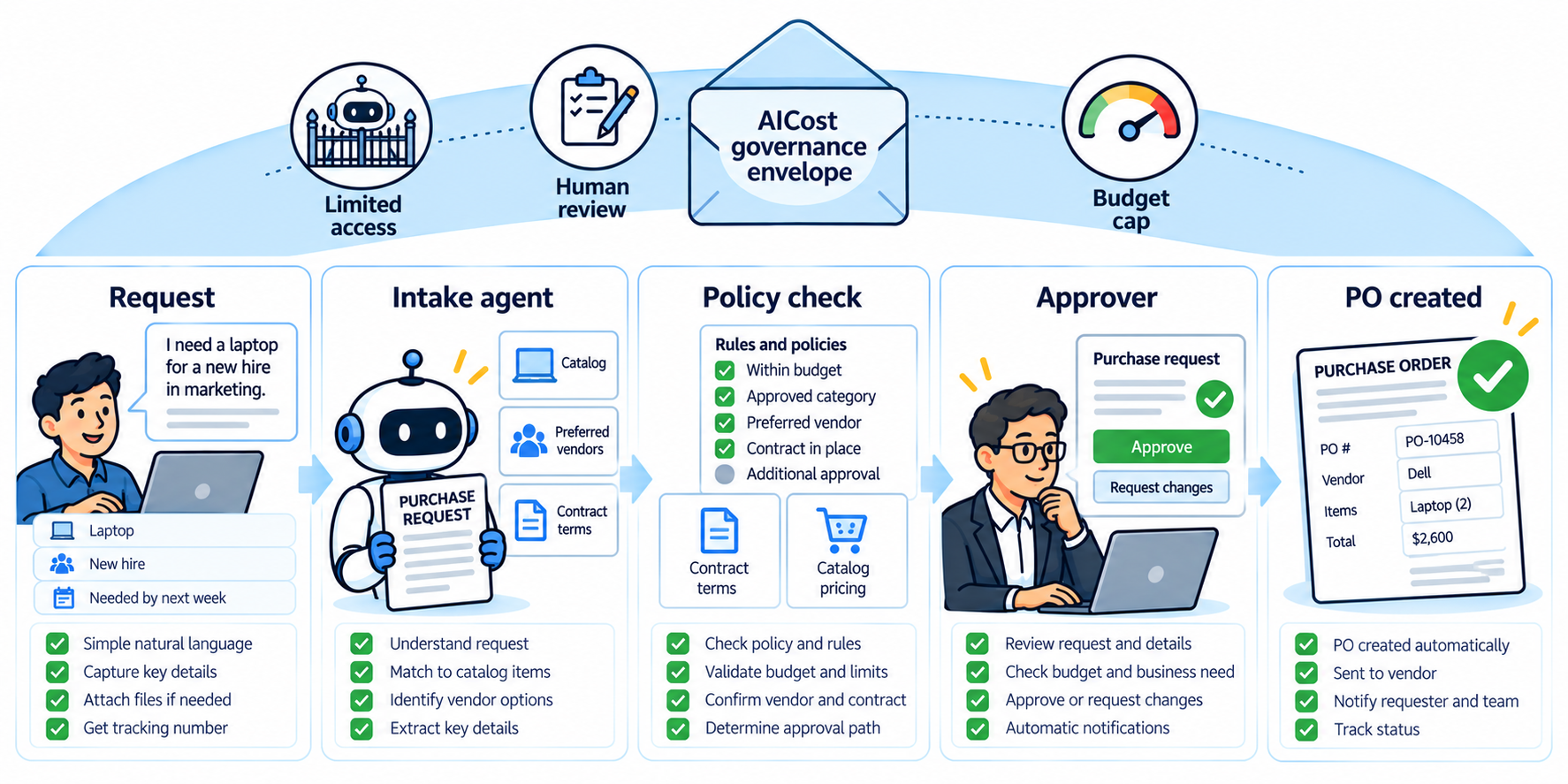
1 · cost
Intake agent per request
$1,490
$558
2 · cost
Contracts and catalogs
$123
3 · cost
P2P and ERP connections
$1,472
4 · gate
Spend authority limits
5 · governance
Approver decides
$1,563
$834
Without AICost
$4,647/mo
$1.86 per routed purchase request
With AICost
$2,986/mo
$1.19 per routed purchase request 36% lower
Monthly saving
$1,661/mo
5 cost levers applied
Governance controls
3
Monthly budget $800
Cost cutLoop cap → Intake agent per request −$628Prompt caching → Intake agent per request −$78Context compaction → Intake agent per request −$112Model routing → Intake agent per request −$114Better grounding → Approver decides −$729
Governance✓ Human review → Approver decides✓ Cost firewall at the gateway✓ Data-class model allowlist
Flow, picture, cost levers, governance and policy envelope
How the work flows today
1Employee describes what they want to buy
2Agent checks for existing contracts and preferred suppliers
3Agent checks the request against vendor documents and flags mismatches
4Agent routes to security, legal, finance and budget approvers
5PO raised in the ERP or P2P system
AICost engine chain (blue: cost, purple: governance)
Cost levers and the step they act on
Loop cap on step Intake agent per request −$62816 turns, 60k tokens, enforced by cost-firewall · Agent LoopA ceiling on turns and tokens per agent run, so a stuck agent cannot run up the bill.
How it works: Each agent run gets a maximum number of turns and tokens. A run that hits the ceiling stops and hands off instead of looping.
How AICost prices it: The Agent Loop engine prices the runs with and without the ceiling, including the runaway tail.
Governance: The cap is enforced by the cost firewall at your gateway, with an alert when it trips.
Prompt caching on step Intake agent per request −$7860% cacheable, 75% hit (applied to every eligible workflow) · Prompt CachingRepeated instructions and documents are cached, so you pay less for the same prompt text.
How it works: The stable part of each prompt (system instructions, tool definitions, reference text) is cached by the model provider and billed at the cached rate.
How AICost prices it: The Prompt Caching engine prices cacheable share and hit rate against the provider's cached-input price.
Governance: No change to answers, models or data. Only the billing of repeated text changes.
* Cacheable share and hit rate are typical values; your logs give the real ones.
Context compaction on step Intake agent per request −$112trim history 60%, net of overhead (applied to every eligible workflow) · Context TrimLong histories are trimmed each turn, so every call carries less text.
How it works: Older turns and long documents are summarized or trimmed before each call, keeping what the model needs.
How AICost prices it: The Context Trim engine prices the smaller context net of the cost of trimming.
Governance: Quality is checked before rollout; nothing reaches the model that it was not allowed to see.
* The trim size is an input; your evals confirm it keeps answer quality.
Model routing on step Intake agent per request −$11440% of calls (planning, tool calls and lookups) to Claude Haiku 5.5; critical work (actions that change records) stays on Claude Sonnet 5.5 (applied to every eligible workflow) · Model RouterRoutine steps run on a cheaper model; critical steps stay on the primary model.
How it works: Each workflow type has routine work (triage, lookups, extraction, summaries, drafts) and critical work (the final answer, code changes, clinical or legal output, decisions). Routine calls go to the economy model; critical work stays on the primary model.
How AICost prices it: The Model Router engine prices the split between the economy and primary model on the workflow's own volume.
Governance: Only approved models for the data class are used. For patient and privileged legal data the share is capped and calls stay with the primary model's vendor and route, so the BAA still covers every call.
* The share of routine calls per workflow type is a starting assumption; your traffic sets the real split.
Better grounding on step Approver decides −$729escalation 15% to 8% · Human ReviewAnswers come only from your approved sources, so fewer cases go to a person.
How it works: The assistant answers from your own approved content with the source attached, and says it does not know instead of guessing. Teams get there with cleaner knowledge-base articles, better retrieval (tighter chunks, reranking) and an answer check before the reply goes out.
How AICost prices it: Fewer low-confidence answers means fewer escalations. The Human Review engine prices reviewer minutes at the lower escalation rate; the saving is the difference.
Governance: Human review stays on for refunds, policy exceptions and anything still low-confidence. Only the share of cases that needed a person goes down.
* The demo assumes escalations fall by half (for example 12% to 6%). Your number comes from your own evaluation results.
Governance controls and the step they act on
Human review on step Approver decides $1,563
Low-confidence, high-value or regulated cases go to a person.
Cost firewall at the gateway policy only, no cost
Monthly budget, daily cap, per-run ceiling, turn cap, spike rule, kill switch.
Data-class model allowlist policy only, no cost
Only models cleared for this data class are routable; others are refused at the gateway.
Policy envelope
Monthly budget$800
Daily hard cap$35
Per-run ceiling$2.38
Turn cap16
See the policy your gateway enforces
{
  "workload_id": "purchase-request-intake-and-approval-routing-agent",
  "scope": "workload",
  "monthly_budget_usd": 800,
  "daily_warning_usd": 24.27,
  "daily_hard_limit_usd": 34.67,
  "max_cost_per_run_usd": 2.38,
  "max_model_calls_per_run": 16,
  "max_retries": 2,
  "max_output_tokens": 1200,
  "requests_per_min": 60,
  "anomaly": {
    "rolling_window": "7d",
    "spike_multiplier": 3,
    "rule": "flag any hour/day exceeding 3x the rolling average, or any single day above the daily hard limit"
  },
  "actions": {
    "warning_threshold": "notify",
    "soft_limit": "route_to:claude-haiku-5-5",
    "hard_limit": "block_noncritical_requests",
    "anomaly": "throttle_and_alert",
    "emergency": "block_all_and_require_approval"
  },
  "emergency_stop": {
    "enabled": true,
    "requires_approval_to_resume": true
  }
}
Where the cost runs away
- Multiple review agents run on every request regardless of size
- Vendor documents (SOC 2 reports, DPAs) re-read on each request
- Platform pricing by spend or request volume
Talk to us about this workflow →
🚚 Procurement · Business solutions
Autonomous supplier negotiation for tail spend
500 closed negotiation a month
Within limits set by procurement, an AI agent negotiates price and terms with suppliers on small, high-volume purchases.
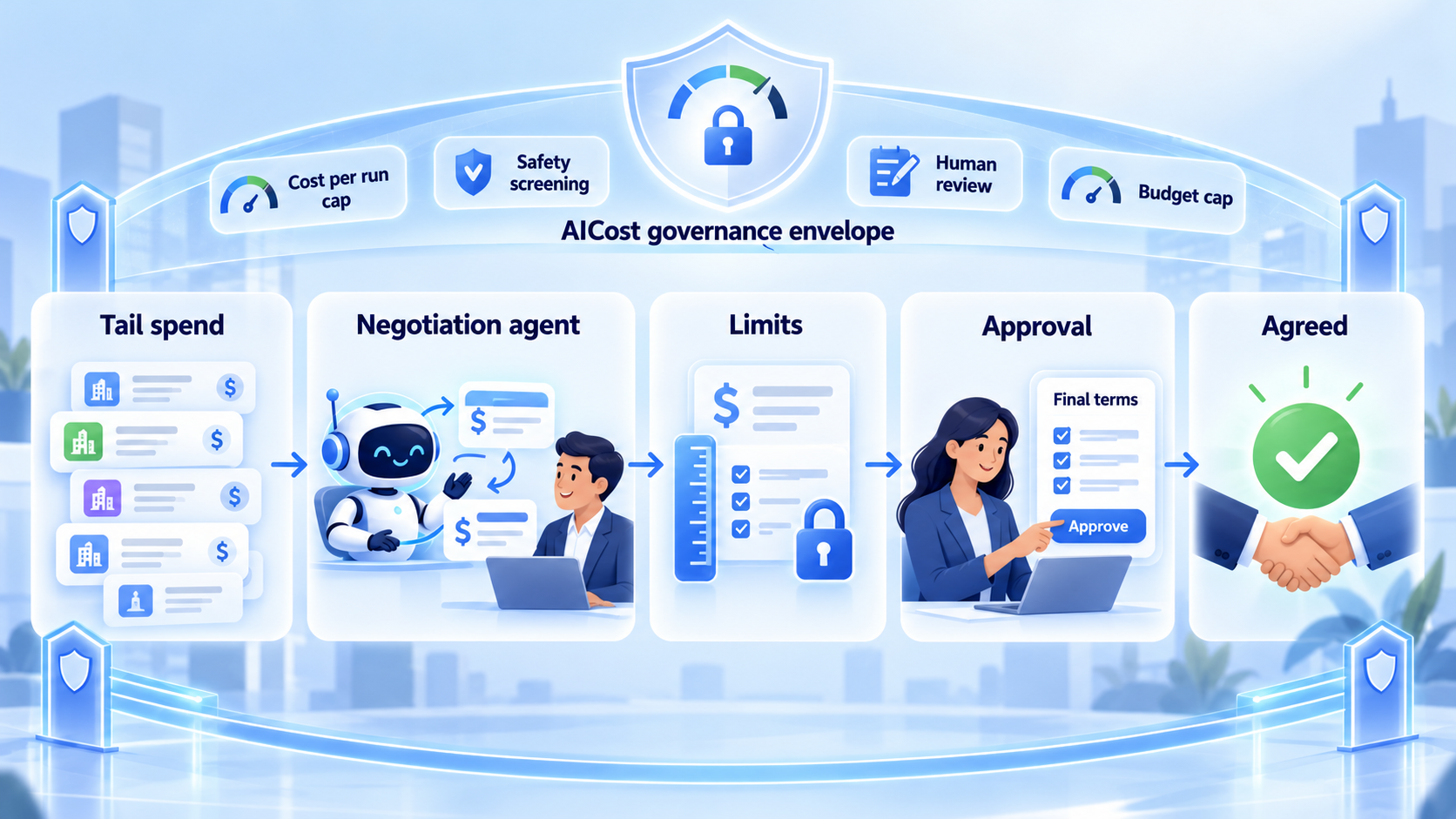
1 · cost
Rounds per negotiation
$443
$233
2 · gate
Max spend per negotiation
3 · governance
Price and term limits
$2
4 · governance
Approval above threshold
$417
$209
5 · gate
Savings vs AI cost
Without AICost
$861/mo
$1.72 per closed negotiation
With AICost
$443/mo
$0.89 per closed negotiation 49% lower
Monthly saving
$418/mo
5 cost levers applied
Governance controls
4
Monthly budget $300
Cost cutLoop cap → Rounds per negotiation −$119Prompt caching → Rounds per negotiation −$23Context compaction → Rounds per negotiation −$34Model routing → Rounds per negotiation −$34Better grounding → Approval above threshold −$208
Governance✓ Guardrail screening → Price and term limits✓ Human review → Approval above threshold✓ Cost firewall at the gateway✓ Data-class model allowlist
Flow, picture, cost levers, governance and policy envelope
How the work flows today
1Procurement sets targets and limits (price, payment terms, discounts)
2AI agent contacts suppliers, often for deals under $50k
3Agent negotiates within the limits
4Deals outside the limits go to a buyer
5Agreed terms recorded in the contract and ERP
AICost engine chain (blue: cost, purple: governance)
Cost levers and the step they act on
Loop cap on step Rounds per negotiation −$11924 turns, 60k tokens, enforced by cost-firewall · Agent LoopA ceiling on turns and tokens per agent run, so a stuck agent cannot run up the bill.
How it works: Each agent run gets a maximum number of turns and tokens. A run that hits the ceiling stops and hands off instead of looping.
How AICost prices it: The Agent Loop engine prices the runs with and without the ceiling, including the runaway tail.
Governance: The cap is enforced by the cost firewall at your gateway, with an alert when it trips.
Prompt caching on step Rounds per negotiation −$2360% cacheable, 75% hit (applied to every eligible workflow) · Prompt CachingRepeated instructions and documents are cached, so you pay less for the same prompt text.
How it works: The stable part of each prompt (system instructions, tool definitions, reference text) is cached by the model provider and billed at the cached rate.
How AICost prices it: The Prompt Caching engine prices cacheable share and hit rate against the provider's cached-input price.
Governance: No change to answers, models or data. Only the billing of repeated text changes.
* Cacheable share and hit rate are typical values; your logs give the real ones.
Context compaction on step Rounds per negotiation −$34trim history 60%, net of overhead (applied to every eligible workflow) · Context TrimLong histories are trimmed each turn, so every call carries less text.
How it works: Older turns and long documents are summarized or trimmed before each call, keeping what the model needs.
How AICost prices it: The Context Trim engine prices the smaller context net of the cost of trimming.
Governance: Quality is checked before rollout; nothing reaches the model that it was not allowed to see.
* The trim size is an input; your evals confirm it keeps answer quality.
Model routing on step Rounds per negotiation −$3440% of calls (planning, tool calls and lookups) to Claude Haiku 5.5; critical work (actions that change records) stays on Claude Sonnet 5.5 (applied to every eligible workflow) · Model RouterRoutine steps run on a cheaper model; critical steps stay on the primary model.
How it works: Each workflow type has routine work (triage, lookups, extraction, summaries, drafts) and critical work (the final answer, code changes, clinical or legal output, decisions). Routine calls go to the economy model; critical work stays on the primary model.
How AICost prices it: The Model Router engine prices the split between the economy and primary model on the workflow's own volume.
Governance: Only approved models for the data class are used. For patient and privileged legal data the share is capped and calls stay with the primary model's vendor and route, so the BAA still covers every call.
* The share of routine calls per workflow type is a starting assumption; your traffic sets the real split.
Better grounding on step Approval above threshold −$208escalation 20% to 10% · Human ReviewAnswers come only from your approved sources, so fewer cases go to a person.
How it works: The assistant answers from your own approved content with the source attached, and says it does not know instead of guessing. Teams get there with cleaner knowledge-base articles, better retrieval (tighter chunks, reranking) and an answer check before the reply goes out.
How AICost prices it: Fewer low-confidence answers means fewer escalations. The Human Review engine prices reviewer minutes at the lower escalation rate; the saving is the difference.
Governance: Human review stays on for refunds, policy exceptions and anything still low-confidence. Only the share of cases that needed a person goes down.
* The demo assumes escalations fall by half (for example 12% to 6%). Your number comes from your own evaluation results.
Governance controls and the step they act on
Guardrail screening on step Price and term limits $2
PII, prompt-attack and policy screening before the model acts.
Human review on step Approval above threshold $417
Low-confidence, high-value or regulated cases go to a person.
Cost firewall at the gateway policy only, no cost
Monthly budget, daily cap, per-run ceiling, turn cap, spike rule, kill switch.
Data-class model allowlist policy only, no cost
Only models cleared for this data class are routable; others are refused at the gateway.
Policy envelope
Monthly budget$300
Daily hard cap$13
Per-run ceiling$3.54
Turn cap24
See the policy your gateway enforces
{
  "workload_id": "autonomous-supplier-negotiation-for-tail-spend",
  "scope": "workload",
  "monthly_budget_usd": 300,
  "daily_warning_usd": 9.1,
  "daily_hard_limit_usd": 13,
  "max_cost_per_run_usd": 3.54,
  "max_model_calls_per_run": 24,
  "max_retries": 2,
  "max_output_tokens": 1200,
  "requests_per_min": 60,
  "anomaly": {
    "rolling_window": "7d",
    "spike_multiplier": 3,
    "rule": "flag any hour/day exceeding 3x the rolling average, or any single day above the daily hard limit"
  },
  "actions": {
    "warning_threshold": "notify",
    "soft_limit": "route_to:claude-haiku-5-5",
    "hard_limit": "block_noncritical_requests",
    "anomaly": "throttle_and_alert",
    "emergency": "block_all_and_require_approval"
  },
  "emergency_stop": {
    "enabled": true,
    "requires_approval_to_resume": true
  }
}
Where the cost runs away
- Long negotiation threads with many rounds per supplier
- Agent spend larger than savings on very small deals
- Success-fee or per-negotiation pricing
Talk to us about this workflow →
🚚 Procurement · Business solutions
Supplier risk and compliance review (security, privacy, tariffs)
300 supplier review a month
For new and renewing suppliers, AI gathers security, privacy and trade information and drafts a risk review for approval.
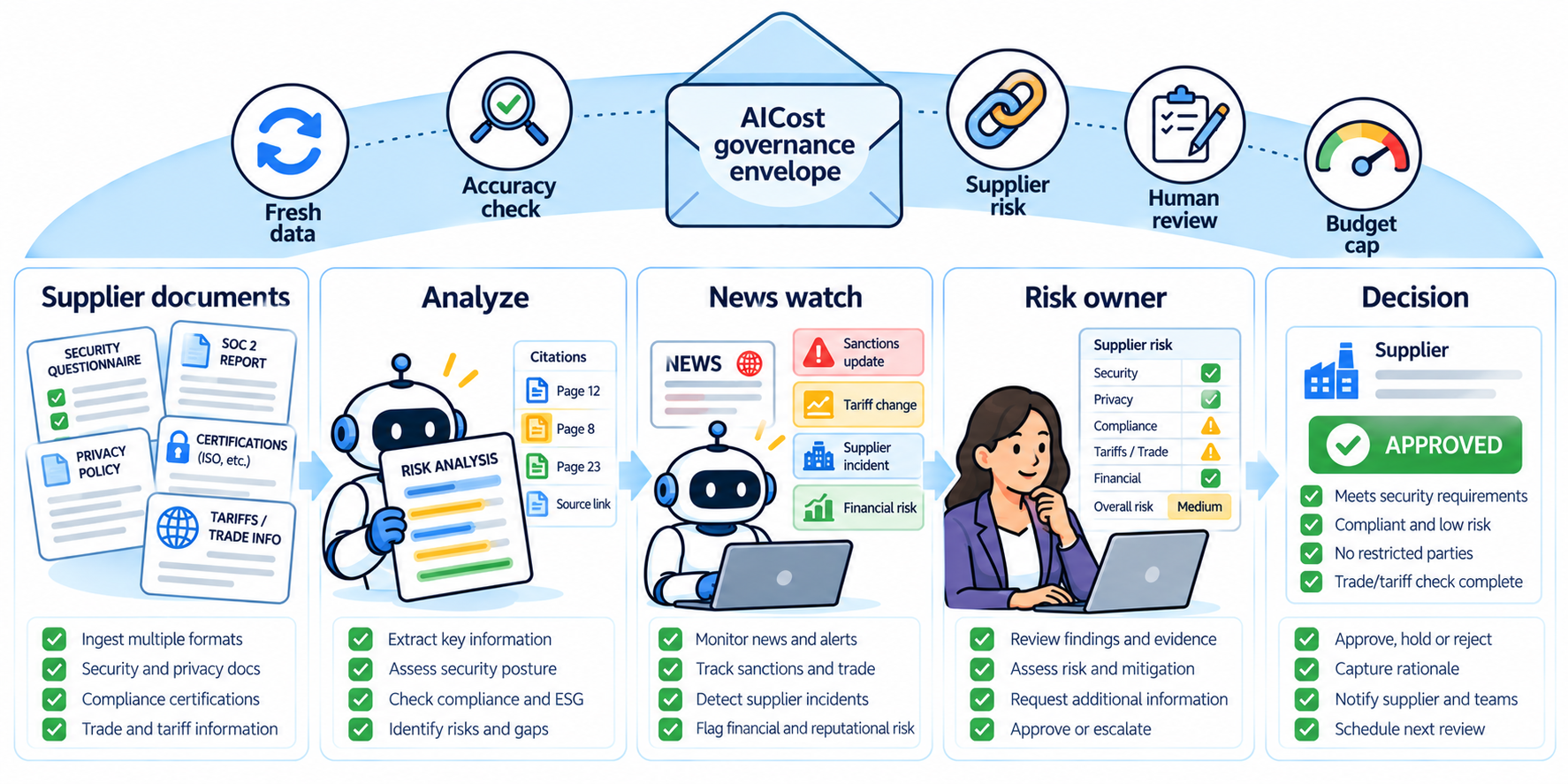
1 · cost
Read SOC 2 reports and questionnaires
$170
2 · cost
Risk findings with citations
$54
$40
3 · gate
Reuse the risk rubric
4 · gate
Review suppliers in batch
5 · cost
News and event monitoring
$1,705
6 · governance
Check every citation
$92
7 · gate
Dependence on one supplier
8 · governance
Risk owner decides
$9,000
$7,200
Without AICost
$11,022/mo
$36.74 per supplier review
With AICost
$9,208/mo
$30.69 per supplier review 16% lower
Monthly saving
$1,814/mo
4 cost levers applied
Governance controls
4
Monthly budget $200
Cost cutPrompt caching → Risk findings with citations −$3Model routing → Risk findings with citations −$7Batch the non-urgent work → Risk findings with citations −$4Shorter review with pre-checked drafts* → Risk owner decides −$1,800
Governance✓ Accuracy and hallucination checks → Check every citation✓ Human review → Risk owner decides✓ Cost firewall at the gateway✓ Data-class model allowlist
Flow, picture, cost levers, governance and policy envelope
How the work flows today
1New or renewing supplier triggers a review
2AI reads security questionnaires, SOC 2 reports and DPAs
3AI flags privacy, security and tariff exposure
4AI monitors news and events for supplier disruptions
5Risk team decides and records mitigations
AICost engine chain (blue: cost, purple: governance)
Cost levers and the step they act on
Prompt caching on step Risk findings with citations −$360% cacheable, 75% hit · Prompt CachingRepeated instructions and documents are cached, so you pay less for the same prompt text.
How it works: The stable part of each prompt (system instructions, tool definitions, reference text) is cached by the model provider and billed at the cached rate.
How AICost prices it: The Prompt Caching engine prices cacheable share and hit rate against the provider's cached-input price.
Governance: No change to answers, models or data. Only the billing of repeated text changes.
* Cacheable share and hit rate are typical values; your logs give the real ones.
Model routing on step Risk findings with citations −$760% of calls (extraction and field checks) to Claude Haiku 5.5; critical work (exceptions) stays on Claude Sonnet 5.5 (applied to every eligible workflow) · Model RouterRoutine steps run on a cheaper model; critical steps stay on the primary model.
How it works: Each workflow type has routine work (triage, lookups, extraction, summaries, drafts) and critical work (the final answer, code changes, clinical or legal output, decisions). Routine calls go to the economy model; critical work stays on the primary model.
How AICost prices it: The Model Router engine prices the split between the economy and primary model on the workflow's own volume.
Governance: Only approved models for the data class are used. For patient and privileged legal data the share is capped and calls stay with the primary model's vendor and route, so the BAA still covers every call.
* The share of routine calls per workflow type is a starting assumption; your traffic sets the real split.
Batch the non-urgent work on step Risk findings with citations −$460% of calls through the batch API · Batch or RealtimeWork that can wait runs in the provider's batch mode at a lower price.
How it works: Requests that do not need an instant answer are queued and sent through the batch API.
How AICost prices it: The Batch or Realtime engine prices the batch-tolerant share at batch rates.
Governance: Urgent and customer-facing requests stay realtime.
* The batch-tolerant share is an input.
Shorter review with pre-checked drafts* on step Risk owner decides −$1,800*assumption: 20% less edit time per supplier review when evals catch errors before the reviewer sees the draft; every supplier review is still reviewed · Human ReviewEvery item is still reviewed, but automated checks catch errors first, so review takes less time.
How it works: An evaluation step checks each draft before the reviewer sees it, so the reviewer edits less.
How AICost prices it: The Human Review engine prices reviewer time at the shorter review time.
Governance: Every item is still reviewed by a person.
* The time saved per review is an assumption, marked with an asterisk.
Governance controls and the step they act on
Accuracy and hallucination checks on step Check every citation $92
Golden-set and live-traffic scoring catch silent regressions.
Human review on step Risk owner decides $9,000
Low-confidence, high-value or regulated cases go to a person.
Cost firewall at the gateway policy only, no cost
Monthly budget, daily cap, per-run ceiling, turn cap, spike rule, kill switch.
Data-class model allowlist policy only, no cost
Only models cleared for this data class are routable; others are refused at the gateway.
Policy envelope
Monthly budget$200
Daily hard cap$9
Per-run ceiling$0.73
Turn cap6
See the policy your gateway enforces
{
  "workload_id": "supplier-risk-and-compliance-review-security-privacy-tariffs",
  "scope": "workload",
  "monthly_budget_usd": 200,
  "daily_warning_usd": 6.07,
  "daily_hard_limit_usd": 8.67,
  "max_cost_per_run_usd": 0.73,
  "max_model_calls_per_run": 6,
  "max_retries": 2,
  "max_output_tokens": 1200,
  "requests_per_min": 60,
  "anomaly": {
    "rolling_window": "7d",
    "spike_multiplier": 3,
    "rule": "flag any hour/day exceeding 3x the rolling average, or any single day above the daily hard limit"
  },
  "actions": {
    "warning_threshold": "notify",
    "soft_limit": "route_to:claude-haiku-5-5",
    "hard_limit": "block_noncritical_requests",
    "anomaly": "throttle_and_alert",
    "emergency": "block_all_and_require_approval"
  },
  "emergency_stop": {
    "enabled": true,
    "requires_approval_to_resume": true
  }
}
Where the cost runs away
- Continuous monitoring of every supplier, not only critical ones
- Large compliance documents re-processed at each renewal
- Overlapping risk-intel subscriptions
Talk to us about this workflow →
🛡️ Security operations · Business solutions
Alert triage and investigation agent (AI Tier-1 analyst)
30,000 investigated alert a month
An AI analyst investigates security alerts from the SIEM, EDR and cloud tools, gathers evidence and closes or escalates each one.
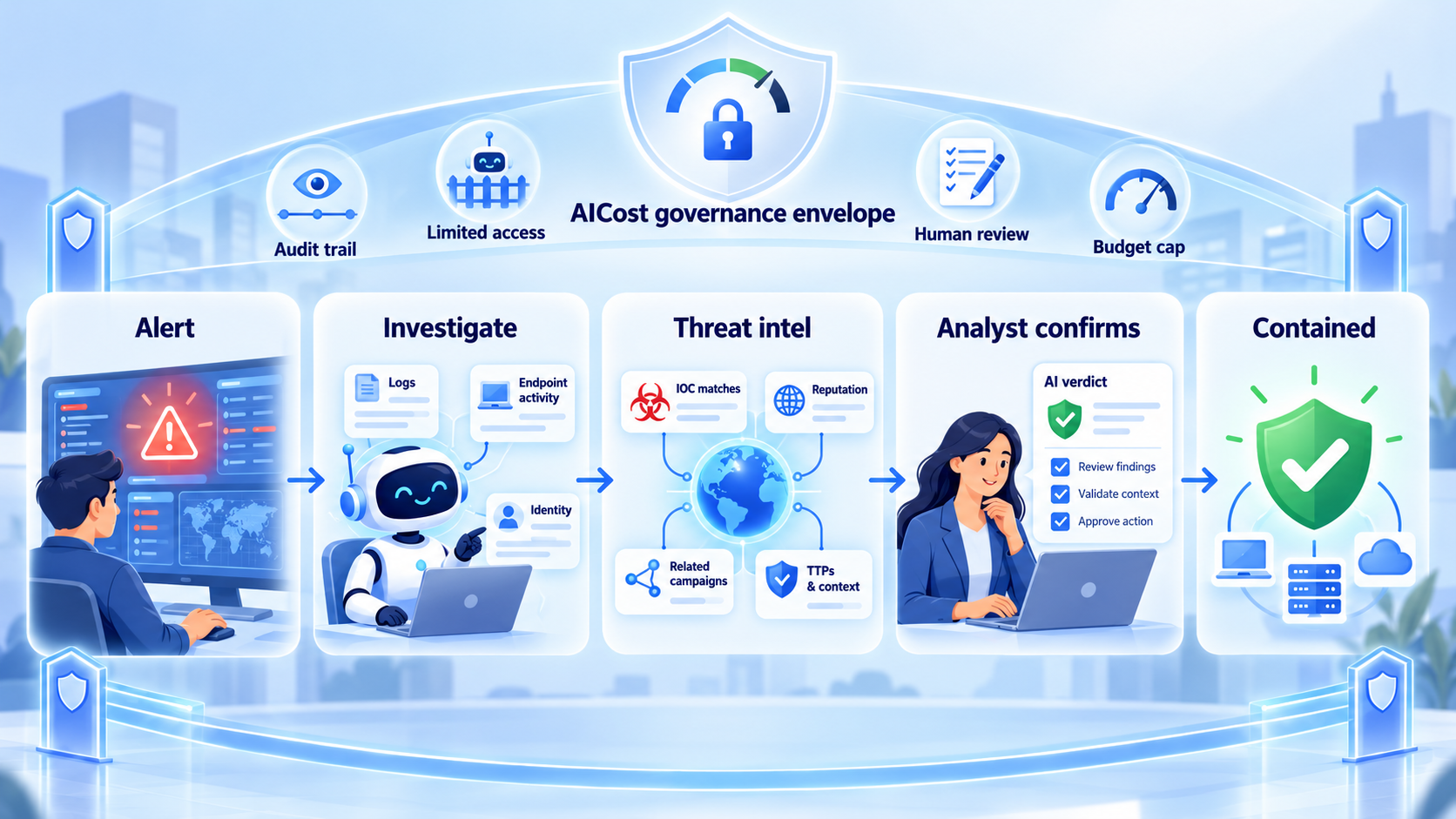
1 · cost
Investigation steps per alert
$35,804
$26,099
2 · gate
Small model for obvious benign alerts
3 · cost
Stop runaway investigations
$35,804
$28,630
4 · governance
Trace every action
$14
5 · gate
Limits on containment actions
6 · governance
Analyst confirms
$45,000
$22,500
7 · gate
Cost as alert volume grows
Without AICost
$116,622/mo
$3.89 per investigated alert
With AICost
$77,242/mo
$2.57 per investigated alert 34% lower
Monthly saving
$39,380/mo
6 cost levers applied
Governance controls
4
Monthly budget $60,300
Cost cutLoop cap → Stop runaway investigations −$7,174Prompt caching → Investigation steps per alert −$2,246Context compaction → Investigation steps per alert −$2,016Model routing → Investigation steps per alert −$3,283Batch the non-urgent work → Investigation steps per alert −$2,160Better grounding → Analyst confirms −$22,500
Governance✓ Tracing and audit log → Trace every action✓ Human review → Analyst confirms✓ Cost firewall at the gateway✓ Data-class model allowlist
Flow, picture, cost levers, governance and policy envelope
How the work flows today
1Alert arrives from SIEM, EDR or cloud tools
2Agent gathers context (user, host, threat intel, related alerts)
3Agent investigates and gives a verdict with evidence
4Benign alerts closed and real threats escalated
5Analyst confirms and starts the response
AICost engine chain (blue: cost, purple: governance)
Cost levers and the step they act on
Loop cap on step Stop runaway investigations −$7,17424 turns, 60k tokens, enforced by cost-firewall · Agent LoopA ceiling on turns and tokens per agent run, so a stuck agent cannot run up the bill.
How it works: Each agent run gets a maximum number of turns and tokens. A run that hits the ceiling stops and hands off instead of looping.
How AICost prices it: The Agent Loop engine prices the runs with and without the ceiling, including the runaway tail.
Governance: The cap is enforced by the cost firewall at your gateway, with an alert when it trips.
Prompt caching on step Investigation steps per alert −$2,24660% cacheable, 75% hit (applied to every eligible workflow) · Prompt CachingRepeated instructions and documents are cached, so you pay less for the same prompt text.
How it works: The stable part of each prompt (system instructions, tool definitions, reference text) is cached by the model provider and billed at the cached rate.
How AICost prices it: The Prompt Caching engine prices cacheable share and hit rate against the provider's cached-input price.
Governance: No change to answers, models or data. Only the billing of repeated text changes.
* Cacheable share and hit rate are typical values; your logs give the real ones.
Context compaction on step Investigation steps per alert −$2,016trim history 60%, net of overhead (applied to every eligible workflow) · Context TrimLong histories are trimmed each turn, so every call carries less text.
How it works: Older turns and long documents are summarized or trimmed before each call, keeping what the model needs.
How AICost prices it: The Context Trim engine prices the smaller context net of the cost of trimming.
Governance: Quality is checked before rollout; nothing reaches the model that it was not allowed to see.
* The trim size is an input; your evals confirm it keeps answer quality.
Model routing on step Investigation steps per alert −$3,28340% of calls (evidence gathering and summaries) to Claude Haiku 5.5; critical work (the decision and its rationale) stays on Claude Sonnet 5.5 · Model RouterRoutine steps run on a cheaper model; critical steps stay on the primary model.
How it works: Each workflow type has routine work (triage, lookups, extraction, summaries, drafts) and critical work (the final answer, code changes, clinical or legal output, decisions). Routine calls go to the economy model; critical work stays on the primary model.
How AICost prices it: The Model Router engine prices the split between the economy and primary model on the workflow's own volume.
Governance: Only approved models for the data class are used. For patient and privileged legal data the share is capped and calls stay with the primary model's vendor and route, so the BAA still covers every call.
* The share of routine calls per workflow type is a starting assumption; your traffic sets the real split.
Batch the non-urgent work on step Investigation steps per alert −$2,16050% of calls through the batch API (applied to every eligible workflow) · Batch or RealtimeWork that can wait runs in the provider's batch mode at a lower price.
How it works: Requests that do not need an instant answer are queued and sent through the batch API.
How AICost prices it: The Batch or Realtime engine prices the batch-tolerant share at batch rates.
Governance: Urgent and customer-facing requests stay realtime.
* The batch-tolerant share is an input.
Better grounding on step Analyst confirms −$22,500escalation 20% to 10% · Human ReviewAnswers come only from your approved sources, so fewer cases go to a person.
How it works: The assistant answers from your own approved content with the source attached, and says it does not know instead of guessing. Teams get there with cleaner knowledge-base articles, better retrieval (tighter chunks, reranking) and an answer check before the reply goes out.
How AICost prices it: Fewer low-confidence answers means fewer escalations. The Human Review engine prices reviewer minutes at the lower escalation rate; the saving is the difference.
Governance: Human review stays on for refunds, policy exceptions and anything still low-confidence. Only the share of cases that needed a person goes down.
* The demo assumes escalations fall by half (for example 12% to 6%). Your number comes from your own evaluation results.
Governance controls and the step they act on
Tracing and audit log on step Trace every action $14
Every call logged with principal, model, tokens and spend state.
Human review on step Analyst confirms $45,000
Low-confidence, high-value or regulated cases go to a person.
Cost firewall at the gateway policy only, no cost
Monthly budget, daily cap, per-run ceiling, turn cap, spike rule, kill switch.
Data-class model allowlist policy only, no cost
Only models cleared for this data class are routable; others are refused at the gateway.
Policy envelope
Monthly budget$60,300
Daily hard cap$2,613
Per-run ceiling$4.77
Turn cap24
See the policy your gateway enforces
{
  "workload_id": "alert-triage-and-investigation-agent-ai-tier-1-analyst",
  "scope": "workload",
  "monthly_budget_usd": 60300,
  "daily_warning_usd": 1829.1,
  "daily_hard_limit_usd": 2613,
  "max_cost_per_run_usd": 4.77,
  "max_model_calls_per_run": 24,
  "max_retries": 2,
  "max_output_tokens": 1200,
  "requests_per_min": 280,
  "anomaly": {
    "rolling_window": "7d",
    "spike_multiplier": 3,
    "rule": "flag any hour/day exceeding 3x the rolling average, or any single day above the daily hard limit"
  },
  "actions": {
    "warning_threshold": "notify",
    "soft_limit": "route_to:claude-haiku-5-5",
    "hard_limit": "block_noncritical_requests",
    "anomaly": "throttle_and_alert",
    "emergency": "block_all_and_require_approval"
  },
  "emergency_stop": {
    "enabled": true,
    "requires_approval_to_resume": true
  }
}
Where the cost runs away
- Full investigation run on every alert during alert storms
- Large log queries pulled into the model context
- Per-alert or per-investigation pricing
Talk to us about this workflow →
🛡️ Security operations · Business solutions
User-reported phishing triage
3,000 triaged phishing report a month
AI analyzes emails that employees report as suspicious, decides whether they are malicious and removes bad ones from every inbox.
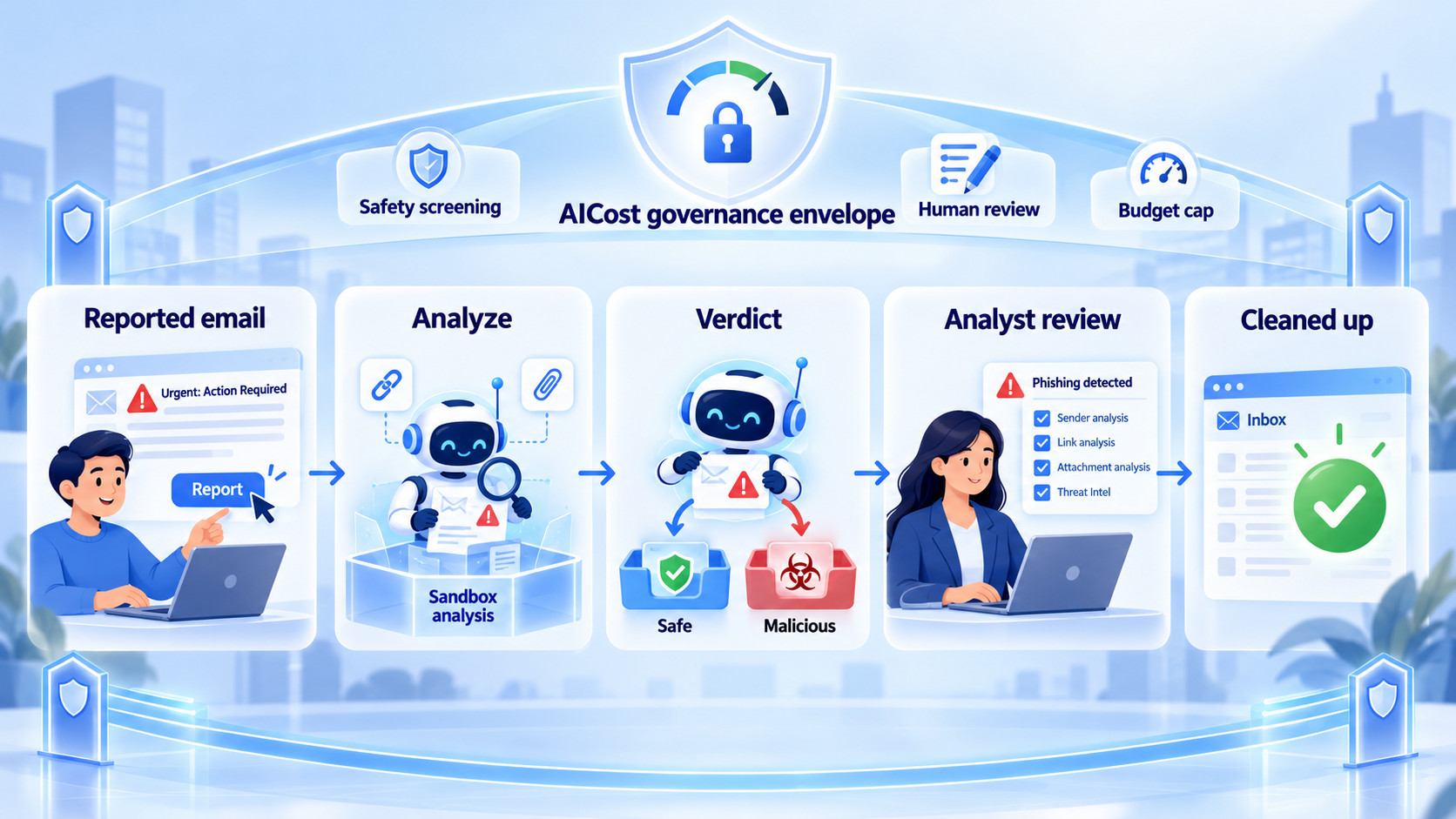
1 · cost
Analysis cost per reported email
$68
$21
2 · gate
Cache the phishing playbook
3 · cost
Screenshots and attachments
$15
4 · governance
Safe handling of malicious content
$3
5 · governance
Analyst reviews malicious cases
$3,750
$1,950
6 · gate
Cost per email vs analyst time
Without AICost
$3,835/mo
$1.28 per triaged phishing report
With AICost
$1,988/mo
$0.66 per triaged phishing report 48% lower
Monthly saving
$1,847/mo
3 cost levers applied
Governance controls
4
Monthly budget $100
Cost cutPrompt caching → Analysis cost per reported email −$13Model routing → Analysis cost per reported email −$34Better grounding → Analyst reviews malicious cases −$1,800
Governance✓ Guardrail screening → Safe handling of malicious content✓ Human review → Analyst reviews malicious cases✓ Cost firewall at the gateway✓ Data-class model allowlist
Flow, picture, cost levers, governance and policy envelope
How the work flows today
1Employee reports a suspicious email
2Agent analyzes headers, links and attachments
3Agent gives a verdict with an explanation
4Benign emails resolved automatically
5Malicious emails purged from all mailboxes and escalated
AICost engine chain (blue: cost, purple: governance)
Cost levers and the step they act on
Prompt caching on step Analysis cost per reported email −$1360% cacheable, 75% hit (combined with the other knobs on this step) · Prompt CachingRepeated instructions and documents are cached, so you pay less for the same prompt text.
How it works: The stable part of each prompt (system instructions, tool definitions, reference text) is cached by the model provider and billed at the cached rate.
How AICost prices it: The Prompt Caching engine prices cacheable share and hit rate against the provider's cached-input price.
Governance: No change to answers, models or data. Only the billing of repeated text changes.
* Cacheable share and hit rate are typical values; your logs give the real ones.
Model routing on step Analysis cost per reported email −$3470% of calls (classification and routing) to Claude Haiku 5.5; critical work (edge cases) stays on Claude Sonnet 5.5 (applied to every eligible workflow) (combined with the other knobs on this step) · Model RouterRoutine steps run on a cheaper model; critical steps stay on the primary model.
How it works: Each workflow type has routine work (triage, lookups, extraction, summaries, drafts) and critical work (the final answer, code changes, clinical or legal output, decisions). Routine calls go to the economy model; critical work stays on the primary model.
How AICost prices it: The Model Router engine prices the split between the economy and primary model on the workflow's own volume.
Governance: Only approved models for the data class are used. For patient and privileged legal data the share is capped and calls stay with the primary model's vendor and route, so the BAA still covers every call.
* The share of routine calls per workflow type is a starting assumption; your traffic sets the real split.
Better grounding on step Analyst reviews malicious cases −$1,800escalation 25% to 13% · Human ReviewAnswers come only from your approved sources, so fewer cases go to a person.
How it works: The assistant answers from your own approved content with the source attached, and says it does not know instead of guessing. Teams get there with cleaner knowledge-base articles, better retrieval (tighter chunks, reranking) and an answer check before the reply goes out.
How AICost prices it: Fewer low-confidence answers means fewer escalations. The Human Review engine prices reviewer minutes at the lower escalation rate; the saving is the difference.
Governance: Human review stays on for refunds, policy exceptions and anything still low-confidence. Only the share of cases that needed a person goes down.
* The demo assumes escalations fall by half (for example 12% to 6%). Your number comes from your own evaluation results.
Governance controls and the step they act on
Guardrail screening on step Safe handling of malicious content $3
PII, prompt-attack and policy screening before the model acts.
Human review on step Analyst reviews malicious cases $3,750
Low-confidence, high-value or regulated cases go to a person.
Cost firewall at the gateway policy only, no cost
Monthly budget, daily cap, per-run ceiling, turn cap, spike rule, kill switch.
Data-class model allowlist policy only, no cost
Only models cleared for this data class are routable; others are refused at the gateway.
Policy envelope
Monthly budget$100
Daily hard cap$4
Per-run ceiling$0.09
Turn cap6
See the policy your gateway enforces
{
  "workload_id": "user-reported-phishing-triage",
  "scope": "workload",
  "monthly_budget_usd": 100,
  "daily_warning_usd": 3.03,
  "daily_hard_limit_usd": 4.33,
  "max_cost_per_run_usd": 0.09,
  "max_model_calls_per_run": 6,
  "max_retries": 2,
  "max_output_tokens": 1200,
  "requests_per_min": 60,
  "anomaly": {
    "rolling_window": "7d",
    "spike_multiplier": 3,
    "rule": "flag any hour/day exceeding 3x the rolling average, or any single day above the daily hard limit"
  },
  "actions": {
    "warning_threshold": "notify",
    "soft_limit": "route_to:claude-haiku-5-5",
    "hard_limit": "block_noncritical_requests",
    "anomaly": "throttle_and_alert",
    "emergency": "block_all_and_require_approval"
  },
  "emergency_stop": {
    "enabled": true,
    "requires_approval_to_resume": true
  }
}
Where the cost runs away
- Every reported email analyzed, including obvious newsletters
- Repeat analysis of the same campaign
- Security Copilot compute-unit consumption
Talk to us about this workflow →
🛡️ Security operations · Business solutions
Detection tuning and threat hunting assistant
Analysts ask questions in plain language, and AI writes the queries, hunts across the data and suggests detection rule changes.
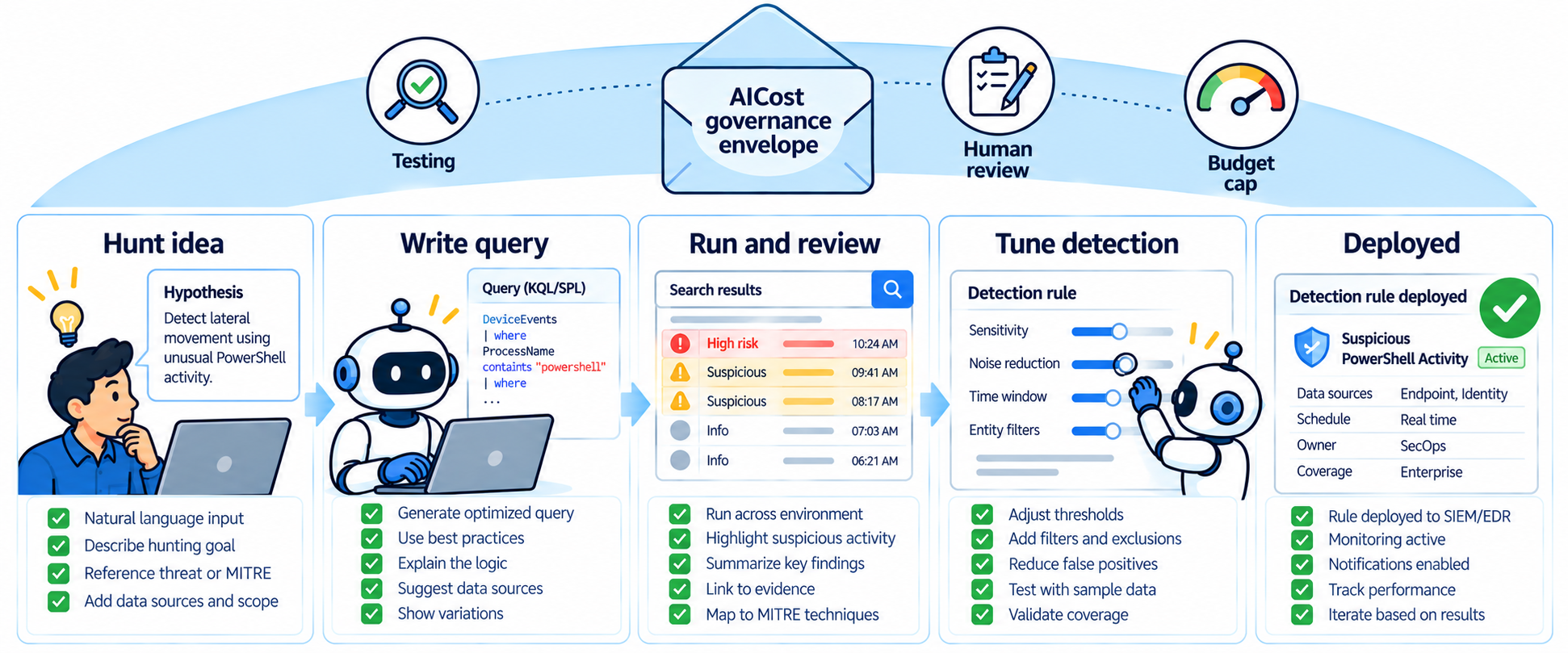
1 · cost
Query writing
$13
$4
2 · gate
Cache detection schemas
3 · cost
Summaries per hunt
$48
4 · governance
Test detections before rollout
$769
5 · governance
Engineer approves changes
$7,333
$5,866
Without AICost
$8,163/mo
$40.82 per threat hunt
With AICost
$6,688/mo
$33.44 per threat hunt 18% lower
Monthly saving
$1,475/mo
5 cost levers applied
Governance controls
4
Monthly budget $1,000
Cost cutPrompt caching → Query writing −$2Context compaction → Query writing −$2Model routing → Query writing −$3Batch the non-urgent work → Query writing −$2Shorter review with pre-checked drafts* → Engineer approves changes −$1,467
Governance✓ Accuracy and hallucination checks → Test detections before rollout✓ Human review → Engineer approves changes✓ Cost firewall at the gateway✓ Data-class model allowlist
Flow, picture, cost levers, governance and policy envelope
How the work flows today
1Analyst asks a question in plain language
2AI writes the hunt query (KQL, SPL)
3AI runs it and summarizes findings
4AI suggests rule changes to cut false positives
5Engineer reviews and deploys the rule
AICost engine chain (blue: cost, purple: governance)
Cost levers and the step they act on
Prompt caching on step Query writing −$260% cacheable, 75% hit (combined with the other knobs on this step) · Prompt CachingRepeated instructions and documents are cached, so you pay less for the same prompt text.
How it works: The stable part of each prompt (system instructions, tool definitions, reference text) is cached by the model provider and billed at the cached rate.
How AICost prices it: The Prompt Caching engine prices cacheable share and hit rate against the provider's cached-input price.
Governance: No change to answers, models or data. Only the billing of repeated text changes.
* Cacheable share and hit rate are typical values; your logs give the real ones.
Context compaction on step Query writing −$2trim history 60%, net of overhead (applied to every eligible workflow) (combined with the other knobs on this step) · Context TrimLong histories are trimmed each turn, so every call carries less text.
How it works: Older turns and long documents are summarized or trimmed before each call, keeping what the model needs.
How AICost prices it: The Context Trim engine prices the smaller context net of the cost of trimming.
Governance: Quality is checked before rollout; nothing reaches the model that it was not allowed to see.
* The trim size is an input; your evals confirm it keeps answer quality.
Model routing on step Query writing −$340% of calls (evidence gathering and summaries) to Claude Haiku 5.5; critical work (the decision and its rationale) stays on Claude Sonnet 5.5 (applied to every eligible workflow) (combined with the other knobs on this step) · Model RouterRoutine steps run on a cheaper model; critical steps stay on the primary model.
How it works: Each workflow type has routine work (triage, lookups, extraction, summaries, drafts) and critical work (the final answer, code changes, clinical or legal output, decisions). Routine calls go to the economy model; critical work stays on the primary model.
How AICost prices it: The Model Router engine prices the split between the economy and primary model on the workflow's own volume.
Governance: Only approved models for the data class are used. For patient and privileged legal data the share is capped and calls stay with the primary model's vendor and route, so the BAA still covers every call.
* The share of routine calls per workflow type is a starting assumption; your traffic sets the real split.
Batch the non-urgent work on step Query writing −$250% of calls through the batch API (applied to every eligible workflow) (combined with the other knobs on this step) · Batch or RealtimeWork that can wait runs in the provider's batch mode at a lower price.
How it works: Requests that do not need an instant answer are queued and sent through the batch API.
How AICost prices it: The Batch or Realtime engine prices the batch-tolerant share at batch rates.
Governance: Urgent and customer-facing requests stay realtime.
* The batch-tolerant share is an input.
Shorter review with pre-checked drafts* on step Engineer approves changes −$1,467*assumption: 20% less edit time per threat hunt when evals catch errors before the reviewer sees the draft; every threat hunt is still reviewed · Human ReviewEvery item is still reviewed, but automated checks catch errors first, so review takes less time.
How it works: An evaluation step checks each draft before the reviewer sees it, so the reviewer edits less.
How AICost prices it: The Human Review engine prices reviewer time at the shorter review time.
Governance: Every item is still reviewed by a person.
* The time saved per review is an assumption, marked with an asterisk.
Governance controls and the step they act on
Accuracy and hallucination checks on step Test detections before rollout $769
Golden-set and live-traffic scoring catch silent regressions.
Human review on step Engineer approves changes $7,333
Low-confidence, high-value or regulated cases go to a person.
Cost firewall at the gateway policy only, no cost
Monthly budget, daily cap, per-run ceiling, turn cap, spike rule, kill switch.
Data-class model allowlist policy only, no cost
Only models cleared for this data class are routable; others are refused at the gateway.
Policy envelope
Monthly budget$1,000
Daily hard cap$43
Per-run ceiling$0.26
Turn cap20
See the policy your gateway enforces
{
  "workload_id": "detection-tuning-and-threat-hunting-assistant",
  "scope": "workload",
  "monthly_budget_usd": 1000,
  "daily_warning_usd": 30.33,
  "daily_hard_limit_usd": 43.33,
  "max_cost_per_run_usd": 0.26,
  "max_model_calls_per_run": 20,
  "max_retries": 2,
  "max_output_tokens": 1200,
  "requests_per_min": 60,
  "anomaly": {
    "rolling_window": "7d",
    "spike_multiplier": 3,
    "rule": "flag any hour/day exceeding 3x the rolling average, or any single day above the daily hard limit"
  },
  "actions": {
    "warning_threshold": "notify",
    "soft_limit": "route_to:claude-haiku-5-5",
    "hard_limit": "block_noncritical_requests",
    "anomaly": "throttle_and_alert",
    "emergency": "block_all_and_require_approval"
  },
  "emergency_stop": {
    "enabled": true,
    "requires_approval_to_resume": true
  }
}
Where the cost runs away
- Broad queries over large data volumes (SIEM ingest and query costs plus model costs)
- Iterative query rewriting loops
- Capacity units bought ahead of use
Talk to us about this workflow →
🧪 Pharma and biotech · Industry solutions
Pharmacovigilance case intake and ICSR processing
5,000 processed safety case a month
AI takes in adverse event reports from email, calls and literature, extracts the case data and drafts the safety report for review.
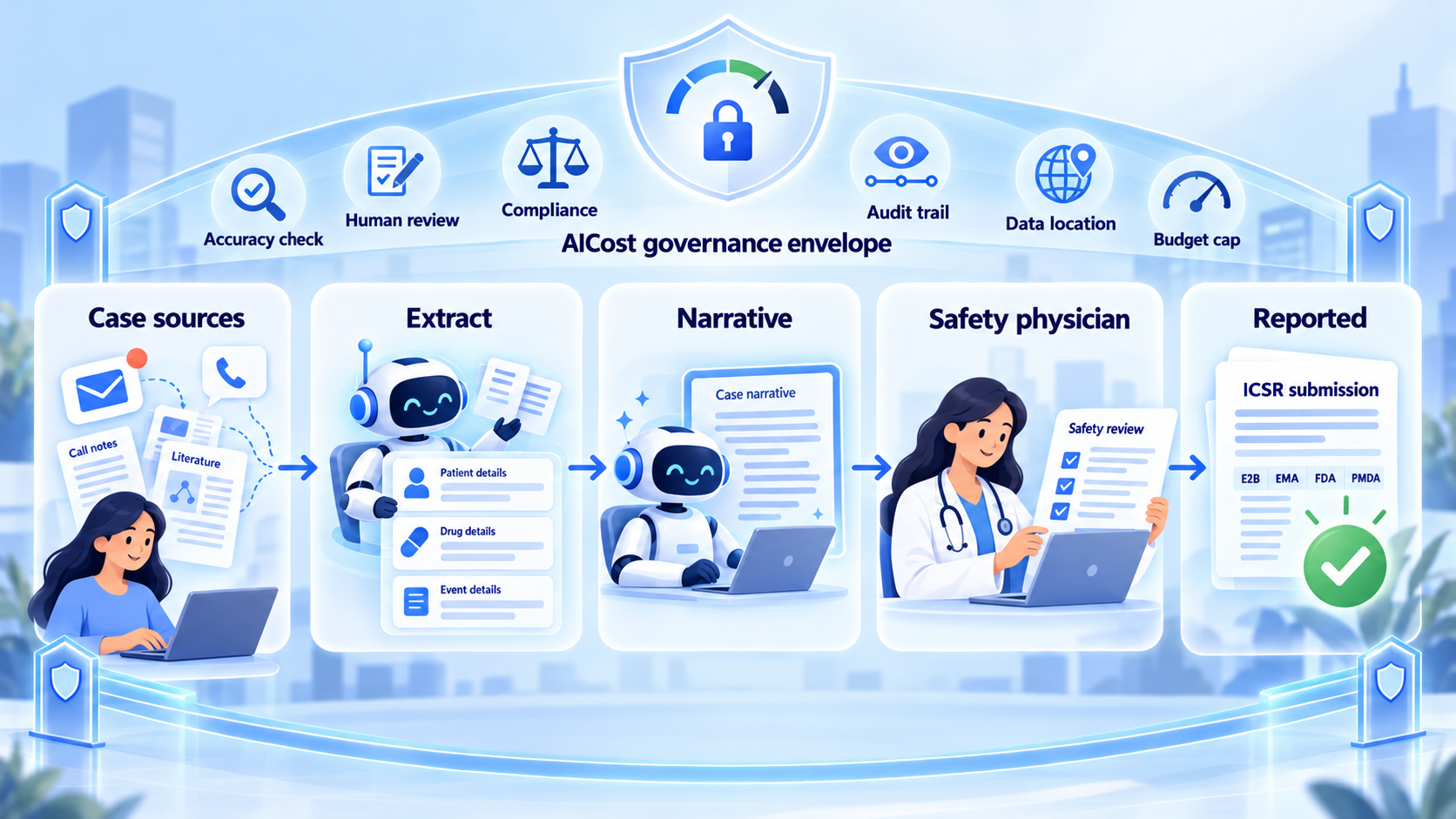
1 · cost
Read case sources (email, PDFs, literature)
$568
2 · cost
Extraction and narrative per case
$210
$63
3 · gate
Small model for non-serious cases
4 · gate
Cache the coding dictionary guide
5 · gate
Case volume growth
6 · governance
Missed adverse events
$93
7 · governance
Safety physician review
$75,000
$60,000
8 · governance
GxP validation and Part 11 records
$3,654
9 · governance
Audit trail
$1
10 · gate
Where patient data is processed
Without AICost
$79,525/mo
$15.91 per processed safety case
With AICost
$64,378/mo
$12.88 per processed safety case 19% lower
Monthly saving
$15,147/mo
4 cost levers applied
Governance controls
6
Monthly budget $200
Cost cutPrompt caching → Extraction and narrative per case −$46Model routing → Extraction and narrative per case −$39Batch the non-urgent work → Extraction and narrative per case −$62Shorter review with pre-checked drafts* → Safety physician review −$15,000
Governance✓ Accuracy and hallucination checks → Missed adverse events✓ Human review → Safety physician review✓ Compliance evidence → GxP validation and Part 11 records✓ Tracing and audit log → Audit trail✓ Cost firewall at the gateway✓ Data-class model allowlist
Flow, picture, cost levers, governance and policy envelope
How the work flows today
1Intake of adverse event reports from email, call-center transcripts, literature, social media, partner feeds and E2B
2Triage: validity check (4 minimum criteria), duplicate check, seriousness and expectedness
3Data entry and MedDRA/WHODrug coding into the safety database
4Case narrative drafting and causality assessment
5Medical review and QC by a safety physician
6Expedited submission (E2B R3) to regulators within 7/15-day clocks
AICost engine chain (blue: cost, purple: governance)
Cost levers and the step they act on
Prompt caching on step Extraction and narrative per case −$4660% cacheable, 75% hit (combined with the other knobs on this step) · Prompt CachingRepeated instructions and documents are cached, so you pay less for the same prompt text.
How it works: The stable part of each prompt (system instructions, tool definitions, reference text) is cached by the model provider and billed at the cached rate.
How AICost prices it: The Prompt Caching engine prices cacheable share and hit rate against the provider's cached-input price.
Governance: No change to answers, models or data. Only the billing of repeated text changes.
* Cacheable share and hit rate are typical values; your logs give the real ones.
Model routing on step Extraction and narrative per case −$3920% of calls (extraction and field checks) to Claude Haiku 5.5; critical work (exceptions) stays on Claude Sonnet 5.5; patient data: routine steps only, same vendor and route as the primary model (combined with the other knobs on this step) · Model RouterRoutine steps run on a cheaper model; critical steps stay on the primary model.
How it works: Each workflow type has routine work (triage, lookups, extraction, summaries, drafts) and critical work (the final answer, code changes, clinical or legal output, decisions). Routine calls go to the economy model; critical work stays on the primary model.
How AICost prices it: The Model Router engine prices the split between the economy and primary model on the workflow's own volume.
Governance: Only approved models for the data class are used. For patient and privileged legal data the share is capped and calls stay with the primary model's vendor and route, so the BAA still covers every call.
* The share of routine calls per workflow type is a starting assumption; your traffic sets the real split.
Batch the non-urgent work on step Extraction and narrative per case −$6260% of calls through the batch API (applied to every eligible workflow) (combined with the other knobs on this step) · Batch or RealtimeWork that can wait runs in the provider's batch mode at a lower price.
How it works: Requests that do not need an instant answer are queued and sent through the batch API.
How AICost prices it: The Batch or Realtime engine prices the batch-tolerant share at batch rates.
Governance: Urgent and customer-facing requests stay realtime.
* The batch-tolerant share is an input.
Shorter review with pre-checked drafts* on step Safety physician review −$15,000*assumption: 20% less edit time per processed safety case when evals catch errors before the reviewer sees the draft; every processed safety case is still reviewed · Human ReviewEvery item is still reviewed, but automated checks catch errors first, so review takes less time.
How it works: An evaluation step checks each draft before the reviewer sees it, so the reviewer edits less.
How AICost prices it: The Human Review engine prices reviewer time at the shorter review time.
Governance: Every item is still reviewed by a person.
* The time saved per review is an assumption, marked with an asterisk.
Governance controls and the step they act on
Accuracy and hallucination checks on step Missed adverse events $93
Golden-set and live-traffic scoring catch silent regressions.
Human review on step Safety physician review $75,000
Low-confidence, high-value or regulated cases go to a person.
Compliance evidence on step GxP validation and Part 11 records $3,654
Audit logs, retention and assessments for the rules that apply.
Tracing and audit log on step Audit trail $1
Every call logged with principal, model, tokens and spend state.
Cost firewall at the gateway policy only, no cost
Monthly budget, daily cap, per-run ceiling, turn cap, spike rule, kill switch.
Data-class model allowlist policy only, no cost
Only models cleared for this data class are routable; others are refused at the gateway.
Policy envelope
Monthly budget$200
Daily hard cap$9
Per-run ceiling$0.17
Turn cap6
See the policy your gateway enforces
{
  "workload_id": "pharmacovigilance-case-intake-and-icsr-processing",
  "scope": "workload",
  "monthly_budget_usd": 200,
  "daily_warning_usd": 6.07,
  "daily_hard_limit_usd": 8.67,
  "max_cost_per_run_usd": 0.17,
  "max_model_calls_per_run": 6,
  "max_retries": 2,
  "max_output_tokens": 1200,
  "requests_per_min": 60,
  "anomaly": {
    "rolling_window": "7d",
    "spike_multiplier": 3,
    "rule": "flag any hour/day exceeding 3x the rolling average, or any single day above the daily hard limit"
  },
  "actions": {
    "warning_threshold": "notify",
    "soft_limit": "route_to:claude-haiku-5-5",
    "hard_limit": "block_noncritical_requests",
    "anomaly": "throttle_and_alert",
    "emergency": "block_all_and_require_approval"
  },
  "emergency_stop": {
    "enabled": true,
    "requires_approval_to_resume": true
  }
}
Where the cost runs away
- Long multi-page source documents (literature, medical records) pushed through large-context models for every case, including duplicates
- Re-running extraction and narrative generation on every follow-up report instead of only processing the changes
- Validation and revalidation effort (GxP) after each model or prompt change
Talk to us about this workflow →
🧪 Pharma and biotech · Industry solutions
Clinical study report (CSR) and regulatory document drafting
20 study report section a month
From the protocol, analysis plan and final tables, AI drafts clinical study reports and regulatory documents for medical writers to finish.
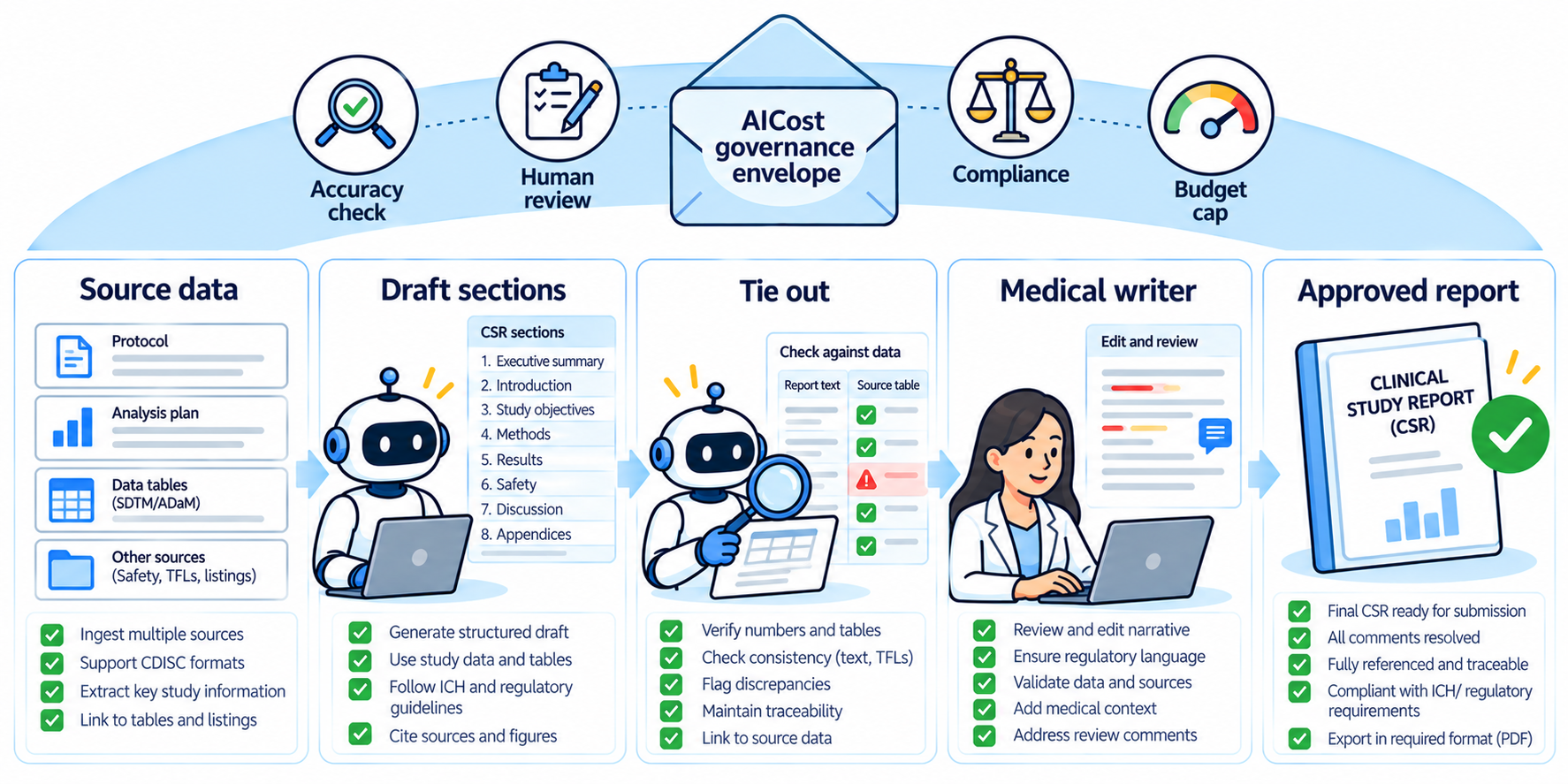
1 · cost
Load protocol, SAP and output tables
$63
2 · cost
Long documents in context
$10
$3
3 · gate
Cache protocol and analysis plan
4 · gate
Draft sections in batch
5 · cost
Draft from source documents
$46
6 · cost
Interpretation sections
$3
7 · governance
Numbers tie out to the tables
$92
8 · governance
Medical writer review
$12,800
$10,240
9 · governance
Regulated-record controls
$3,654
Without AICost
$16,667/mo
$833.33 per study report section
With AICost
$14,100/mo
$704.99 per study report section 15% lower
Monthly saving
$2,567/mo
5 cost levers applied
Governance controls
5
Monthly budget $200
Cost cutPrompt caching → Long documents in context −$2Context compaction → Long documents in context −$2Model routing → Long documents in context −$1Batch the non-urgent work → Long documents in context −$2Shorter review with pre-checked drafts* → Medical writer review −$2,560
Governance✓ Accuracy and hallucination checks → Numbers tie out to the tables✓ Human review → Medical writer review✓ Compliance evidence → Regulated-record controls✓ Cost firewall at the gateway✓ Data-class model allowlist
Flow, picture, cost levers, governance and policy envelope
How the work flows today
1Ingest the protocol, SAP and final TLFs (tables, listings, figures)
2Generate a first-draft CSR from the TransCelerate template (synopsis, results sections, patient narratives)
3Check source-to-text consistency against TLF numbers
4Medical writer and cross-functional review cycles
5QC, publishing and eCTD Module 2/5 assembly
AICost engine chain (blue: cost, purple: governance)
Cost levers and the step they act on
Prompt caching on step Long documents in context −$260% cacheable, 75% hit (combined with the other knobs on this step) · Prompt CachingRepeated instructions and documents are cached, so you pay less for the same prompt text.
How it works: The stable part of each prompt (system instructions, tool definitions, reference text) is cached by the model provider and billed at the cached rate.
How AICost prices it: The Prompt Caching engine prices cacheable share and hit rate against the provider's cached-input price.
Governance: No change to answers, models or data. Only the billing of repeated text changes.
* Cacheable share and hit rate are typical values; your logs give the real ones.
Context compaction on step Long documents in context −$2trim history 60%, net of overhead (applied to every eligible workflow) (combined with the other knobs on this step) · Context TrimLong histories are trimmed each turn, so every call carries less text.
How it works: Older turns and long documents are summarized or trimmed before each call, keeping what the model needs.
How AICost prices it: The Context Trim engine prices the smaller context net of the cost of trimming.
Governance: Quality is checked before rollout; nothing reaches the model that it was not allowed to see.
* The trim size is an input; your evals confirm it keeps answer quality.
Model routing on step Long documents in context −$120% of calls (outlines and section summaries) to Claude Haiku 5.5; critical work (the drafted document) stays on Claude Sonnet 5.5; patient data: routine steps only, same vendor and route as the primary model (applied to every eligible workflow) (combined with the other knobs on this step) · Model RouterRoutine steps run on a cheaper model; critical steps stay on the primary model.
How it works: Each workflow type has routine work (triage, lookups, extraction, summaries, drafts) and critical work (the final answer, code changes, clinical or legal output, decisions). Routine calls go to the economy model; critical work stays on the primary model.
How AICost prices it: The Model Router engine prices the split between the economy and primary model on the workflow's own volume.
Governance: Only approved models for the data class are used. For patient and privileged legal data the share is capped and calls stay with the primary model's vendor and route, so the BAA still covers every call.
* The share of routine calls per workflow type is a starting assumption; your traffic sets the real split.
Batch the non-urgent work on step Long documents in context −$240% of calls through the batch API (combined with the other knobs on this step) · Batch or RealtimeWork that can wait runs in the provider's batch mode at a lower price.
How it works: Requests that do not need an instant answer are queued and sent through the batch API.
How AICost prices it: The Batch or Realtime engine prices the batch-tolerant share at batch rates.
Governance: Urgent and customer-facing requests stay realtime.
* The batch-tolerant share is an input.
Shorter review with pre-checked drafts* on step Medical writer review −$2,560*assumption: 20% less edit time per study report section when evals catch errors before the reviewer sees the draft; every study report section is still reviewed · Human ReviewEvery item is still reviewed, but automated checks catch errors first, so review takes less time.
How it works: An evaluation step checks each draft before the reviewer sees it, so the reviewer edits less.
How AICost prices it: The Human Review engine prices reviewer time at the shorter review time.
Governance: Every item is still reviewed by a person.
* The time saved per review is an assumption, marked with an asterisk.
Governance controls and the step they act on
Accuracy and hallucination checks on step Numbers tie out to the tables $92
Golden-set and live-traffic scoring catch silent regressions.
Human review on step Medical writer review $12,800
Low-confidence, high-value or regulated cases go to a person.
Compliance evidence on step Regulated-record controls $3,654
Audit logs, retention and assessments for the rules that apply.
Cost firewall at the gateway policy only, no cost
Monthly budget, daily cap, per-run ceiling, turn cap, spike rule, kill switch.
Data-class model allowlist policy only, no cost
Only models cleared for this data class are routable; others are refused at the gateway.
Policy envelope
Monthly budget$200
Daily hard cap$9
Per-run ceiling$1.96
Turn cap20
See the policy your gateway enforces
{
  "workload_id": "clinical-study-report-csr-and-regulatory-document-drafting",
  "scope": "workload",
  "monthly_budget_usd": 200,
  "daily_warning_usd": 6.07,
  "daily_hard_limit_usd": 8.67,
  "max_cost_per_run_usd": 1.96,
  "max_model_calls_per_run": 20,
  "max_retries": 2,
  "max_output_tokens": 1200,
  "requests_per_min": 60,
  "anomaly": {
    "rolling_window": "7d",
    "spike_multiplier": 3,
    "rule": "flag any hour/day exceeding 3x the rolling average, or any single day above the daily hard limit"
  },
  "actions": {
    "warning_threshold": "notify",
    "soft_limit": "route_to:claude-haiku-5-5",
    "hard_limit": "block_noncritical_requests",
    "anomaly": "throttle_and_alert",
    "emergency": "block_all_and_require_approval"
  },
  "emergency_stop": {
    "enabled": true,
    "requires_approval_to_resume": true
  }
}
Where the cost runs away
- Whole TLF packages (hundreds of pages) sent to the model per section and per revision
- Regenerating full documents on every review cycle instead of only changed sections
- Use of premium reasoning models for boilerplate sections
Talk to us about this workflow →
🧪 Pharma and biotech · Industry solutions
MLR (medical, legal, regulatory) content review
600 reviewed promo piece a month
AI pre-checks promotional and medical content for claims, references and required language before medical, legal and regulatory review.
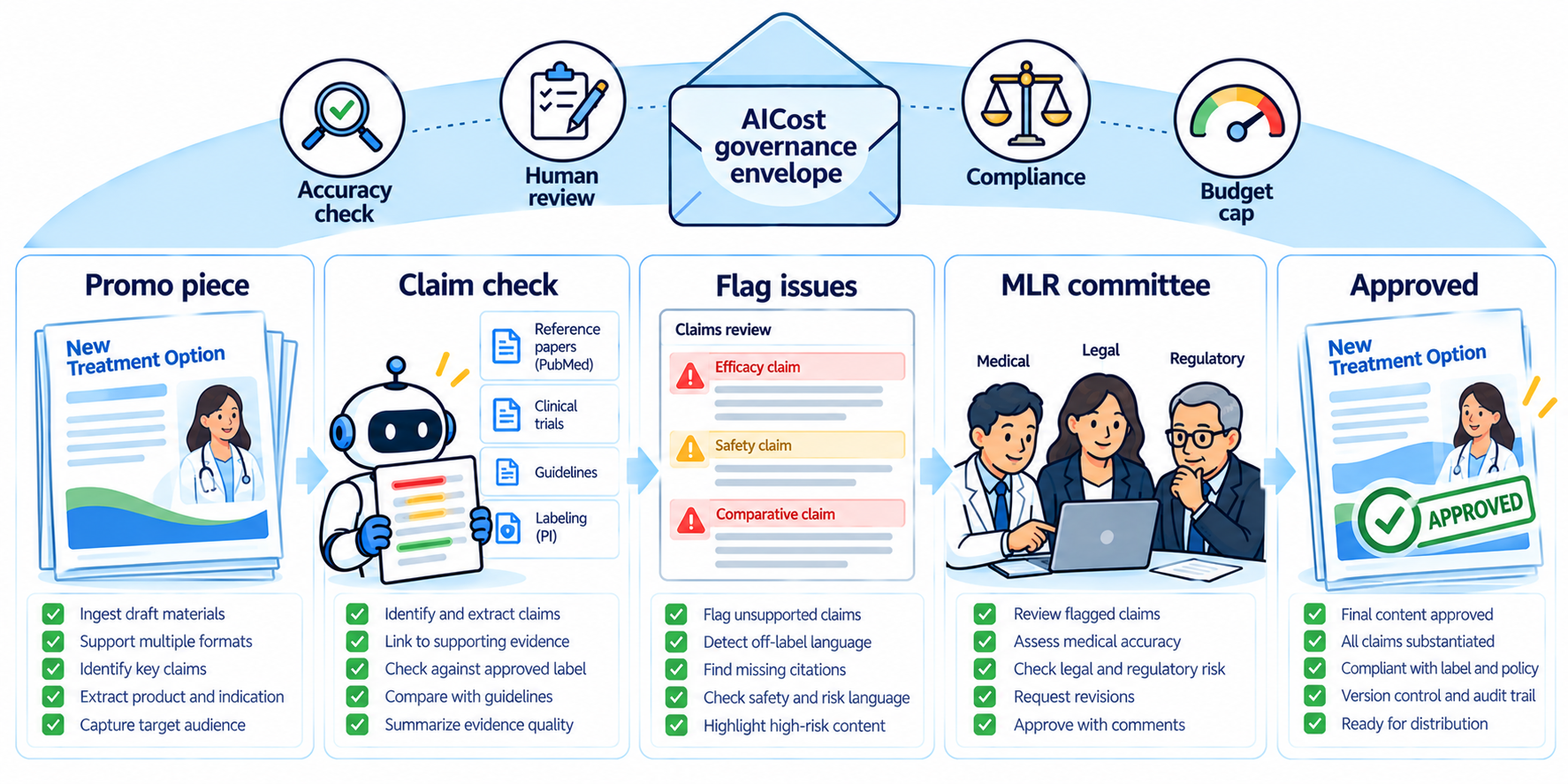
1 · cost
Read the promotional piece
$85
2 · cost
Check visuals and layout
$15
3 · cost
Match claims to references
$64
$36
4 · gate
Cache the claims library
5 · governance
Unsupported claims
$92
6 · governance
MLR committee sign-off
$45,000
$36,000
7 · governance
FDA promotional rules
$1,754
Without AICost
$47,010/mo
$78.35 per reviewed promo piece
With AICost
$37,983/mo
$63.30 per reviewed promo piece 19% lower
Monthly saving
$9,027/mo
4 cost levers applied
Governance controls
5
Monthly budget $200
Cost cutPrompt caching → Match claims to references −$6Model routing → Match claims to references −$14Batch the non-urgent work → Match claims to references −$8Shorter review with pre-checked drafts* → MLR committee sign-off −$9,000
Governance✓ Accuracy and hallucination checks → Unsupported claims✓ Human review → MLR committee sign-off✓ Compliance evidence → FDA promotional rules✓ Cost firewall at the gateway✓ Data-class model allowlist
Flow, picture, cost levers, governance and policy envelope
How the work flows today
1Agency or brand team uploads promotional or medical content with references
2Claims extraction and linking each claim to its supporting reference
3Pre-review checks: fair balance, ISI present, label consistency, brand rules
4Medical, legal and regulatory reviewer annotation and decision
5Approval, expiry tracking and FDA Form 2253 submission
AICost engine chain (blue: cost, purple: governance)
Cost levers and the step they act on
Prompt caching on step Match claims to references −$660% cacheable, 75% hit · Prompt CachingRepeated instructions and documents are cached, so you pay less for the same prompt text.
How it works: The stable part of each prompt (system instructions, tool definitions, reference text) is cached by the model provider and billed at the cached rate.
How AICost prices it: The Prompt Caching engine prices cacheable share and hit rate against the provider's cached-input price.
Governance: No change to answers, models or data. Only the billing of repeated text changes.
* Cacheable share and hit rate are typical values; your logs give the real ones.
Model routing on step Match claims to references −$1460% of calls (extraction and field checks) to Claude Haiku 5.5; critical work (exceptions) stays on Claude Sonnet 5.5 (applied to every eligible workflow) · Model RouterRoutine steps run on a cheaper model; critical steps stay on the primary model.
How it works: Each workflow type has routine work (triage, lookups, extraction, summaries, drafts) and critical work (the final answer, code changes, clinical or legal output, decisions). Routine calls go to the economy model; critical work stays on the primary model.
How AICost prices it: The Model Router engine prices the split between the economy and primary model on the workflow's own volume.
Governance: Only approved models for the data class are used. For patient and privileged legal data the share is capped and calls stay with the primary model's vendor and route, so the BAA still covers every call.
* The share of routine calls per workflow type is a starting assumption; your traffic sets the real split.
Batch the non-urgent work on step Match claims to references −$860% of calls through the batch API (applied to every eligible workflow) · Batch or RealtimeWork that can wait runs in the provider's batch mode at a lower price.
How it works: Requests that do not need an instant answer are queued and sent through the batch API.
How AICost prices it: The Batch or Realtime engine prices the batch-tolerant share at batch rates.
Governance: Urgent and customer-facing requests stay realtime.
* The batch-tolerant share is an input.
Shorter review with pre-checked drafts* on step MLR committee sign-off −$9,000*assumption: 20% less edit time per reviewed promo piece when evals catch errors before the reviewer sees the draft; every reviewed promo piece is still reviewed · Human ReviewEvery item is still reviewed, but automated checks catch errors first, so review takes less time.
How it works: An evaluation step checks each draft before the reviewer sees it, so the reviewer edits less.
How AICost prices it: The Human Review engine prices reviewer time at the shorter review time.
Governance: Every item is still reviewed by a person.
* The time saved per review is an assumption, marked with an asterisk.
Governance controls and the step they act on
Accuracy and hallucination checks on step Unsupported claims $92
Golden-set and live-traffic scoring catch silent regressions.
Human review on step MLR committee sign-off $45,000
Low-confidence, high-value or regulated cases go to a person.
Compliance evidence on step FDA promotional rules $1,754
Audit logs, retention and assessments for the rules that apply.
Cost firewall at the gateway policy only, no cost
Monthly budget, daily cap, per-run ceiling, turn cap, spike rule, kill switch.
Data-class model allowlist policy only, no cost
Only models cleared for this data class are routable; others are refused at the gateway.
Policy envelope
Monthly budget$200
Daily hard cap$9
Per-run ceiling$0.43
Turn cap6
See the policy your gateway enforces
{
  "workload_id": "mlr-medical-legal-regulatory-content-review",
  "scope": "workload",
  "monthly_budget_usd": 200,
  "daily_warning_usd": 6.07,
  "daily_hard_limit_usd": 8.67,
  "max_cost_per_run_usd": 0.43,
  "max_model_calls_per_run": 6,
  "max_retries": 2,
  "max_output_tokens": 1200,
  "requests_per_min": 60,
  "anomaly": {
    "rolling_window": "7d",
    "spike_multiplier": 3,
    "rule": "flag any hour/day exceeding 3x the rolling average, or any single day above the daily hard limit"
  },
  "actions": {
    "warning_threshold": "notify",
    "soft_limit": "route_to:claude-haiku-5-5",
    "hard_limit": "block_noncritical_requests",
    "anomaly": "throttle_and_alert",
    "emergency": "block_all_and_require_approval"
  },
  "emergency_stop": {
    "enabled": true,
    "requires_approval_to_resume": true
  }
}
Where the cost runs away
- Every version of every asset (including localized variants) re-reviewed end to end by the model
- Large reference PDFs re-embedded or re-read per review
- Agent loops on long video and interactive assets
Talk to us about this workflow →
🏥 Hospitals · Industry solutions
Ambient clinical documentation
120,000 visit note a month
With patient consent, AI listens to the visit, transcribes it and drafts a structured clinical note that the clinician reviews and signs in the EHR.
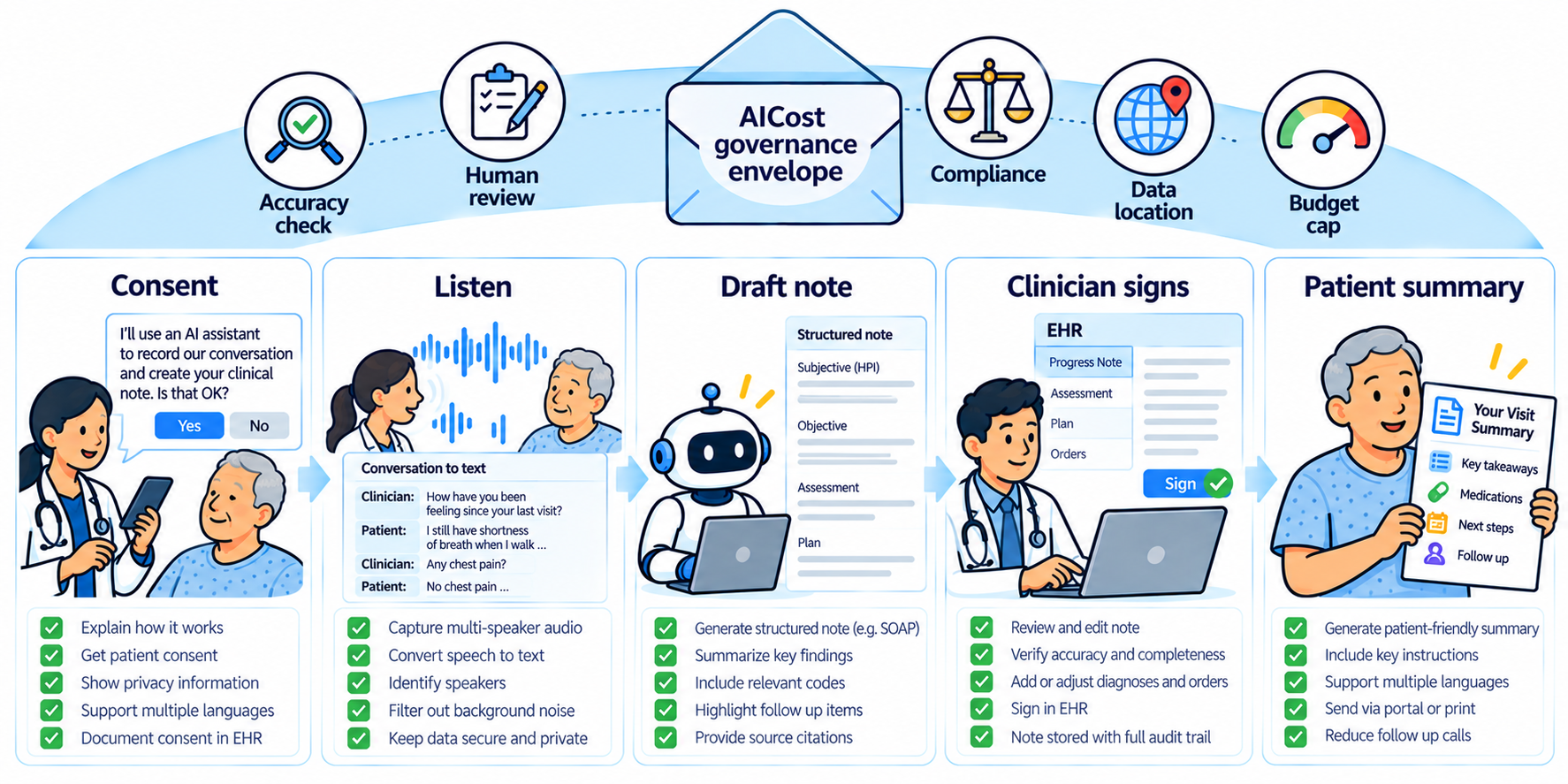
1 · cost
Transcribe the visit
$10,800
2 · cost
Note drafting per visit
$6,720
$2,920
3 · gate
Reuse the specialty note template
4 · gate
Cheaper model for routine visits
5 · gate
All clinicians across sites
6 · governance
Omissions and invented findings
$108
7 · governance
Clinician signs the note
$600,000
$480,000
8 · governance
HIPAA and recording consent
$3,654
9 · gate
Where patient data is processed
10 · gate
Seat cost vs time saved
Without AICost
$621,281/mo
$5.18 per visit note
With AICost
$497,482/mo
$4.15 per visit note 20% lower
Monthly saving
$123,799/mo
4 cost levers applied
Governance controls
5
Monthly budget $3,400
Cost cutPrompt caching → Note drafting per visit −$1,498Context compaction → Note drafting per visit −$1,344Model routing → Note drafting per visit −$958Shorter review with pre-checked drafts* → Clinician signs the note −$120,000
Governance✓ Accuracy and hallucination checks → Omissions and invented findings✓ Human review → Clinician signs the note✓ Compliance evidence → HIPAA and recording consent✓ Cost firewall at the gateway✓ Data-class model allowlist
Flow, picture, cost levers, governance and policy envelope
How the work flows today
1Get patient consent and start the ambient session from the EHR mobile app
2Record and transcribe the encounter
3Generate a structured note (HPI, exam, assessment and plan) plus orders and codes
4Clinician reviews, edits and signs in the EHR
5Downstream: patient instructions, coding suggestions, quality capture
AICost engine chain (blue: cost, purple: governance)
Cost levers and the step they act on
Prompt caching on step Note drafting per visit −$1,49860% cacheable, 75% hit · Prompt CachingRepeated instructions and documents are cached, so you pay less for the same prompt text.
How it works: The stable part of each prompt (system instructions, tool definitions, reference text) is cached by the model provider and billed at the cached rate.
How AICost prices it: The Prompt Caching engine prices cacheable share and hit rate against the provider's cached-input price.
Governance: No change to answers, models or data. Only the billing of repeated text changes.
* Cacheable share and hit rate are typical values; your logs give the real ones.
Context compaction on step Note drafting per visit −$1,344trim history 60%, net of overhead (applied to every eligible workflow) · Context TrimLong histories are trimmed each turn, so every call carries less text.
How it works: Older turns and long documents are summarized or trimmed before each call, keeping what the model needs.
How AICost prices it: The Context Trim engine prices the smaller context net of the cost of trimming.
Governance: Quality is checked before rollout; nothing reaches the model that it was not allowed to see.
* The trim size is an input; your evals confirm it keeps answer quality.
Model routing on step Note drafting per visit −$95815% of calls (transcript cleanup and coding hints) to Claude Haiku 5.5; critical work (the clinical note itself) stays on Claude Sonnet 5.5; patient data: routine steps only, same vendor and route as the primary model · Model RouterRoutine steps run on a cheaper model; critical steps stay on the primary model.
How it works: Each workflow type has routine work (triage, lookups, extraction, summaries, drafts) and critical work (the final answer, code changes, clinical or legal output, decisions). Routine calls go to the economy model; critical work stays on the primary model.
How AICost prices it: The Model Router engine prices the split between the economy and primary model on the workflow's own volume.
Governance: Only approved models for the data class are used. For patient and privileged legal data the share is capped and calls stay with the primary model's vendor and route, so the BAA still covers every call.
* The share of routine calls per workflow type is a starting assumption; your traffic sets the real split.
Shorter review with pre-checked drafts* on step Clinician signs the note −$120,000*assumption: 20% less edit time per visit note when evals catch errors before the reviewer sees the draft; every visit note is still reviewed · Human ReviewEvery item is still reviewed, but automated checks catch errors first, so review takes less time.
How it works: An evaluation step checks each draft before the reviewer sees it, so the reviewer edits less.
How AICost prices it: The Human Review engine prices reviewer time at the shorter review time.
Governance: Every item is still reviewed by a person.
* The time saved per review is an assumption, marked with an asterisk.
Governance controls and the step they act on
Accuracy and hallucination checks on step Omissions and invented findings $108
Golden-set and live-traffic scoring catch silent regressions.
Human review on step Clinician signs the note $600,000
Low-confidence, high-value or regulated cases go to a person.
Compliance evidence on step HIPAA and recording consent $3,654
Audit logs, retention and assessments for the rules that apply.
Cost firewall at the gateway policy only, no cost
Monthly budget, daily cap, per-run ceiling, turn cap, spike rule, kill switch.
Data-class model allowlist policy only, no cost
Only models cleared for this data class are routable; others are refused at the gateway.
Policy envelope
Monthly budget$3,400
Daily hard cap$147
Per-run ceiling$0.22
Turn cap6
See the policy your gateway enforces
{
  "workload_id": "ambient-clinical-documentation",
  "scope": "workload",
  "monthly_budget_usd": 3400,
  "daily_warning_usd": 103.13,
  "daily_hard_limit_usd": 147.33,
  "max_cost_per_run_usd": 0.22,
  "max_model_calls_per_run": 6,
  "max_retries": 2,
  "max_output_tokens": 1200,
  "requests_per_min": 1140,
  "anomaly": {
    "rolling_window": "7d",
    "spike_multiplier": 3,
    "rule": "flag any hour/day exceeding 3x the rolling average, or any single day above the daily hard limit"
  },
  "actions": {
    "warning_threshold": "notify",
    "soft_limit": "route_to:claude-haiku-5-5",
    "hard_limit": "block_noncritical_requests",
    "anomaly": "throttle_and_alert",
    "emergency": "block_all_and_require_approval"
  },
  "emergency_stop": {
    "enabled": true,
    "requires_approval_to_resume": true
  }
}
Where the cost runs away
- Per-clinician seat licenses bought enterprise-wide while active use is low (TPMG: 3,442 of about 10,000 offered physicians adopted)
- Long encounters and re-generation of notes by specialty template increase token and audio minutes
- Paying separately for overlapping ambient tools (EHR-native and third party)
Talk to us about this workflow →
🏥 Hospitals · Industry solutions
Patient message (In Basket) triage and draft replies
60,000 patient message a month
AI sorts patient portal messages by urgency and drafts replies for nurses and physicians to edit and send.
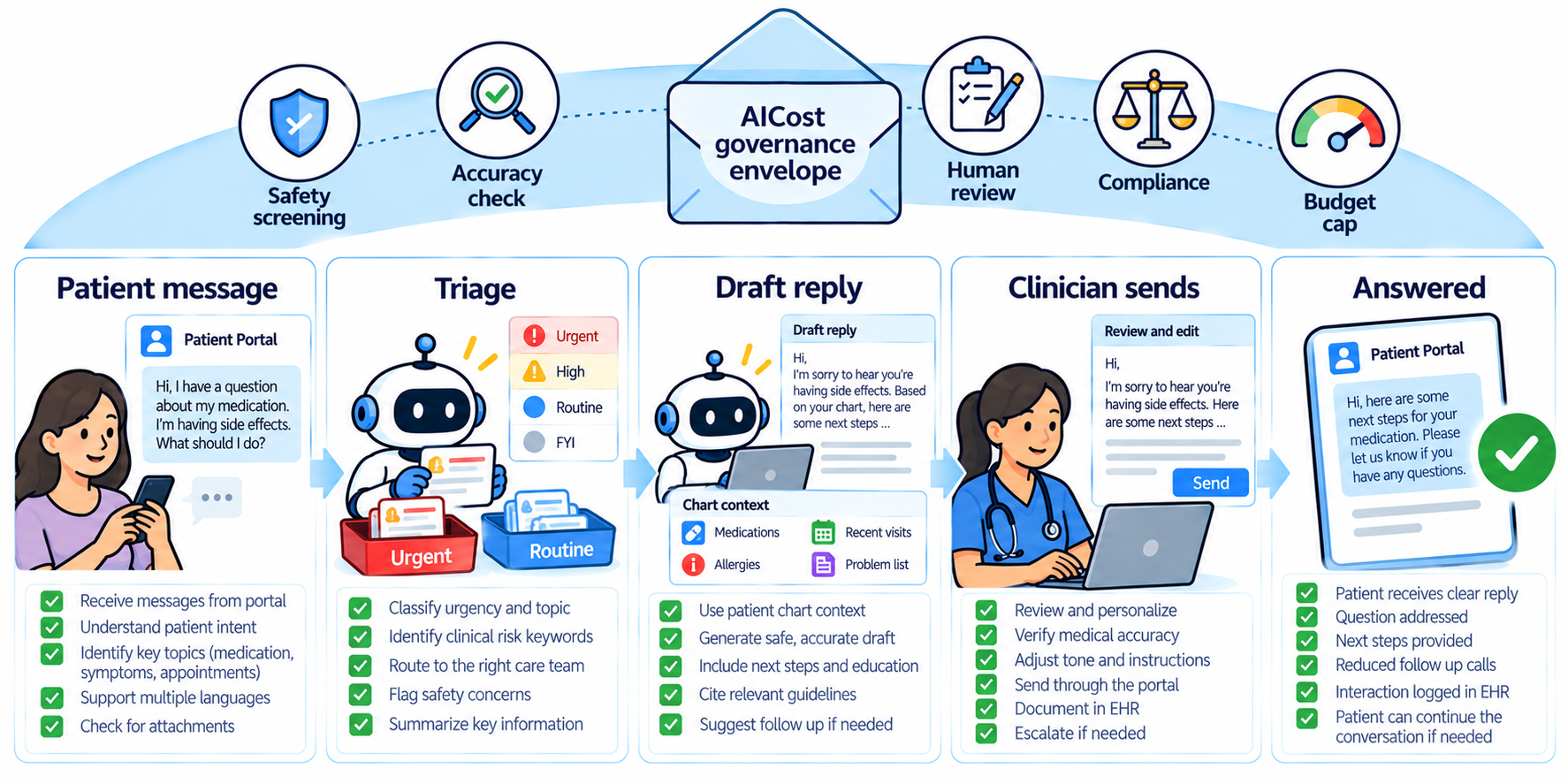
1 · gate
Classify messages with a small model
2 · cost
Pull chart context
$1,905
$572
3 · gate
Reuse chart context
4 · governance
Escalate urgent symptoms
$56
5 · governance
Draft accuracy sampling
$100
6 · governance
Clinician sends
$120,000
$96,000
7 · governance
AI-message disclosure rules
$3,654
Without AICost
$125,714/mo
$2.10 per patient message
With AICost
$100,381/mo
$1.67 per patient message 20% lower
Monthly saving
$25,333/mo
3 cost levers applied
Governance controls
6
Monthly budget $900
Cost cutPrompt caching → Pull chart context −$808Model routing → Pull chart context −$525Shorter review with pre-checked drafts* → Clinician sends −$24,000
Governance✓ Guardrail screening → Escalate urgent symptoms✓ Accuracy and hallucination checks → Draft accuracy sampling✓ Human review → Clinician sends✓ Compliance evidence → AI-message disclosure rules✓ Cost firewall at the gateway✓ Data-class model allowlist
Flow, picture, cost levers, governance and policy envelope
How the work flows today
1Patient sends a portal message (MyChart) or chats with a digital assistant
2AI self-service deflects administrative requests (scheduling, refills, navigation)
3Classify and route the remaining messages to the right pool (clinical, billing, refill)
4Draft a reply using chart context
5Clinician edits and sends, with an AI-disclosure footer where required
AICost engine chain (blue: cost, purple: governance)
Cost levers and the step they act on
Prompt caching on step Pull chart context −$80860% cacheable, 75% hit (combined with the other knobs on this step) · Prompt CachingRepeated instructions and documents are cached, so you pay less for the same prompt text.
How it works: The stable part of each prompt (system instructions, tool definitions, reference text) is cached by the model provider and billed at the cached rate.
How AICost prices it: The Prompt Caching engine prices cacheable share and hit rate against the provider's cached-input price.
Governance: No change to answers, models or data. Only the billing of repeated text changes.
* Cacheable share and hit rate are typical values; your logs give the real ones.
Model routing on step Pull chart context −$52520% of calls (classification and routing) to Claude Haiku 5.5; critical work (edge cases) stays on Claude Sonnet 5.5; patient data: routine steps only, same vendor and route as the primary model (combined with the other knobs on this step) · Model RouterRoutine steps run on a cheaper model; critical steps stay on the primary model.
How it works: Each workflow type has routine work (triage, lookups, extraction, summaries, drafts) and critical work (the final answer, code changes, clinical or legal output, decisions). Routine calls go to the economy model; critical work stays on the primary model.
How AICost prices it: The Model Router engine prices the split between the economy and primary model on the workflow's own volume.
Governance: Only approved models for the data class are used. For patient and privileged legal data the share is capped and calls stay with the primary model's vendor and route, so the BAA still covers every call.
* The share of routine calls per workflow type is a starting assumption; your traffic sets the real split.
Shorter review with pre-checked drafts* on step Clinician sends −$24,000*assumption: 20% less edit time per patient message when evals catch errors before the reviewer sees the draft; every patient message is still reviewed · Human ReviewEvery item is still reviewed, but automated checks catch errors first, so review takes less time.
How it works: An evaluation step checks each draft before the reviewer sees it, so the reviewer edits less.
How AICost prices it: The Human Review engine prices reviewer time at the shorter review time.
Governance: Every item is still reviewed by a person.
* The time saved per review is an assumption, marked with an asterisk.
Governance controls and the step they act on
Guardrail screening on step Escalate urgent symptoms $56
PII, prompt-attack and policy screening before the model acts.
Accuracy and hallucination checks on step Draft accuracy sampling $100
Golden-set and live-traffic scoring catch silent regressions.
Human review on step Clinician sends $120,000
Low-confidence, high-value or regulated cases go to a person.
Compliance evidence on step AI-message disclosure rules $3,654
Audit logs, retention and assessments for the rules that apply.
Cost firewall at the gateway policy only, no cost
Monthly budget, daily cap, per-run ceiling, turn cap, spike rule, kill switch.
Data-class model allowlist policy only, no cost
Only models cleared for this data class are routable; others are refused at the gateway.
Policy envelope
Monthly budget$900
Daily hard cap$39
Per-run ceiling$0.13
Turn cap6
See the policy your gateway enforces
{
  "workload_id": "patient-message-in-basket-triage-and-draft-replies",
  "scope": "workload",
  "monthly_budget_usd": 900,
  "daily_warning_usd": 27.3,
  "daily_hard_limit_usd": 39,
  "max_cost_per_run_usd": 0.13,
  "max_model_calls_per_run": 6,
  "max_retries": 2,
  "max_output_tokens": 1200,
  "requests_per_min": 570,
  "anomaly": {
    "rolling_window": "7d",
    "spike_multiplier": 3,
    "rule": "flag any hour/day exceeding 3x the rolling average, or any single day above the daily hard limit"
  },
  "actions": {
    "warning_threshold": "notify",
    "soft_limit": "route_to:claude-haiku-5-5",
    "hard_limit": "block_noncritical_requests",
    "anomaly": "throttle_and_alert",
    "emergency": "block_all_and_require_approval"
  },
  "emergency_stop": {
    "enabled": true,
    "requires_approval_to_resume": true
  }
}
Where the cost runs away
- Drafting replies for every message, including ones the clinician deletes
- Pulling the full chart into context for simple administrative messages
- Volume spikes (portal messages keep rising) on per-message pricing
Talk to us about this workflow →
🏥 Hospitals · Industry solutions
Revenue cycle: coding, denials and appeal letters
40,000 coded claim a month
AI suggests codes from clinical documentation, predicts denials and drafts appeal letters for the revenue cycle team.
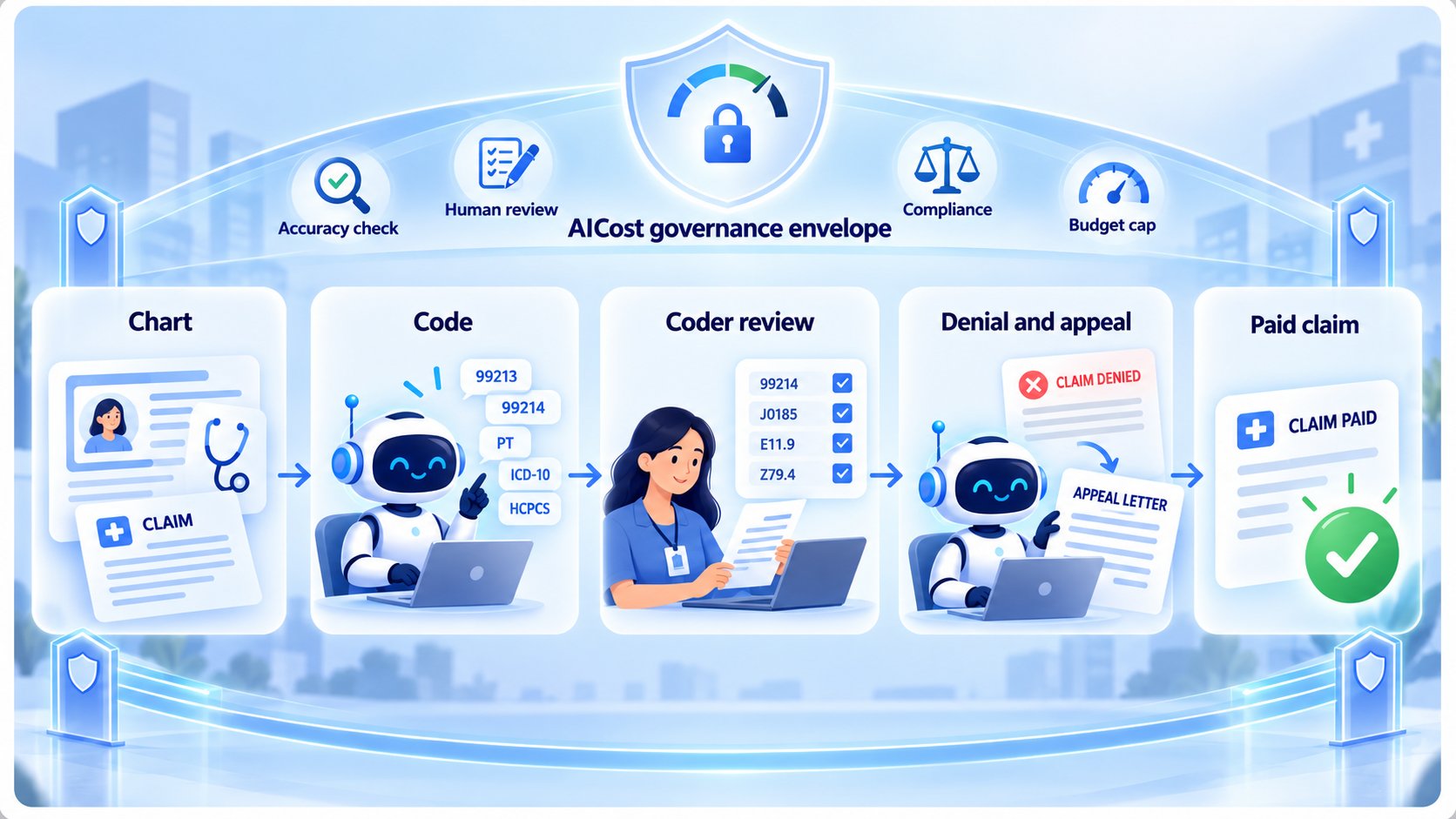
1 · cost
Read charts and payer letters
$3,408
2 · cost
Code assignment
$2,160
$963
3 · gate
Code charts in batch
4 · governance
Accuracy and upcoding checks
$98
5 · governance
Coder review
$44,000
$22,000
6 · cost
Appeal letters
$1,680
7 · governance
Coding compliance
$3,654
8 · gate
Recovered revenue vs AI cost
Without AICost
$54,999/mo
$1.37 per coded claim
With AICost
$31,802/mo
$0.80 per coded claim 42% lower
Monthly saving
$23,197/mo
4 cost levers applied
Governance controls
5
Monthly budget $3,100
Cost cutPrompt caching → Code assignment −$374Model routing → Code assignment −$319Batch the non-urgent work → Code assignment −$504Better grounding → Coder review −$22,000
Governance✓ Accuracy and hallucination checks✓ Human review → Coder review✓ Compliance evidence → Coding compliance✓ Cost firewall at the gateway✓ Data-class model allowlist
Flow, picture, cost levers, governance and policy envelope
How the work flows today
1Autonomous or assisted coding from the documentation
2Pre-bill claim scrubbing and denial-risk prediction
3Work denials: classify the reason and pull supporting chart evidence
4Draft the appeal letter with clinical and payer-policy citations
5Submit, track and feed results back into prevention rules
AICost engine chain (blue: cost, purple: governance)
Cost levers and the step they act on
Prompt caching on step Code assignment −$37460% cacheable, 75% hit (applied to every eligible workflow) · Prompt CachingRepeated instructions and documents are cached, so you pay less for the same prompt text.
How it works: The stable part of each prompt (system instructions, tool definitions, reference text) is cached by the model provider and billed at the cached rate.
How AICost prices it: The Prompt Caching engine prices cacheable share and hit rate against the provider's cached-input price.
Governance: No change to answers, models or data. Only the billing of repeated text changes.
* Cacheable share and hit rate are typical values; your logs give the real ones.
Model routing on step Code assignment −$31920% of calls (extraction and field checks) to Claude Haiku 5.5; critical work (exceptions) stays on Claude Sonnet 5.5; patient data: routine steps only, same vendor and route as the primary model (applied to every eligible workflow) · Model RouterRoutine steps run on a cheaper model; critical steps stay on the primary model.
How it works: Each workflow type has routine work (triage, lookups, extraction, summaries, drafts) and critical work (the final answer, code changes, clinical or legal output, decisions). Routine calls go to the economy model; critical work stays on the primary model.
How AICost prices it: The Model Router engine prices the split between the economy and primary model on the workflow's own volume.
Governance: Only approved models for the data class are used. For patient and privileged legal data the share is capped and calls stay with the primary model's vendor and route, so the BAA still covers every call.
* The share of routine calls per workflow type is a starting assumption; your traffic sets the real split.
Batch the non-urgent work on step Code assignment −$50460% of calls through the batch API · Batch or RealtimeWork that can wait runs in the provider's batch mode at a lower price.
How it works: Requests that do not need an instant answer are queued and sent through the batch API.
How AICost prices it: The Batch or Realtime engine prices the batch-tolerant share at batch rates.
Governance: Urgent and customer-facing requests stay realtime.
* The batch-tolerant share is an input.
Better grounding on step Coder review −$22,000escalation 30% to 15% · Human ReviewAnswers come only from your approved sources, so fewer cases go to a person.
How it works: The assistant answers from your own approved content with the source attached, and says it does not know instead of guessing. Teams get there with cleaner knowledge-base articles, better retrieval (tighter chunks, reranking) and an answer check before the reply goes out.
How AICost prices it: Fewer low-confidence answers means fewer escalations. The Human Review engine prices reviewer minutes at the lower escalation rate; the saving is the difference.
Governance: Human review stays on for refunds, policy exceptions and anything still low-confidence. Only the share of cases that needed a person goes down.
* The demo assumes escalations fall by half (for example 12% to 6%). Your number comes from your own evaluation results.
Governance controls and the step they act on
Accuracy and hallucination checks on step Accuracy and upcoding checks $98
Golden-set and live-traffic scoring catch silent regressions.
Human review on step Coder review $44,000
Low-confidence, high-value or regulated cases go to a person.
Compliance evidence on step Coding compliance $3,654
Audit logs, retention and assessments for the rules that apply.
Cost firewall at the gateway policy only, no cost
Monthly budget, daily cap, per-run ceiling, turn cap, spike rule, kill switch.
Data-class model allowlist policy only, no cost
Only models cleared for this data class are routable; others are refused at the gateway.
Policy envelope
Monthly budget$3,100
Daily hard cap$134
Per-run ceiling$0.22
Turn cap6
See the policy your gateway enforces
{
  "workload_id": "revenue-cycle-coding-denials-and-appeal-letters",
  "scope": "workload",
  "monthly_budget_usd": 3100,
  "daily_warning_usd": 94.03,
  "daily_hard_limit_usd": 134.33,
  "max_cost_per_run_usd": 0.22,
  "max_model_calls_per_run": 6,
  "max_retries": 2,
  "max_output_tokens": 1200,
  "requests_per_min": 380,
  "anomaly": {
    "rolling_window": "7d",
    "spike_multiplier": 3,
    "rule": "flag any hour/day exceeding 3x the rolling average, or any single day above the daily hard limit"
  },
  "actions": {
    "warning_threshold": "notify",
    "soft_limit": "route_to:claude-haiku-5-5",
    "hard_limit": "block_noncritical_requests",
    "anomaly": "throttle_and_alert",
    "emergency": "block_all_and_require_approval"
  },
  "emergency_stop": {
    "enabled": true,
    "requires_approval_to_resume": true
  }
}
Where the cost runs away
- Full-chart context for every claim line instead of only the relevant encounter
- Agentic payer-portal bots that retry and loop
- An AI-vs-AI 'battle of the bots' with payers that drives up volume on both sides
Talk to us about this workflow →
🩺 Clinics and practices · Industry solutions
AI scribe for independent and specialty practices
An AI scribe records the visit with consent and drafts the note for the provider to review and sign.
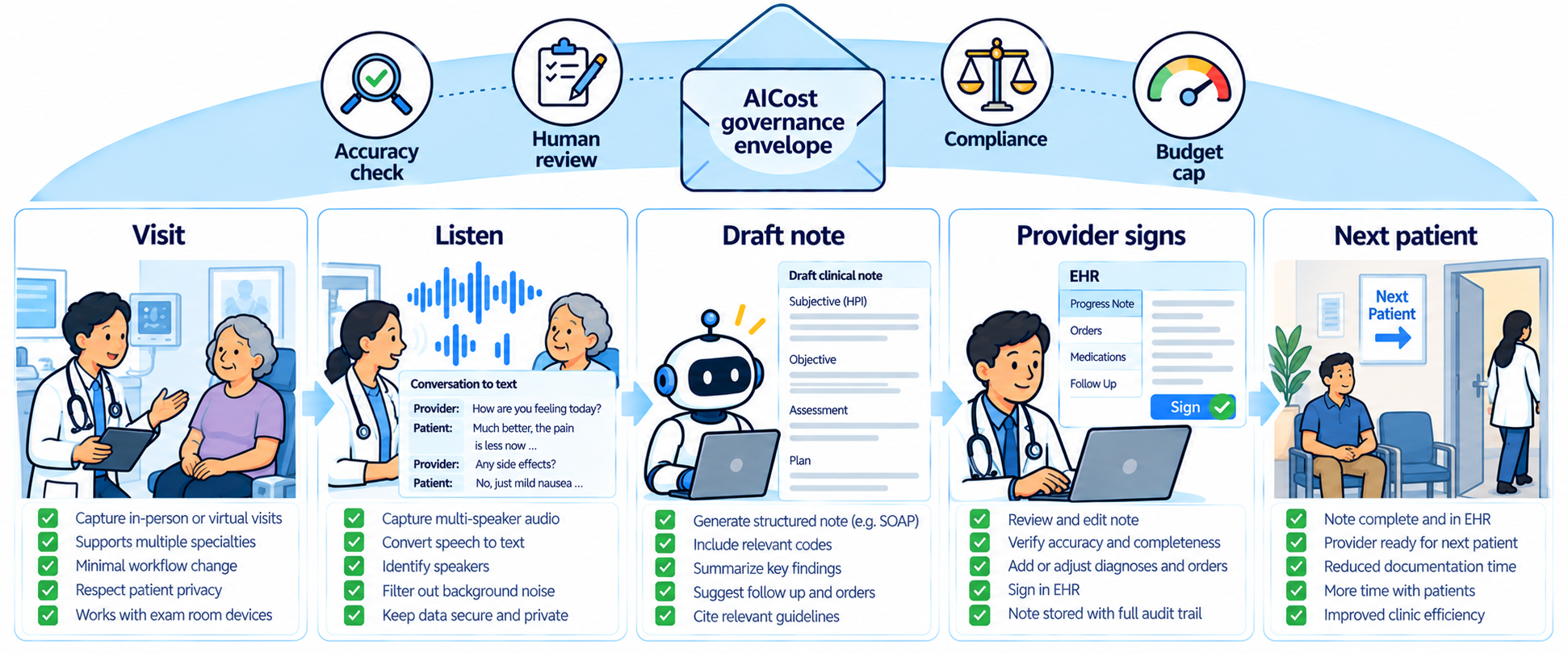
1 · cost
Transcribe the visit
$720
2 · cost
Note drafting per visit
$448
$194
3 · gate
Reuse the specialty template
4 · gate
Cheaper model for routine visits
5 · gate
Vendor plan vs API pricing
6 · governance
Note accuracy checks
$93
7 · governance
Provider signs the note
$40,000
$32,000
8 · governance
HIPAA, BAA and consent
$3,654
9 · gate
Seat cost vs time saved
Without AICost
$44,915/mo
$5.61 per visit note
With AICost
$36,662/mo
$4.58 per visit note 18% lower
Monthly saving
$8,253/mo
4 cost levers applied
Governance controls
5
Monthly budget $400
Cost cutPrompt caching → Note drafting per visit −$100Context compaction → Note drafting per visit −$90Model routing → Note drafting per visit −$64Shorter review with pre-checked drafts* → Provider signs the note −$8,000
Governance✓ Accuracy and hallucination checks → Note accuracy checks✓ Human review → Provider signs the note✓ Compliance evidence → HIPAA, BAA and consent✓ Cost firewall at the gateway✓ Data-class model allowlist
Flow, picture, cost levers, governance and policy envelope
How the work flows today
1Patient consent at check-in
2Record the visit (in person or telehealth)
3Generate the SOAP note and patient summary
4Provider reviews and signs; push to the EHR by integration or copy-paste
5Code suggestion and charge capture
AICost engine chain (blue: cost, purple: governance)
Cost levers and the step they act on
Prompt caching on step Note drafting per visit −$10060% cacheable, 75% hit · Prompt CachingRepeated instructions and documents are cached, so you pay less for the same prompt text.
How it works: The stable part of each prompt (system instructions, tool definitions, reference text) is cached by the model provider and billed at the cached rate.
How AICost prices it: The Prompt Caching engine prices cacheable share and hit rate against the provider's cached-input price.
Governance: No change to answers, models or data. Only the billing of repeated text changes.
* Cacheable share and hit rate are typical values; your logs give the real ones.
Context compaction on step Note drafting per visit −$90trim history 60%, net of overhead (applied to every eligible workflow) · Context TrimLong histories are trimmed each turn, so every call carries less text.
How it works: Older turns and long documents are summarized or trimmed before each call, keeping what the model needs.
How AICost prices it: The Context Trim engine prices the smaller context net of the cost of trimming.
Governance: Quality is checked before rollout; nothing reaches the model that it was not allowed to see.
* The trim size is an input; your evals confirm it keeps answer quality.
Model routing on step Note drafting per visit −$6415% of calls (transcript cleanup and coding hints) to Claude Haiku 5.5; critical work (the clinical note itself) stays on Claude Sonnet 5.5; patient data: routine steps only, same vendor and route as the primary model · Model RouterRoutine steps run on a cheaper model; critical steps stay on the primary model.
How it works: Each workflow type has routine work (triage, lookups, extraction, summaries, drafts) and critical work (the final answer, code changes, clinical or legal output, decisions). Routine calls go to the economy model; critical work stays on the primary model.
How AICost prices it: The Model Router engine prices the split between the economy and primary model on the workflow's own volume.
Governance: Only approved models for the data class are used. For patient and privileged legal data the share is capped and calls stay with the primary model's vendor and route, so the BAA still covers every call.
* The share of routine calls per workflow type is a starting assumption; your traffic sets the real split.
Shorter review with pre-checked drafts* on step Provider signs the note −$8,000*assumption: 20% less edit time per visit note when evals catch errors before the reviewer sees the draft; every visit note is still reviewed · Human ReviewEvery item is still reviewed, but automated checks catch errors first, so review takes less time.
How it works: An evaluation step checks each draft before the reviewer sees it, so the reviewer edits less.
How AICost prices it: The Human Review engine prices reviewer time at the shorter review time.
Governance: Every item is still reviewed by a person.
* The time saved per review is an assumption, marked with an asterisk.
Governance controls and the step they act on
Accuracy and hallucination checks on step Note accuracy checks $93
Golden-set and live-traffic scoring catch silent regressions.
Human review on step Provider signs the note $40,000
Low-confidence, high-value or regulated cases go to a person.
Compliance evidence on step HIPAA, BAA and consent $3,654
Audit logs, retention and assessments for the rules that apply.
Cost firewall at the gateway policy only, no cost
Monthly budget, daily cap, per-run ceiling, turn cap, spike rule, kill switch.
Data-class model allowlist policy only, no cost
Only models cleared for this data class are routable; others are refused at the gateway.
Policy envelope
Monthly budget$400
Daily hard cap$17
Per-run ceiling$0.22
Turn cap6
See the policy your gateway enforces
{
  "workload_id": "ai-scribe-for-independent-and-specialty-practices",
  "scope": "workload",
  "monthly_budget_usd": 400,
  "daily_warning_usd": 12.13,
  "daily_hard_limit_usd": 17.33,
  "max_cost_per_run_usd": 0.22,
  "max_model_calls_per_run": 6,
  "max_retries": 2,
  "max_output_tokens": 1200,
  "requests_per_min": 80,
  "anomaly": {
    "rolling_window": "7d",
    "spike_multiplier": 3,
    "rule": "flag any hour/day exceeding 3x the rolling average, or any single day above the daily hard limit"
  },
  "actions": {
    "warning_threshold": "notify",
    "soft_limit": "route_to:claude-haiku-5-5",
    "hard_limit": "block_noncritical_requests",
    "anomaly": "throttle_and_alert",
    "emergency": "block_all_and_require_approval"
  },
  "emergency_stop": {
    "enabled": true,
    "requires_approval_to_resume": true
  }
}
Where the cost runs away
- Per-provider subscriptions that keep running for part-time or inactive providers
- Stacking a scribe on top of an EHR that already bundles ambient
- Usage-priced tools billed per audio minute with long visits
Talk to us about this workflow →
🩺 Clinics and practices · Industry solutions
AI front desk: phone, scheduling, intake and eligibility
6,000 patient call a month
An AI front desk answers calls, books appointments, collects intake details and checks insurance eligibility.
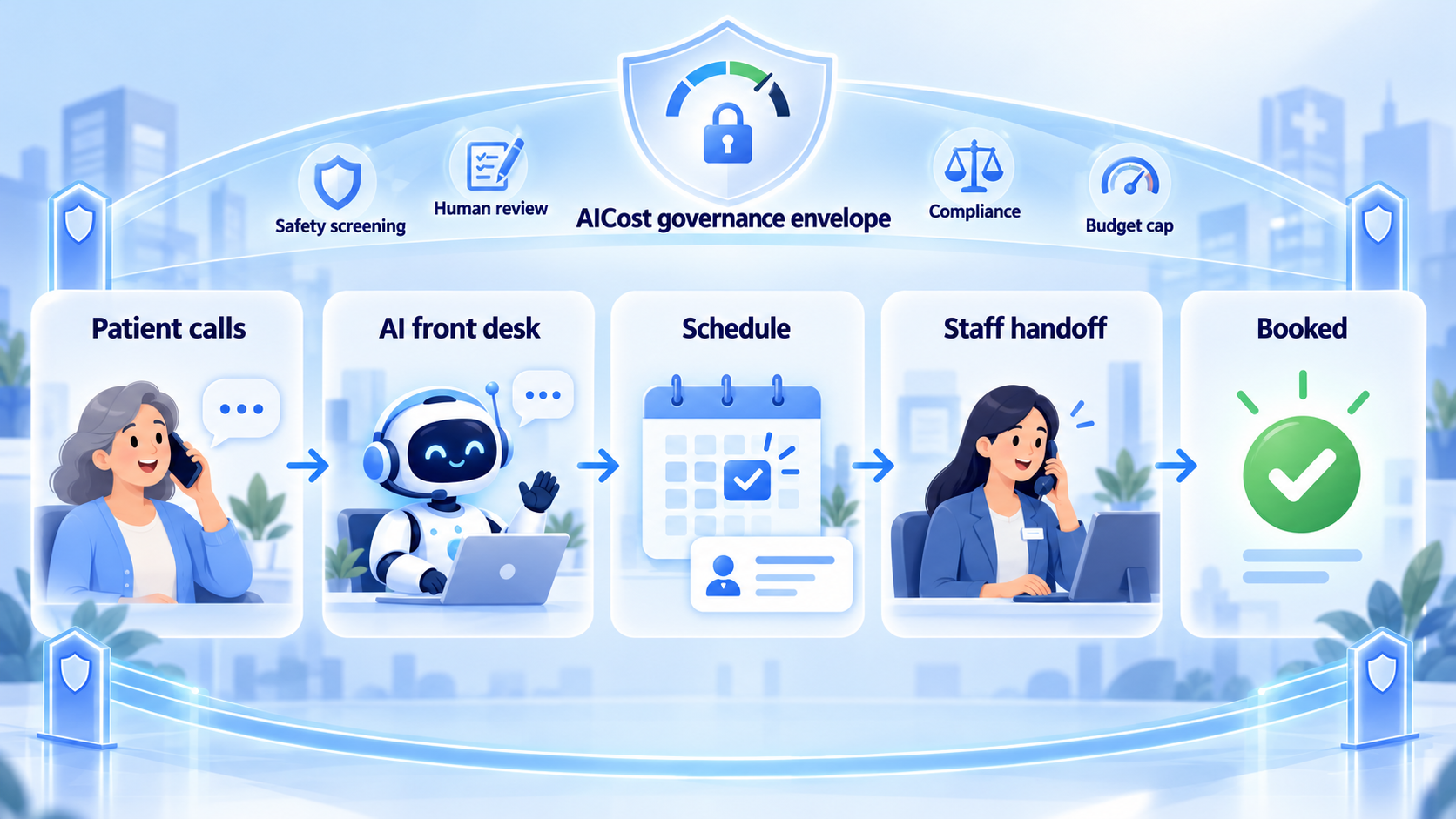
1 · cost
Price each call
$2,196
$1,686
2 · cost
Limit turns per call
$3,266
$1,764
3 · cost
Scheduling and EHR lookups
$1,472
4 · governance
Identity checks, no clinical advice
$15
5 · governance
Hand off to staff
$3,000
$1,600
6 · governance
TCPA and AI-voice disclosure
$3,654
7 · gate
Cost per call vs front-desk staff
Without AICost
$13,603/mo
$2.27 per patient call
With AICost
$10,192/mo
$1.70 per patient call 25% lower
Monthly saving
$3,411/mo
5 cost levers applied
Governance controls
5
Monthly budget $2,000
Cost cutLoop cap → Limit turns per call −$1,502Prompt caching → Price each call −$150Context compaction → Price each call −$269Model routing → Price each call −$91Better grounding → Hand off to staff −$1,400
Governance✓ Guardrail screening → Identity checks, no clinical advice✓ Human review → Hand off to staff✓ Compliance evidence → TCPA and AI-voice disclosure✓ Cost firewall at the gateway✓ Data-class model allowlist
Flow, picture, cost levers, governance and policy envelope
How the work flows today
1AI voice agent answers inbound calls after hours or on overflow
2Identify the patient and intent (schedule, refill, billing, directions)
3Book or reschedule in the PM system; send reminders and intake forms
4Verify insurance eligibility
5Hand off to staff with a summary when needed
AICost engine chain (blue: cost, purple: governance)
Cost levers and the step they act on
Loop cap on step Limit turns per call −$1,50216 turns, 60k tokens, enforced by cost-firewall · Agent LoopA ceiling on turns and tokens per agent run, so a stuck agent cannot run up the bill.
How it works: Each agent run gets a maximum number of turns and tokens. A run that hits the ceiling stops and hands off instead of looping.
How AICost prices it: The Agent Loop engine prices the runs with and without the ceiling, including the runaway tail.
Governance: The cap is enforced by the cost firewall at your gateway, with an alert when it trips.
Prompt caching on step Price each call −$15060% cacheable, 75% hit (applied to every eligible workflow) · Prompt CachingRepeated instructions and documents are cached, so you pay less for the same prompt text.
How it works: The stable part of each prompt (system instructions, tool definitions, reference text) is cached by the model provider and billed at the cached rate.
How AICost prices it: The Prompt Caching engine prices cacheable share and hit rate against the provider's cached-input price.
Governance: No change to answers, models or data. Only the billing of repeated text changes.
* Cacheable share and hit rate are typical values; your logs give the real ones.
Context compaction on step Price each call −$269trim history 60%, net of overhead (applied to every eligible workflow) · Context TrimLong histories are trimmed each turn, so every call carries less text.
How it works: Older turns and long documents are summarized or trimmed before each call, keeping what the model needs.
How AICost prices it: The Context Trim engine prices the smaller context net of the cost of trimming.
Governance: Quality is checked before rollout; nothing reaches the model that it was not allowed to see.
* The trim size is an input; your evals confirm it keeps answer quality.
Model routing on step Price each call −$9120% of calls (intent detection and lookups) to Claude Haiku 5.5; critical work (actions on the account) stays on Claude Sonnet 5.5; patient data: routine steps only, same vendor and route as the primary model (applied to every eligible workflow) · Model RouterRoutine steps run on a cheaper model; critical steps stay on the primary model.
How it works: Each workflow type has routine work (triage, lookups, extraction, summaries, drafts) and critical work (the final answer, code changes, clinical or legal output, decisions). Routine calls go to the economy model; critical work stays on the primary model.
How AICost prices it: The Model Router engine prices the split between the economy and primary model on the workflow's own volume.
Governance: Only approved models for the data class are used. For patient and privileged legal data the share is capped and calls stay with the primary model's vendor and route, so the BAA still covers every call.
* The share of routine calls per workflow type is a starting assumption; your traffic sets the real split.
Better grounding on step Hand off to staff −$1,400escalation 15% to 8% · Human ReviewAnswers come only from your approved sources, so fewer cases go to a person.
How it works: The assistant answers from your own approved content with the source attached, and says it does not know instead of guessing. Teams get there with cleaner knowledge-base articles, better retrieval (tighter chunks, reranking) and an answer check before the reply goes out.
How AICost prices it: Fewer low-confidence answers means fewer escalations. The Human Review engine prices reviewer minutes at the lower escalation rate; the saving is the difference.
Governance: Human review stays on for refunds, policy exceptions and anything still low-confidence. Only the share of cases that needed a person goes down.
* The demo assumes escalations fall by half (for example 12% to 6%). Your number comes from your own evaluation results.
Governance controls and the step they act on
Guardrail screening on step Identity checks, no clinical advice $15
PII, prompt-attack and policy screening before the model acts.
Human review on step Hand off to staff $3,000
Low-confidence, high-value or regulated cases go to a person.
Compliance evidence on step TCPA and AI-voice disclosure $3,654
Audit logs, retention and assessments for the rules that apply.
Cost firewall at the gateway policy only, no cost
Monthly budget, daily cap, per-run ceiling, turn cap, spike rule, kill switch.
Data-class model allowlist policy only, no cost
Only models cleared for this data class are routable; others are refused at the gateway.
Policy envelope
Monthly budget$2,000
Daily hard cap$87
Per-run ceiling$1.46
Turn cap16
See the policy your gateway enforces
{
  "workload_id": "ai-front-desk-phone-scheduling-intake-and-eligibility",
  "scope": "workload",
  "monthly_budget_usd": 2000,
  "daily_warning_usd": 60.67,
  "daily_hard_limit_usd": 86.67,
  "max_cost_per_run_usd": 1.46,
  "max_model_calls_per_run": 16,
  "max_retries": 2,
  "max_output_tokens": 1200,
  "requests_per_min": 60,
  "anomaly": {
    "rolling_window": "7d",
    "spike_multiplier": 3,
    "rule": "flag any hour/day exceeding 3x the rolling average, or any single day above the daily hard limit"
  },
  "actions": {
    "warning_threshold": "notify",
    "soft_limit": "route_to:claude-haiku-5-5",
    "hard_limit": "block_noncritical_requests",
    "anomaly": "throttle_and_alert",
    "emergency": "block_all_and_require_approval"
  },
  "emergency_stop": {
    "enabled": true,
    "requires_approval_to_resume": true
  }
}
Where the cost runs away
- Per-minute voice costs (STT, LLM and TTS stacked) on long hold or loop calls
- Bots that fail to resolve, so staff handle the call anyway (double cost)
- Outbound reminder campaigns at scale
Talk to us about this workflow →
🩺 Clinics and practices · Industry solutions
Dental radiograph AI and treatment-plan acceptance
3,000 radiograph set a month
AI reviews dental X-rays, highlights findings for the dentist and helps explain the treatment plan to the patient.
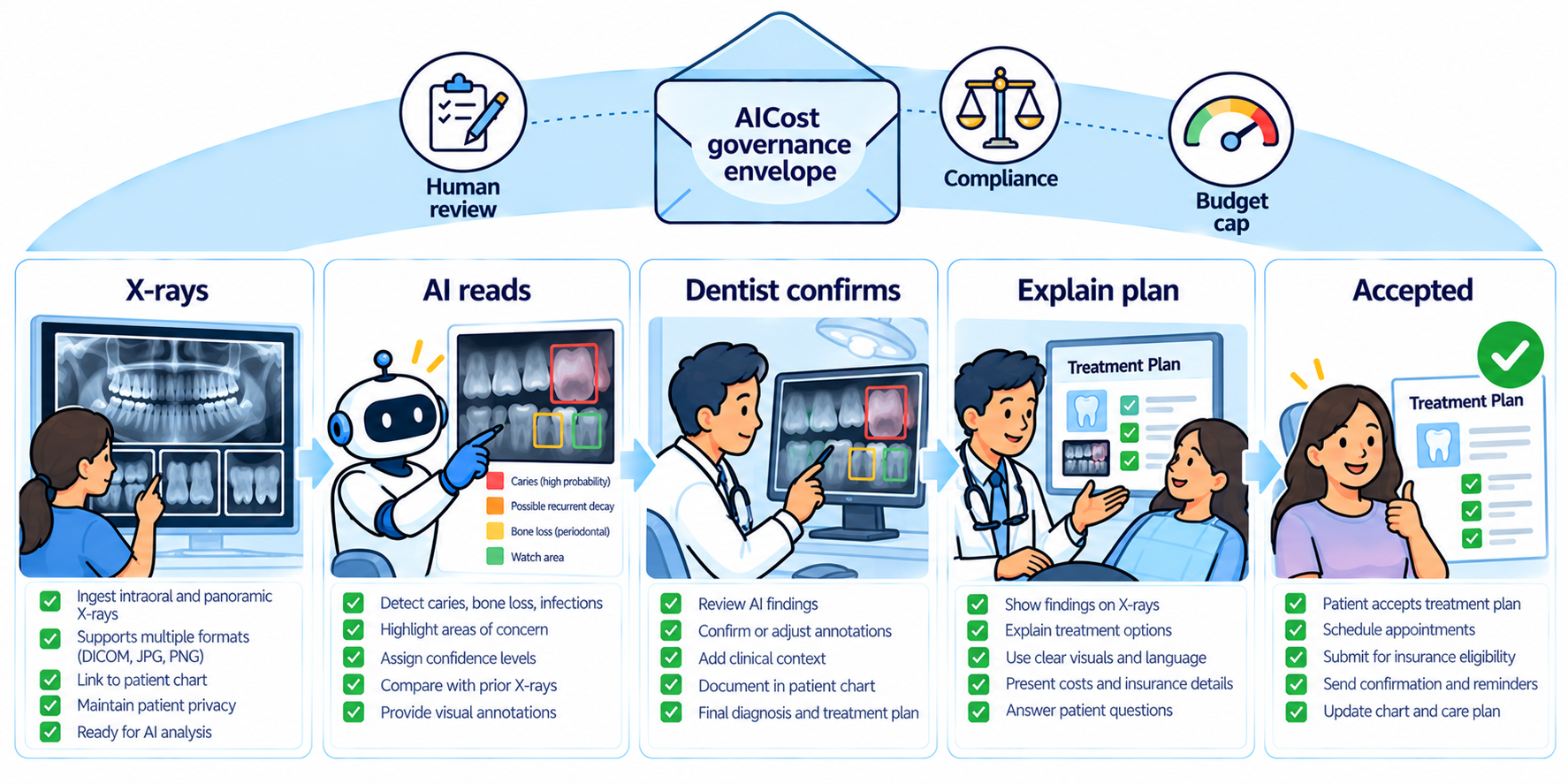
1 · cost
Read radiographs
$60
2 · cost
Patient explanations
$15
$5
3 · gate
Cheaper model for patient explanations
4 · governance
Dentist confirms findings
$6,000
5 · governance
FDA-cleared device use
$3,654
6 · gate
Accepted treatment vs AI cost
Without AICost
$9,729/mo
$3.24 per radiograph set
With AICost
$9,719/mo
$3.24 per radiograph set 0% lower
Monthly saving
$10/mo
3 cost levers applied
Governance controls
4
Monthly budget $100
Cost cutPrompt caching → Patient explanations −$4Model routing → Patient explanations −$3Batch the non-urgent work → Patient explanations −$3
Governance✓ Human review → Dentist confirms findings✓ Compliance evidence → FDA-cleared device use✓ Cost firewall at the gateway✓ Data-class model allowlist
Flow, picture, cost levers, governance and policy envelope
How the work flows today
1Capture bitewings, periapicals and panoramic images
2AI flags caries, calculus, bone loss and margins in real time
3Chairside review with the patient using annotated images
4Build the treatment plan in the PMS
5Attach AI-annotated images to insurance claims; payer-side review
AICost engine chain (blue: cost, purple: governance)
Cost levers and the step they act on
Prompt caching on step Patient explanations −$460% cacheable, 75% hit (applied to every eligible workflow) · Prompt CachingRepeated instructions and documents are cached, so you pay less for the same prompt text.
How it works: The stable part of each prompt (system instructions, tool definitions, reference text) is cached by the model provider and billed at the cached rate.
How AICost prices it: The Prompt Caching engine prices cacheable share and hit rate against the provider's cached-input price.
Governance: No change to answers, models or data. Only the billing of repeated text changes.
* Cacheable share and hit rate are typical values; your logs give the real ones.
Model routing on step Patient explanations −$320% of calls (image pre-screening) to Claude Haiku 5.5; critical work (flagged cases) stays on Claude Sonnet 5.5; patient data: routine steps only, same vendor and route as the primary model · Model RouterRoutine steps run on a cheaper model; critical steps stay on the primary model.
How it works: Each workflow type has routine work (triage, lookups, extraction, summaries, drafts) and critical work (the final answer, code changes, clinical or legal output, decisions). Routine calls go to the economy model; critical work stays on the primary model.
How AICost prices it: The Model Router engine prices the split between the economy and primary model on the workflow's own volume.
Governance: Only approved models for the data class are used. For patient and privileged legal data the share is capped and calls stay with the primary model's vendor and route, so the BAA still covers every call.
* The share of routine calls per workflow type is a starting assumption; your traffic sets the real split.
Batch the non-urgent work on step Patient explanations −$340% of calls through the batch API (applied to every eligible workflow) · Batch or RealtimeWork that can wait runs in the provider's batch mode at a lower price.
How it works: Requests that do not need an instant answer are queued and sent through the batch API.
How AICost prices it: The Batch or Realtime engine prices the batch-tolerant share at batch rates.
Governance: Urgent and customer-facing requests stay realtime.
* The batch-tolerant share is an input.
Governance controls and the step they act on
Human review on step Dentist confirms findings $6,000
Low-confidence, high-value or regulated cases go to a person.
Compliance evidence on step FDA-cleared device use $3,654
Audit logs, retention and assessments for the rules that apply.
Cost firewall at the gateway policy only, no cost
Monthly budget, daily cap, per-run ceiling, turn cap, spike rule, kill switch.
Data-class model allowlist policy only, no cost
Only models cleared for this data class are routable; others are refused at the gateway.
Policy envelope
Monthly budget$100
Daily hard cap$4
Per-run ceiling$0.05
Turn cap6
See the policy your gateway enforces
{
  "workload_id": "dental-radiograph-ai-and-treatment-plan-acceptance",
  "scope": "workload",
  "monthly_budget_usd": 100,
  "daily_warning_usd": 3.03,
  "daily_hard_limit_usd": 4.33,
  "max_cost_per_run_usd": 0.05,
  "max_model_calls_per_run": 6,
  "max_retries": 2,
  "max_output_tokens": 1200,
  "requests_per_min": 60,
  "anomaly": {
    "rolling_window": "7d",
    "spike_multiplier": 3,
    "rule": "flag any hour/day exceeding 3x the rolling average, or any single day above the daily hard limit"
  },
  "actions": {
    "warning_threshold": "notify",
    "soft_limit": "route_to:claude-haiku-5-5",
    "hard_limit": "block_noncritical_requests",
    "anomaly": "throttle_and_alert",
    "emergency": "block_all_and_require_approval"
  },
  "emergency_stop": {
    "enabled": true,
    "requires_approval_to_resume": true
  }
}
Where the cost runs away
- Per-location, per-image licensing across hundreds of offices
- Duplicate AI on both provider and payer side for the same claim
- Integration and IT cost per imaging system
Talk to us about this workflow →
📋 Health plans · Industry solutions
Prior authorization (utilization management) automation
15,000 prior auth request a month
AI receives prior authorization requests, extracts the clinical facts, matches them to medical policy and approves clear cases, while any denial goes to a clinician.
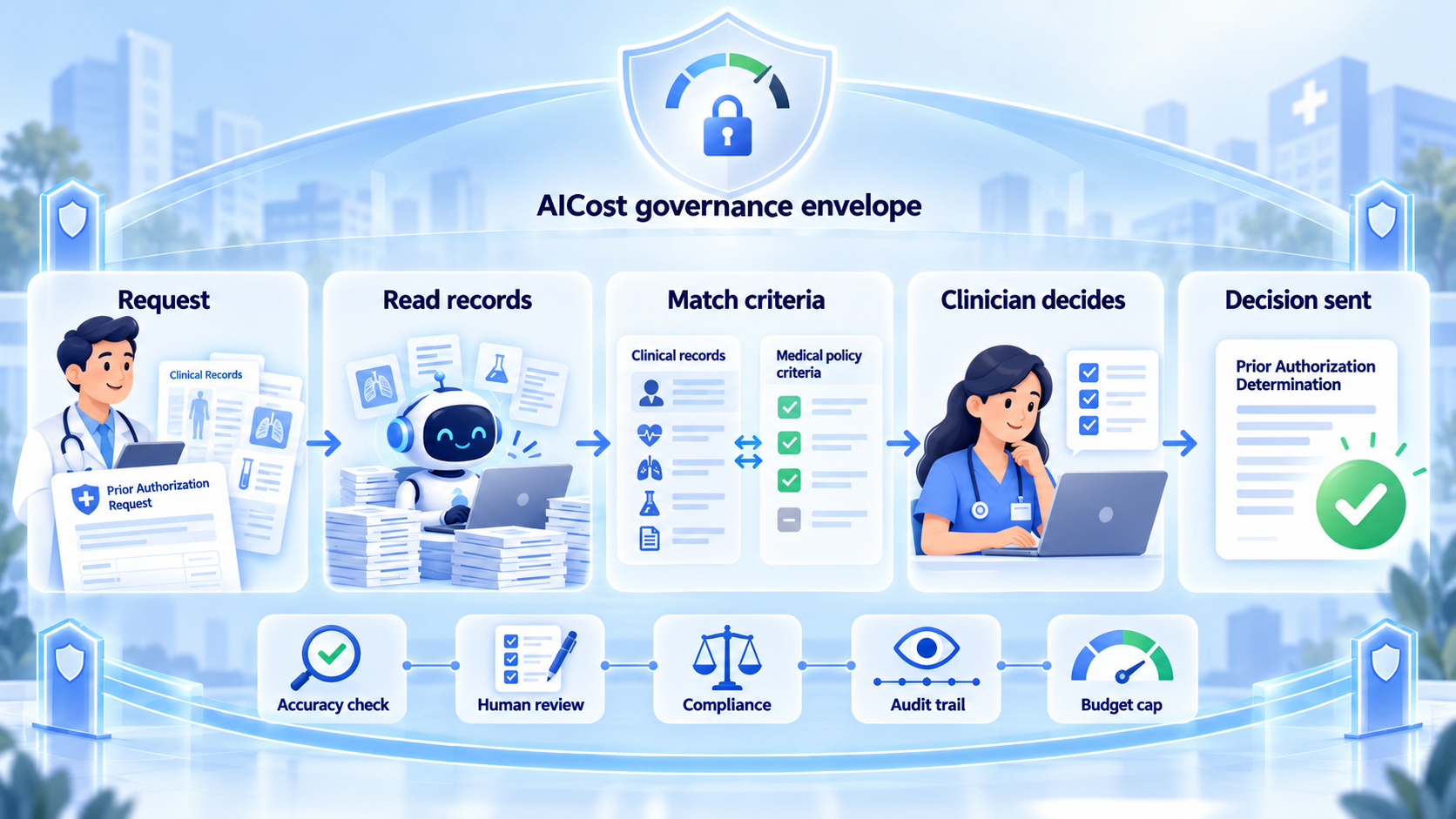
1 · cost
Read faxed and uploaded records
$5,325
2 · cost
Long clinical records
$2,775
$832
3 · gate
Cache medical policy criteria
4 · cost
Medical policy criteria
$510
5 · cost
Criteria matching
$1,350
6 · governance
Decision accuracy sampling
$94
7 · governance
Clinician makes every denial
$85,500
$42,750
8 · governance
CMS decision clocks
$3,654
9 · governance
Evidence for audits
$2
Without AICost
$99,210/mo
$6.61 per prior auth request
With AICost
$54,518/mo
$3.63 per prior auth request 45% lower
Monthly saving
$44,692/mo
5 cost levers applied
Governance controls
6
Monthly budget $3,100
Cost cutPrompt caching → Long clinical records −$617Context compaction → Long clinical records −$554Model routing → Long clinical records −$376Batch the non-urgent work → Long clinical records −$396Better grounding → Clinician makes every denial −$42,750
Governance✓ Accuracy and hallucination checks → Decision accuracy sampling✓ Human review → Clinician makes every denial✓ Compliance evidence → CMS decision clocks✓ Tracing and audit log → Evidence for audits✓ Cost firewall at the gateway✓ Data-class model allowlist
Flow, picture, cost levers, governance and policy envelope
How the work flows today
1Receive the PA request (ePA / FHIR API, portal, fax)
2Extract clinicals and match them to medical policy or criteria
3Auto-approve when criteria are clearly met
4Route non-approvals to a nurse or medical director with an AI summary
5Issue the decision with a specific denial reason within CMS timeframes; post status through the API
AICost engine chain (blue: cost, purple: governance)
Cost levers and the step they act on
Prompt caching on step Long clinical records −$61760% cacheable, 75% hit (combined with the other knobs on this step) · Prompt CachingRepeated instructions and documents are cached, so you pay less for the same prompt text.
How it works: The stable part of each prompt (system instructions, tool definitions, reference text) is cached by the model provider and billed at the cached rate.
How AICost prices it: The Prompt Caching engine prices cacheable share and hit rate against the provider's cached-input price.
Governance: No change to answers, models or data. Only the billing of repeated text changes.
* Cacheable share and hit rate are typical values; your logs give the real ones.
Context compaction on step Long clinical records −$554trim history 60%, net of overhead (applied to every eligible workflow) (combined with the other knobs on this step) · Context TrimLong histories are trimmed each turn, so every call carries less text.
How it works: Older turns and long documents are summarized or trimmed before each call, keeping what the model needs.
How AICost prices it: The Context Trim engine prices the smaller context net of the cost of trimming.
Governance: Quality is checked before rollout; nothing reaches the model that it was not allowed to see.
* The trim size is an input; your evals confirm it keeps answer quality.
Model routing on step Long clinical records −$37620% of calls (outlines and section summaries) to Claude Haiku 5.5; critical work (the drafted document) stays on Claude Sonnet 5.5; patient data: routine steps only, same vendor and route as the primary model (applied to every eligible workflow) (combined with the other knobs on this step) · Model RouterRoutine steps run on a cheaper model; critical steps stay on the primary model.
How it works: Each workflow type has routine work (triage, lookups, extraction, summaries, drafts) and critical work (the final answer, code changes, clinical or legal output, decisions). Routine calls go to the economy model; critical work stays on the primary model.
How AICost prices it: The Model Router engine prices the split between the economy and primary model on the workflow's own volume.
Governance: Only approved models for the data class are used. For patient and privileged legal data the share is capped and calls stay with the primary model's vendor and route, so the BAA still covers every call.
* The share of routine calls per workflow type is a starting assumption; your traffic sets the real split.
Batch the non-urgent work on step Long clinical records −$39640% of calls through the batch API (applied to every eligible workflow) (combined with the other knobs on this step) · Batch or RealtimeWork that can wait runs in the provider's batch mode at a lower price.
How it works: Requests that do not need an instant answer are queued and sent through the batch API.
How AICost prices it: The Batch or Realtime engine prices the batch-tolerant share at batch rates.
Governance: Urgent and customer-facing requests stay realtime.
* The batch-tolerant share is an input.
Better grounding on step Clinician makes every denial −$42,750escalation 30% to 15% · Human ReviewAnswers come only from your approved sources, so fewer cases go to a person.
How it works: The assistant answers from your own approved content with the source attached, and says it does not know instead of guessing. Teams get there with cleaner knowledge-base articles, better retrieval (tighter chunks, reranking) and an answer check before the reply goes out.
How AICost prices it: Fewer low-confidence answers means fewer escalations. The Human Review engine prices reviewer minutes at the lower escalation rate; the saving is the difference.
Governance: Human review stays on for refunds, policy exceptions and anything still low-confidence. Only the share of cases that needed a person goes down.
* The demo assumes escalations fall by half (for example 12% to 6%). Your number comes from your own evaluation results.
Governance controls and the step they act on
Accuracy and hallucination checks on step Decision accuracy sampling $94
Golden-set and live-traffic scoring catch silent regressions.
Human review on step Clinician makes every denial $85,500
Low-confidence, high-value or regulated cases go to a person.
Compliance evidence on step CMS decision clocks $3,654
Audit logs, retention and assessments for the rules that apply.
Tracing and audit log on step Evidence for audits $2
Every call logged with principal, model, tokens and spend state.
Cost firewall at the gateway policy only, no cost
Monthly budget, daily cap, per-run ceiling, turn cap, spike rule, kill switch.
Data-class model allowlist policy only, no cost
Only models cleared for this data class are routable; others are refused at the gateway.
Policy envelope
Monthly budget$3,100
Daily hard cap$134
Per-run ceiling$0.74
Turn cap8
See the policy your gateway enforces
{
  "workload_id": "prior-authorization-utilization-management-automation",
  "scope": "workload",
  "monthly_budget_usd": 3100,
  "daily_warning_usd": 94.03,
  "daily_hard_limit_usd": 134.33,
  "max_cost_per_run_usd": 0.74,
  "max_model_calls_per_run": 8,
  "max_retries": 2,
  "max_output_tokens": 1200,
  "requests_per_min": 140,
  "anomaly": {
    "rolling_window": "7d",
    "spike_multiplier": 3,
    "rule": "flag any hour/day exceeding 3x the rolling average, or any single day above the daily hard limit"
  },
  "actions": {
    "warning_threshold": "notify",
    "soft_limit": "route_to:claude-haiku-5-5",
    "hard_limit": "block_noncritical_requests",
    "anomaly": "throttle_and_alert",
    "emergency": "block_all_and_require_approval"
  },
  "emergency_stop": {
    "enabled": true,
    "requires_approval_to_resume": true
  }
}
Where the cost runs away
- Long clinical attachments (hundreds of pages) summarized per request and per resubmission
- Running full LLM review on requests the rules engine could auto-approve
- Duplicated AI on the provider side and payer side
Talk to us about this workflow →
📋 Health plans · Industry solutions
Member services: agent assist and call wrap-up
50,000 member call a month
While members call or chat, AI finds benefit and cost answers for the agent and writes the call summary.
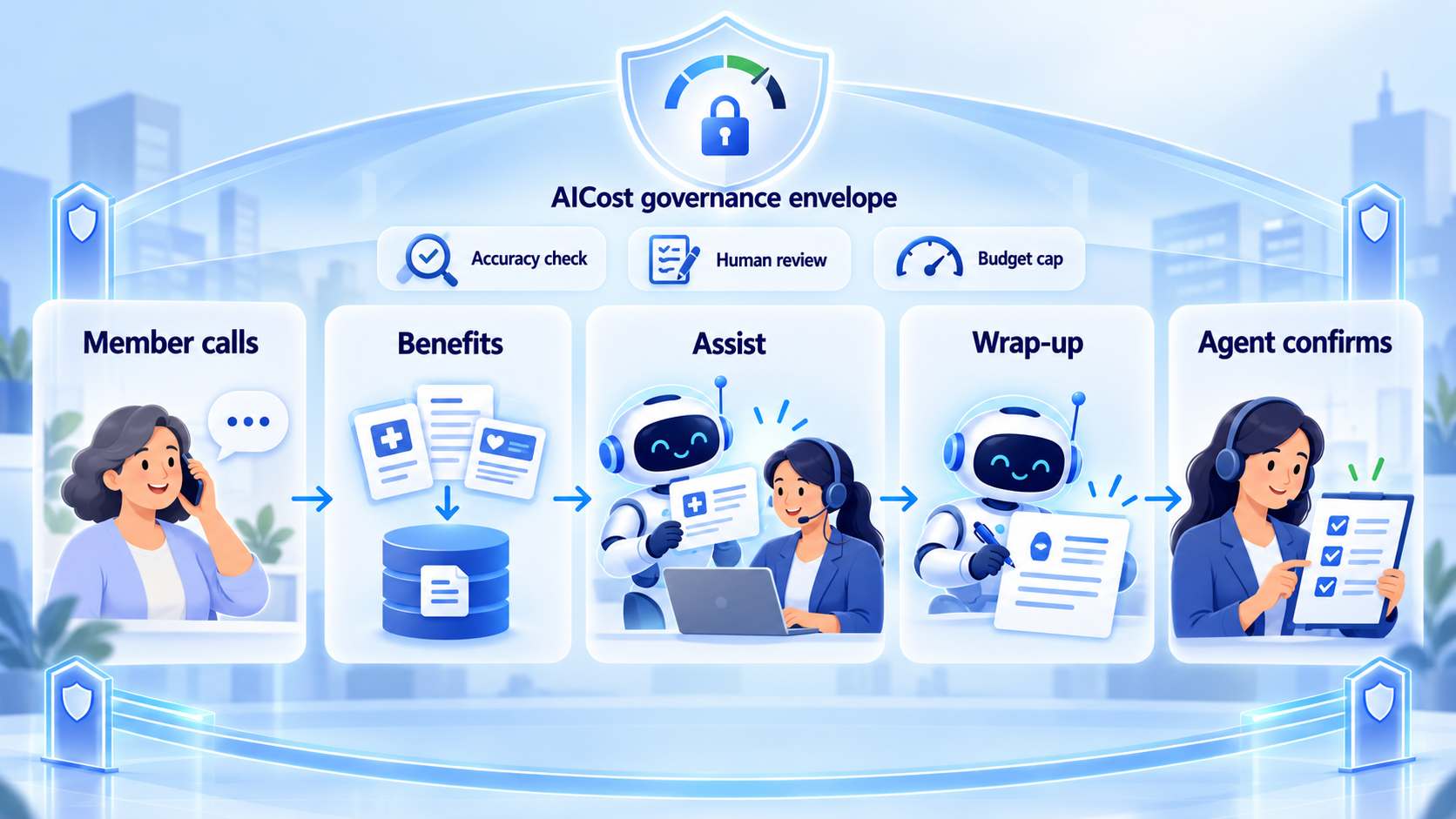
1 · cost
Transcribe member calls
$2,100
2 · cost
Benefit documents
$1,595
$479
3 · gate
Cache benefit documents
4 · gate
Batch the wrap-up summaries
5 · governance
Wrong benefit answers
$99
6 · governance
Agent confirms
$100,000
$80,000
7 · gate
Return per agent seat
Without AICost
$103,793/mo
$2.08 per member call
With AICost
$82,677/mo
$1.65 per member call 20% lower
Monthly saving
$21,116/mo
4 cost levers applied
Governance controls
4
Monthly budget $700
Cost cutPrompt caching → Benefit documents −$440Context compaction → Benefit documents −$395Model routing → Benefit documents −$281Shorter review with pre-checked drafts* → Agent confirms −$20,000
Governance✓ Accuracy and hallucination checks → Wrong benefit answers✓ Human review → Agent confirms✓ Cost firewall at the gateway✓ Data-class model allowlist
Flow, picture, cost levers, governance and policy envelope
How the work flows today
1Member contacts by phone, chat or app
2Virtual assistant answers benefits, cost-estimate and find-a-doctor questions
3Agent assist pulls eligibility, claims and benefits from multiple systems
4Auto-generate the post-call summary and disposition
5Analyze calls for root causes and quality
AICost engine chain (blue: cost, purple: governance)
Cost levers and the step they act on
Prompt caching on step Benefit documents −$44060% cacheable, 75% hit (combined with the other knobs on this step) · Prompt CachingRepeated instructions and documents are cached, so you pay less for the same prompt text.
How it works: The stable part of each prompt (system instructions, tool definitions, reference text) is cached by the model provider and billed at the cached rate.
How AICost prices it: The Prompt Caching engine prices cacheable share and hit rate against the provider's cached-input price.
Governance: No change to answers, models or data. Only the billing of repeated text changes.
* Cacheable share and hit rate are typical values; your logs give the real ones.
Context compaction on step Benefit documents −$395trim history 60%, net of overhead (applied to every eligible workflow) (combined with the other knobs on this step) · Context TrimLong histories are trimmed each turn, so every call carries less text.
How it works: Older turns and long documents are summarized or trimmed before each call, keeping what the model needs.
How AICost prices it: The Context Trim engine prices the smaller context net of the cost of trimming.
Governance: Quality is checked before rollout; nothing reaches the model that it was not allowed to see.
* The trim size is an input; your evals confirm it keeps answer quality.
Model routing on step Benefit documents −$28115% of calls (transcript cleanup and coding hints) to Claude Haiku 5.5; critical work (the clinical note itself) stays on Claude Sonnet 5.5; patient data: routine steps only, same vendor and route as the primary model (applied to every eligible workflow) (combined with the other knobs on this step) · Model RouterRoutine steps run on a cheaper model; critical steps stay on the primary model.
How it works: Each workflow type has routine work (triage, lookups, extraction, summaries, drafts) and critical work (the final answer, code changes, clinical or legal output, decisions). Routine calls go to the economy model; critical work stays on the primary model.
How AICost prices it: The Model Router engine prices the split between the economy and primary model on the workflow's own volume.
Governance: Only approved models for the data class are used. For patient and privileged legal data the share is capped and calls stay with the primary model's vendor and route, so the BAA still covers every call.
* The share of routine calls per workflow type is a starting assumption; your traffic sets the real split.
Shorter review with pre-checked drafts* on step Agent confirms −$20,000*assumption: 20% less edit time per member call when evals catch errors before the reviewer sees the draft; every member call is still reviewed · Human ReviewEvery item is still reviewed, but automated checks catch errors first, so review takes less time.
How it works: An evaluation step checks each draft before the reviewer sees it, so the reviewer edits less.
How AICost prices it: The Human Review engine prices reviewer time at the shorter review time.
Governance: Every item is still reviewed by a person.
* The time saved per review is an assumption, marked with an asterisk.
Governance controls and the step they act on
Accuracy and hallucination checks on step Wrong benefit answers $99
Golden-set and live-traffic scoring catch silent regressions.
Human review on step Agent confirms $100,000
Low-confidence, high-value or regulated cases go to a person.
Cost firewall at the gateway policy only, no cost
Monthly budget, daily cap, per-run ceiling, turn cap, spike rule, kill switch.
Data-class model allowlist policy only, no cost
Only models cleared for this data class are routable; others are refused at the gateway.
Policy envelope
Monthly budget$700
Daily hard cap$30
Per-run ceiling$0.13
Turn cap6
See the policy your gateway enforces
{
  "workload_id": "member-services-agent-assist-and-call-wrap-up",
  "scope": "workload",
  "monthly_budget_usd": 700,
  "daily_warning_usd": 21.23,
  "daily_hard_limit_usd": 30.33,
  "max_cost_per_run_usd": 0.13,
  "max_model_calls_per_run": 6,
  "max_retries": 2,
  "max_output_tokens": 1200,
  "requests_per_min": 470,
  "anomaly": {
    "rolling_window": "7d",
    "spike_multiplier": 3,
    "rule": "flag any hour/day exceeding 3x the rolling average, or any single day above the daily hard limit"
  },
  "actions": {
    "warning_threshold": "notify",
    "soft_limit": "route_to:claude-haiku-5-5",
    "hard_limit": "block_noncritical_requests",
    "anomaly": "throttle_and_alert",
    "emergency": "block_all_and_require_approval"
  },
  "emergency_stop": {
    "enabled": true,
    "requires_approval_to_resume": true
  }
}
Where the cost runs away
- Summarizing every call, including short ones that need no summary
- Long multi-system context per turn
- Analytics re-processing of the same transcripts
Talk to us about this workflow →
📋 Health plans · Industry solutions
Risk adjustment chart review and payment integrity
20,000 chart reviewed a month
AI reviews retrieved medical records for supported diagnoses in both directions and flags payment issues for coders.
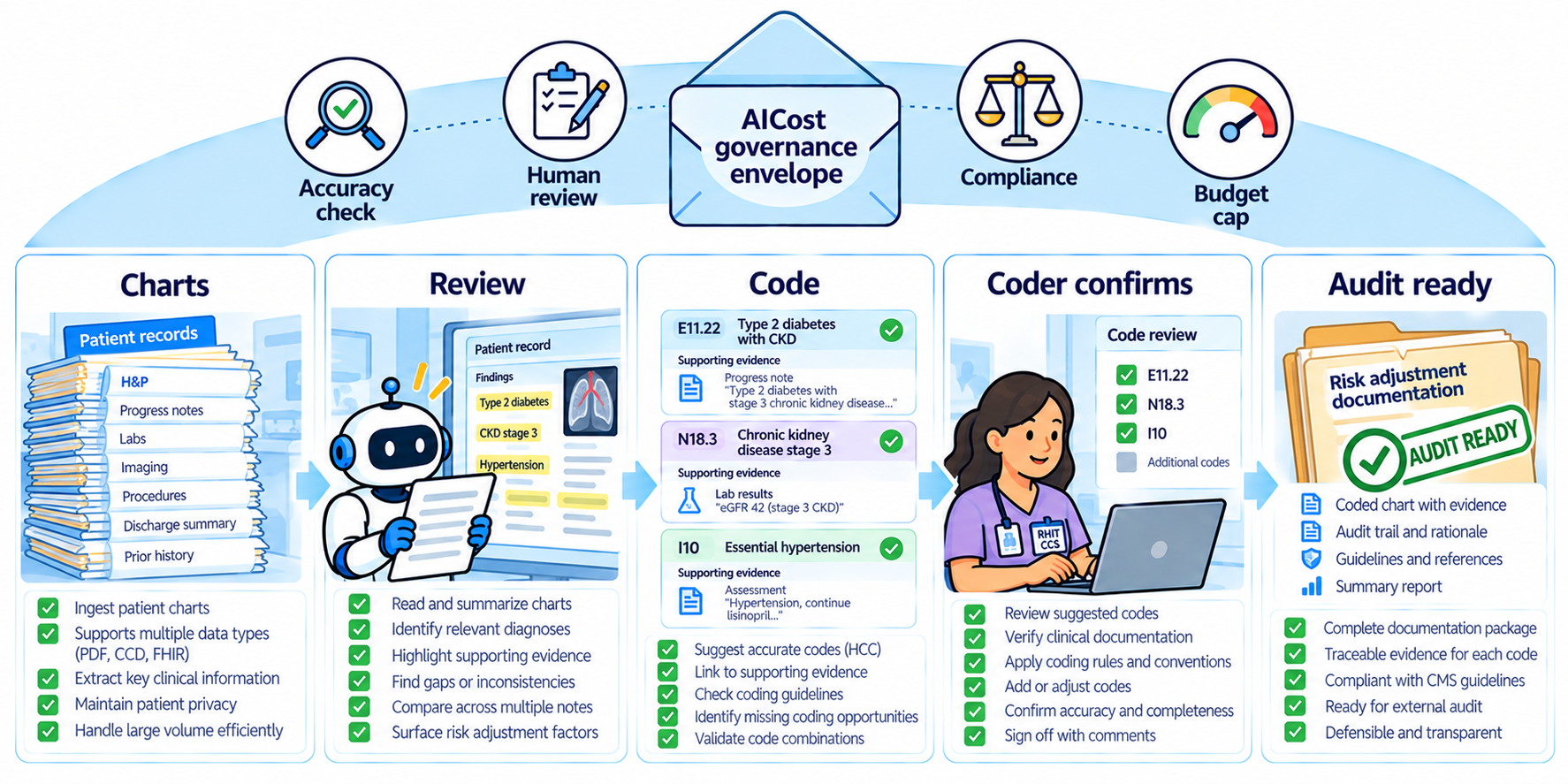
1 · cost
Chart backlog
$177
2 · cost
Model calls
$840
$252
3 · cost
Read charts
$11,360
5 · governance
Only supported codes
$95
6 · governance
Certified coder confirms
$48,000
$24,000
7 · governance
RADV audit evidence
$3,654
Without AICost
$64,125/mo
$3.21 per chart reviewed
With AICost
$39,537/mo
$1.98 per chart reviewed 38% lower
Monthly saving
$24,588/mo
4 cost levers applied
Governance controls
5
Monthly budget $400
Cost cutPrompt caching → Model calls −$184Model routing → Model calls −$157Batch the non-urgent work → Model calls −$247Better grounding → Certified coder confirms −$24,000
Governance✓ Accuracy and hallucination checks → Only supported codes✓ Human review → Certified coder confirms✓ Compliance evidence → RADV audit evidence✓ Cost firewall at the gateway✓ Data-class model allowlist
Flow, picture, cost levers, governance and policy envelope
How the work flows today
1Retrieve medical records (chart chase)
2NLP/LLM identifies HCC-supported diagnoses with MEAT evidence
3Coder validates adds and deletes (two-way review)
4Submit to CMS (encounter data / RAPS)
5Payment integrity: pre- and post-pay claim review for FWA and coding errors
AICost engine chain (blue: cost, purple: governance)
Cost levers and the step they act on
Prompt caching on step Model calls −$18460% cacheable, 75% hit (applied to every eligible workflow) (combined with the other knobs on this step) · Prompt CachingRepeated instructions and documents are cached, so you pay less for the same prompt text.
How it works: The stable part of each prompt (system instructions, tool definitions, reference text) is cached by the model provider and billed at the cached rate.
How AICost prices it: The Prompt Caching engine prices cacheable share and hit rate against the provider's cached-input price.
Governance: No change to answers, models or data. Only the billing of repeated text changes.
* Cacheable share and hit rate are typical values; your logs give the real ones.
Model routing on step Model calls −$15720% of calls (extraction and field checks) to Claude Haiku 5.5; critical work (exceptions) stays on Claude Sonnet 5.5; patient data: routine steps only, same vendor and route as the primary model (applied to every eligible workflow) (combined with the other knobs on this step) · Model RouterRoutine steps run on a cheaper model; critical steps stay on the primary model.
How it works: Each workflow type has routine work (triage, lookups, extraction, summaries, drafts) and critical work (the final answer, code changes, clinical or legal output, decisions). Routine calls go to the economy model; critical work stays on the primary model.
How AICost prices it: The Model Router engine prices the split between the economy and primary model on the workflow's own volume.
Governance: Only approved models for the data class are used. For patient and privileged legal data the share is capped and calls stay with the primary model's vendor and route, so the BAA still covers every call.
* The share of routine calls per workflow type is a starting assumption; your traffic sets the real split.
Batch the non-urgent work on step Model calls −$24760% of calls through the batch API (combined with the other knobs on this step) · Batch or RealtimeWork that can wait runs in the provider's batch mode at a lower price.
How it works: Requests that do not need an instant answer are queued and sent through the batch API.
How AICost prices it: The Batch or Realtime engine prices the batch-tolerant share at batch rates.
Governance: Urgent and customer-facing requests stay realtime.
* The batch-tolerant share is an input.
Better grounding on step Certified coder confirms −$24,000escalation 30% to 15% · Human ReviewAnswers come only from your approved sources, so fewer cases go to a person.
How it works: The assistant answers from your own approved content with the source attached, and says it does not know instead of guessing. Teams get there with cleaner knowledge-base articles, better retrieval (tighter chunks, reranking) and an answer check before the reply goes out.
How AICost prices it: Fewer low-confidence answers means fewer escalations. The Human Review engine prices reviewer minutes at the lower escalation rate; the saving is the difference.
Governance: Human review stays on for refunds, policy exceptions and anything still low-confidence. Only the share of cases that needed a person goes down.
* The demo assumes escalations fall by half (for example 12% to 6%). Your number comes from your own evaluation results.
Governance controls and the step they act on
Accuracy and hallucination checks on step Only supported codes $95
Golden-set and live-traffic scoring catch silent regressions.
Human review on step Certified coder confirms $48,000
Low-confidence, high-value or regulated cases go to a person.
Compliance evidence on step RADV audit evidence $3,654
Audit logs, retention and assessments for the rules that apply.
Cost firewall at the gateway policy only, no cost
Monthly budget, daily cap, per-run ceiling, turn cap, spike rule, kill switch.
Data-class model allowlist policy only, no cost
Only models cleared for this data class are routable; others are refused at the gateway.
Policy envelope
Monthly budget$400
Daily hard cap$17
Per-run ceiling$0.17
Turn cap6
See the policy your gateway enforces
{
  "workload_id": "risk-adjustment-chart-review-and-payment-integrity",
  "scope": "workload",
  "monthly_budget_usd": 400,
  "daily_warning_usd": 12.13,
  "daily_hard_limit_usd": 17.33,
  "max_cost_per_run_usd": 0.17,
  "max_model_calls_per_run": 6,
  "max_retries": 2,
  "max_output_tokens": 1200,
  "requests_per_min": 190,
  "anomaly": {
    "rolling_window": "7d",
    "spike_multiplier": 3,
    "rule": "flag any hour/day exceeding 3x the rolling average, or any single day above the daily hard limit"
  },
  "actions": {
    "warning_threshold": "notify",
    "soft_limit": "route_to:claude-haiku-5-5",
    "hard_limit": "block_noncritical_requests",
    "anomaly": "throttle_and_alert",
    "emergency": "block_all_and_require_approval"
  },
  "emergency_stop": {
    "enabled": true,
    "requires_approval_to_resume": true
  }
}
Where the cost runs away
- Processing whole charts (often 100+ pages) for every member each year
- Re-running models after each CMS-HCC model version change
- OCR plus LLM double processing
Talk to us about this workflow →
🏦 Banking · Industry solutions
KYC/AML alert review and case investigation
8,000 AML alert reviewed a month
AI gathers customer, transaction and screening data for KYC and AML alerts, drafts the investigation and recommends a disposition for an analyst.
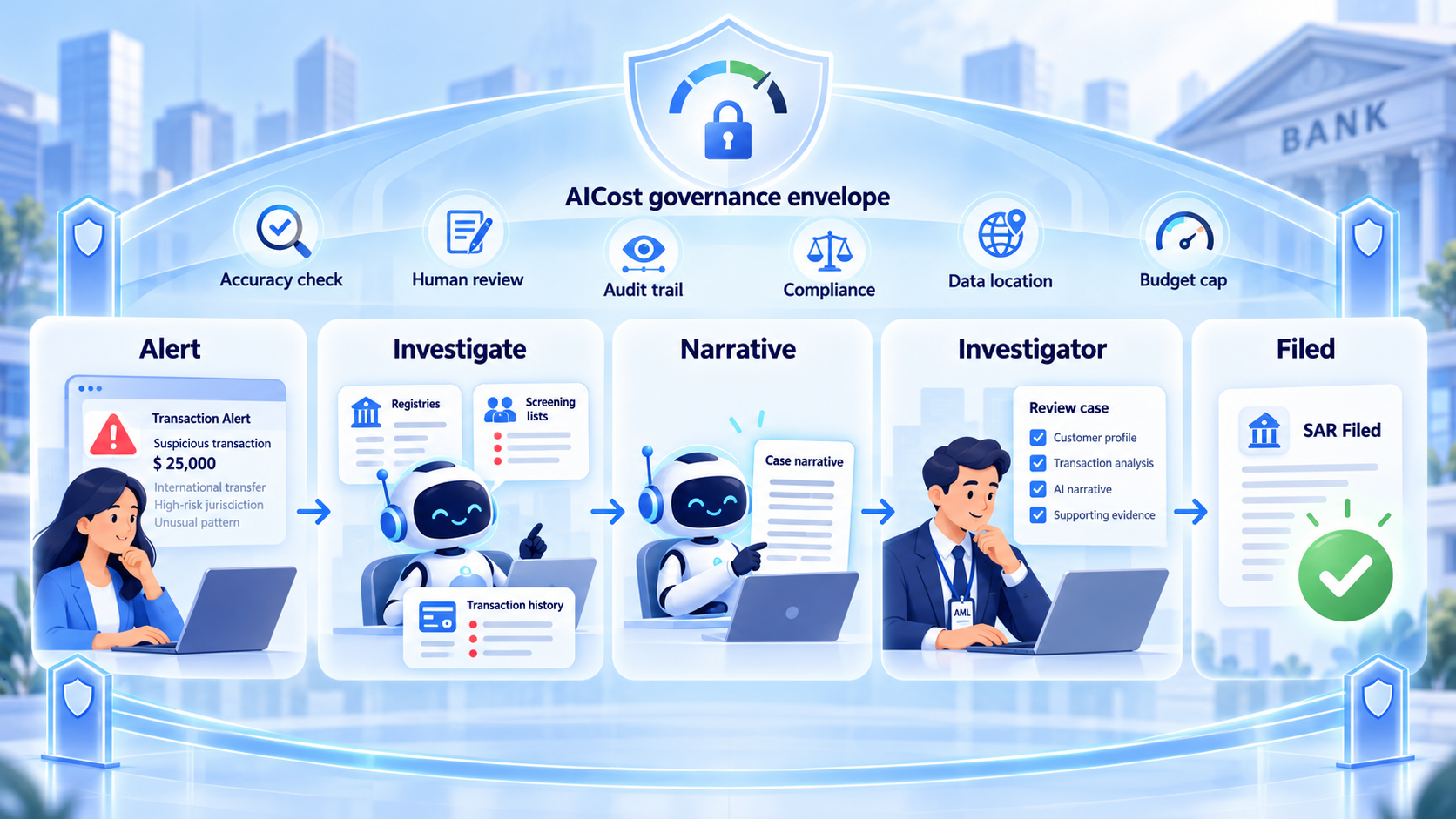
1 · cost
Investigation steps per alert
$9,548
$6,959
2 · cost
Registries and screening lists
$1,472
3 · cost
Stop runaway investigations
$9,548
$7,635
4 · governance
Narrative accuracy
$93
5 · governance
Investigator files the report
$74,667
$59,734
6 · governance
Model-risk evidence
$4
7 · governance
Model risk management
$3,654
8 · gate
Where customer data is processed
Without AICost
$98,985/mo
$12.37 per AML alert reviewed
With AICost
$79,551/mo
$9.94 per AML alert reviewed 20% lower
Monthly saving
$19,434/mo
6 cost levers applied
Governance controls
6
Monthly budget $16,200
Cost cutLoop cap → Stop runaway investigations −$1,913Prompt caching → Investigation steps per alert −$599Context compaction → Investigation steps per alert −$538Model routing → Investigation steps per alert −$876Batch the non-urgent work → Investigation steps per alert −$576Shorter review with pre-checked drafts* → Investigator files the report −$14,933
Governance✓ Accuracy and hallucination checks → Narrative accuracy✓ Human review → Investigator files the report✓ Tracing and audit log → Model-risk evidence✓ Compliance evidence → Model risk management✓ Cost firewall at the gateway✓ Data-class model allowlist
Flow, picture, cost levers, governance and policy envelope
How the work flows today
1Trigger: onboarding, periodic refresh or transaction-monitoring alert
2Gather data: registries, filings, adverse media, transactions
3Map ownership and identify UBOs; screen for PEPs and sanctions
4Analyze transactions and relationship purpose
5Draft the KYC memo or SAR narrative with a recommendation
6Human investigator decides and files (SAR); full audit trail kept
AICost engine chain (blue: cost, purple: governance)
Cost levers and the step they act on
Loop cap on step Stop runaway investigations −$1,91324 turns, 60k tokens, enforced by cost-firewall · Agent LoopA ceiling on turns and tokens per agent run, so a stuck agent cannot run up the bill.
How it works: Each agent run gets a maximum number of turns and tokens. A run that hits the ceiling stops and hands off instead of looping.
How AICost prices it: The Agent Loop engine prices the runs with and without the ceiling, including the runaway tail.
Governance: The cap is enforced by the cost firewall at your gateway, with an alert when it trips.
Prompt caching on step Investigation steps per alert −$59960% cacheable, 75% hit (applied to every eligible workflow) · Prompt CachingRepeated instructions and documents are cached, so you pay less for the same prompt text.
How it works: The stable part of each prompt (system instructions, tool definitions, reference text) is cached by the model provider and billed at the cached rate.
How AICost prices it: The Prompt Caching engine prices cacheable share and hit rate against the provider's cached-input price.
Governance: No change to answers, models or data. Only the billing of repeated text changes.
* Cacheable share and hit rate are typical values; your logs give the real ones.
Context compaction on step Investigation steps per alert −$538trim history 60%, net of overhead (applied to every eligible workflow) · Context TrimLong histories are trimmed each turn, so every call carries less text.
How it works: Older turns and long documents are summarized or trimmed before each call, keeping what the model needs.
How AICost prices it: The Context Trim engine prices the smaller context net of the cost of trimming.
Governance: Quality is checked before rollout; nothing reaches the model that it was not allowed to see.
* The trim size is an input; your evals confirm it keeps answer quality.
Model routing on step Investigation steps per alert −$87640% of calls (evidence gathering and summaries) to Claude Haiku 5.5; critical work (the decision and its rationale) stays on Claude Sonnet 5.5; financial data: routine steps only, approved models for this data class (applied to every eligible workflow) · Model RouterRoutine steps run on a cheaper model; critical steps stay on the primary model.
How it works: Each workflow type has routine work (triage, lookups, extraction, summaries, drafts) and critical work (the final answer, code changes, clinical or legal output, decisions). Routine calls go to the economy model; critical work stays on the primary model.
How AICost prices it: The Model Router engine prices the split between the economy and primary model on the workflow's own volume.
Governance: Only approved models for the data class are used. For patient and privileged legal data the share is capped and calls stay with the primary model's vendor and route, so the BAA still covers every call.
* The share of routine calls per workflow type is a starting assumption; your traffic sets the real split.
Batch the non-urgent work on step Investigation steps per alert −$57650% of calls through the batch API (applied to every eligible workflow) · Batch or RealtimeWork that can wait runs in the provider's batch mode at a lower price.
How it works: Requests that do not need an instant answer are queued and sent through the batch API.
How AICost prices it: The Batch or Realtime engine prices the batch-tolerant share at batch rates.
Governance: Urgent and customer-facing requests stay realtime.
* The batch-tolerant share is an input.
Shorter review with pre-checked drafts* on step Investigator files the report −$14,933*assumption: 20% less edit time per AML alert reviewed when evals catch errors before the reviewer sees the draft; every AML alert reviewed is still reviewed · Human ReviewEvery item is still reviewed, but automated checks catch errors first, so review takes less time.
How it works: An evaluation step checks each draft before the reviewer sees it, so the reviewer edits less.
How AICost prices it: The Human Review engine prices reviewer time at the shorter review time.
Governance: Every item is still reviewed by a person.
* The time saved per review is an assumption, marked with an asterisk.
Governance controls and the step they act on
Accuracy and hallucination checks on step Narrative accuracy $93
Golden-set and live-traffic scoring catch silent regressions.
Human review on step Investigator files the report $74,667
Low-confidence, high-value or regulated cases go to a person.
Tracing and audit log on step Model-risk evidence $4
Every call logged with principal, model, tokens and spend state.
Compliance evidence on step Model risk management $3,654
Audit logs, retention and assessments for the rules that apply.
Cost firewall at the gateway policy only, no cost
Monthly budget, daily cap, per-run ceiling, turn cap, spike rule, kill switch.
Data-class model allowlist policy only, no cost
Only models cleared for this data class are routable; others are refused at the gateway.
Policy envelope
Monthly budget$16,200
Daily hard cap$702
Per-run ceiling$4.77
Turn cap24
See the policy your gateway enforces
{
  "workload_id": "kyc-aml-alert-review-and-case-investigation",
  "scope": "workload",
  "monthly_budget_usd": 16200,
  "daily_warning_usd": 491.4,
  "daily_hard_limit_usd": 702,
  "max_cost_per_run_usd": 4.77,
  "max_model_calls_per_run": 24,
  "max_retries": 2,
  "max_output_tokens": 1200,
  "requests_per_min": 80,
  "anomaly": {
    "rolling_window": "7d",
    "spike_multiplier": 3,
    "rule": "flag any hour/day exceeding 3x the rolling average, or any single day above the daily hard limit"
  },
  "actions": {
    "warning_threshold": "notify",
    "soft_limit": "route_to:claude-haiku-5-5",
    "hard_limit": "block_noncritical_requests",
    "anomaly": "throttle_and_alert",
    "emergency": "block_all_and_require_approval"
  },
  "emergency_stop": {
    "enabled": true,
    "requires_approval_to_resume": true
  }
}
Where the cost runs away
- Multi-agent squads (4-5 agents per step, 10 steps) multiplying tokens per case
- Adverse-media web searches and long filings per entity
- Re-running full investigations on periodic refresh
Talk to us about this workflow →
🏦 Banking · Industry solutions
Commercial credit: spreading and credit memo drafting
AI spreads financial statements and tax returns and drafts the credit memo for the underwriter.
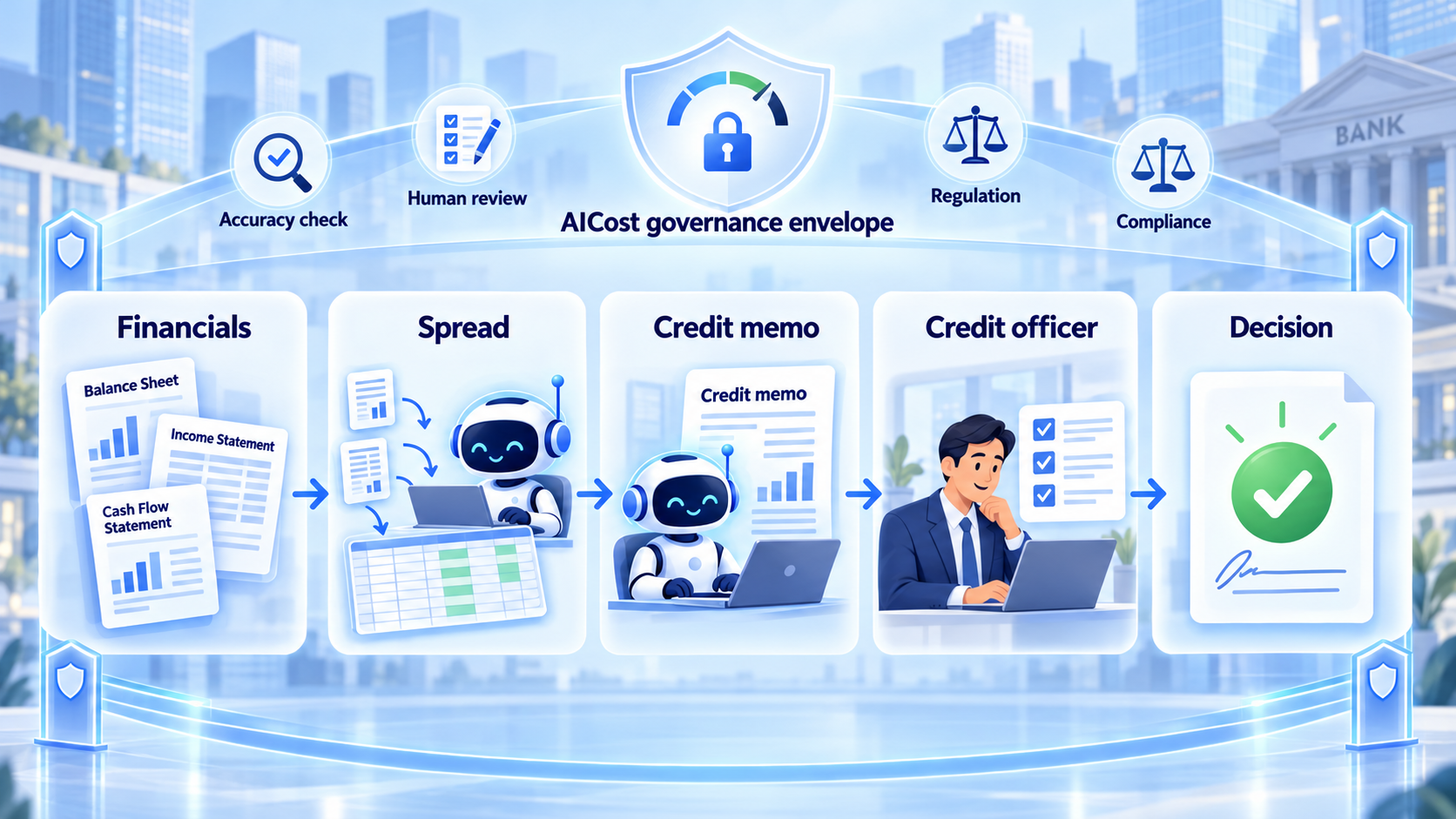
1 · cost
Read financial statements
$256
2 · cost
Spreading per borrower
$255
$77
3 · gate
Cache the credit policy
4 · gate
Spread statements in batch
5 · cost
Credit memo drafting
$38
6 · governance
Spread tie-out
$92
7 · governance
Credit officer decides
$27,000
$21,600
8 · gate
Credit scoring is high-risk in the EU
9 · governance
Fair-lending and model risk
$3,654
Without AICost
$31,294/mo
$104.31 per credit memo
With AICost
$25,716/mo
$85.72 per credit memo 18% lower
Monthly saving
$5,578/mo
5 cost levers applied
Governance controls
5
Monthly budget $300
Cost cutPrompt caching → Spreading per borrower −$54Context compaction → Spreading per borrower −$48Model routing → Spreading per borrower −$37Batch the non-urgent work → Spreading per borrower −$39Shorter review with pre-checked drafts* → Credit officer decides −$5,400
Governance✓ Accuracy and hallucination checks → Spread tie-out✓ Human review → Credit officer decides✓ Compliance evidence → Fair-lending and model risk✓ Cost firewall at the gateway✓ Data-class model allowlist
Flow, picture, cost levers, governance and policy envelope
How the work flows today
1Collect financial statements, tax returns and the application
2Automated financial spreading and validation
3Risk rating and covenant analysis
4Draft the credit memo (borrower, industry, cash flow, risks)
5Credit officer review, approval and booking
AICost engine chain (blue: cost, purple: governance)
Cost levers and the step they act on
Prompt caching on step Spreading per borrower −$5460% cacheable, 75% hit (combined with the other knobs on this step) · Prompt CachingRepeated instructions and documents are cached, so you pay less for the same prompt text.
How it works: The stable part of each prompt (system instructions, tool definitions, reference text) is cached by the model provider and billed at the cached rate.
How AICost prices it: The Prompt Caching engine prices cacheable share and hit rate against the provider's cached-input price.
Governance: No change to answers, models or data. Only the billing of repeated text changes.
* Cacheable share and hit rate are typical values; your logs give the real ones.
Context compaction on step Spreading per borrower −$48trim history 60%, net of overhead (applied to every eligible workflow) (combined with the other knobs on this step) · Context TrimLong histories are trimmed each turn, so every call carries less text.
How it works: Older turns and long documents are summarized or trimmed before each call, keeping what the model needs.
How AICost prices it: The Context Trim engine prices the smaller context net of the cost of trimming.
Governance: Quality is checked before rollout; nothing reaches the model that it was not allowed to see.
* The trim size is an input; your evals confirm it keeps answer quality.
Model routing on step Spreading per borrower −$3720% of calls (outlines and section summaries) to Claude Haiku 5.5; critical work (the drafted document) stays on Claude Sonnet 5.5; financial data: routine steps only, approved models for this data class (applied to every eligible workflow) (combined with the other knobs on this step) · Model RouterRoutine steps run on a cheaper model; critical steps stay on the primary model.
How it works: Each workflow type has routine work (triage, lookups, extraction, summaries, drafts) and critical work (the final answer, code changes, clinical or legal output, decisions). Routine calls go to the economy model; critical work stays on the primary model.
How AICost prices it: The Model Router engine prices the split between the economy and primary model on the workflow's own volume.
Governance: Only approved models for the data class are used. For patient and privileged legal data the share is capped and calls stay with the primary model's vendor and route, so the BAA still covers every call.
* The share of routine calls per workflow type is a starting assumption; your traffic sets the real split.
Batch the non-urgent work on step Spreading per borrower −$3940% of calls through the batch API (combined with the other knobs on this step) · Batch or RealtimeWork that can wait runs in the provider's batch mode at a lower price.
How it works: Requests that do not need an instant answer are queued and sent through the batch API.
How AICost prices it: The Batch or Realtime engine prices the batch-tolerant share at batch rates.
Governance: Urgent and customer-facing requests stay realtime.
* The batch-tolerant share is an input.
Shorter review with pre-checked drafts* on step Credit officer decides −$5,400*assumption: 20% less edit time per credit memo when evals catch errors before the reviewer sees the draft; every credit memo is still reviewed · Human ReviewEvery item is still reviewed, but automated checks catch errors first, so review takes less time.
How it works: An evaluation step checks each draft before the reviewer sees it, so the reviewer edits less.
How AICost prices it: The Human Review engine prices reviewer time at the shorter review time.
Governance: Every item is still reviewed by a person.
* The time saved per review is an assumption, marked with an asterisk.
Governance controls and the step they act on
Accuracy and hallucination checks on step Spread tie-out $92
Golden-set and live-traffic scoring catch silent regressions.
Human review on step Credit officer decides $27,000
Low-confidence, high-value or regulated cases go to a person.
Compliance evidence on step Fair-lending and model risk $3,654
Audit logs, retention and assessments for the rules that apply.
Cost firewall at the gateway policy only, no cost
Monthly budget, daily cap, per-run ceiling, turn cap, spike rule, kill switch.
Data-class model allowlist policy only, no cost
Only models cleared for this data class are routable; others are refused at the gateway.
Policy envelope
Monthly budget$300
Daily hard cap$13
Per-run ceiling$3.40
Turn cap20
See the policy your gateway enforces
{
  "workload_id": "commercial-credit-spreading-and-credit-memo-drafting",
  "scope": "workload",
  "monthly_budget_usd": 300,
  "daily_warning_usd": 9.1,
  "daily_hard_limit_usd": 13,
  "max_cost_per_run_usd": 3.4,
  "max_model_calls_per_run": 20,
  "max_retries": 2,
  "max_output_tokens": 1200,
  "requests_per_min": 60,
  "anomaly": {
    "rolling_window": "7d",
    "spike_multiplier": 3,
    "rule": "flag any hour/day exceeding 3x the rolling average, or any single day above the daily hard limit"
  },
  "actions": {
    "warning_threshold": "notify",
    "soft_limit": "route_to:claude-haiku-5-5",
    "hard_limit": "block_noncritical_requests",
    "anomaly": "throttle_and_alert",
    "emergency": "block_all_and_require_approval"
  },
  "emergency_stop": {
    "enabled": true,
    "requires_approval_to_resume": true
  }
}
Where the cost runs away
- Multi-year statements re-extracted for each renewal
- Long memos regenerated per review comment
- Bank-wide copilots priced per seat with low use
Talk to us about this workflow →
🏦 Banking · Industry solutions
Advisor and banker assistant (knowledge Q&A and meeting notes)
6,000 advisor meeting a month
Advisors ask an AI assistant about research, products and procedures, and it writes meeting notes and follow-ups after client meetings.
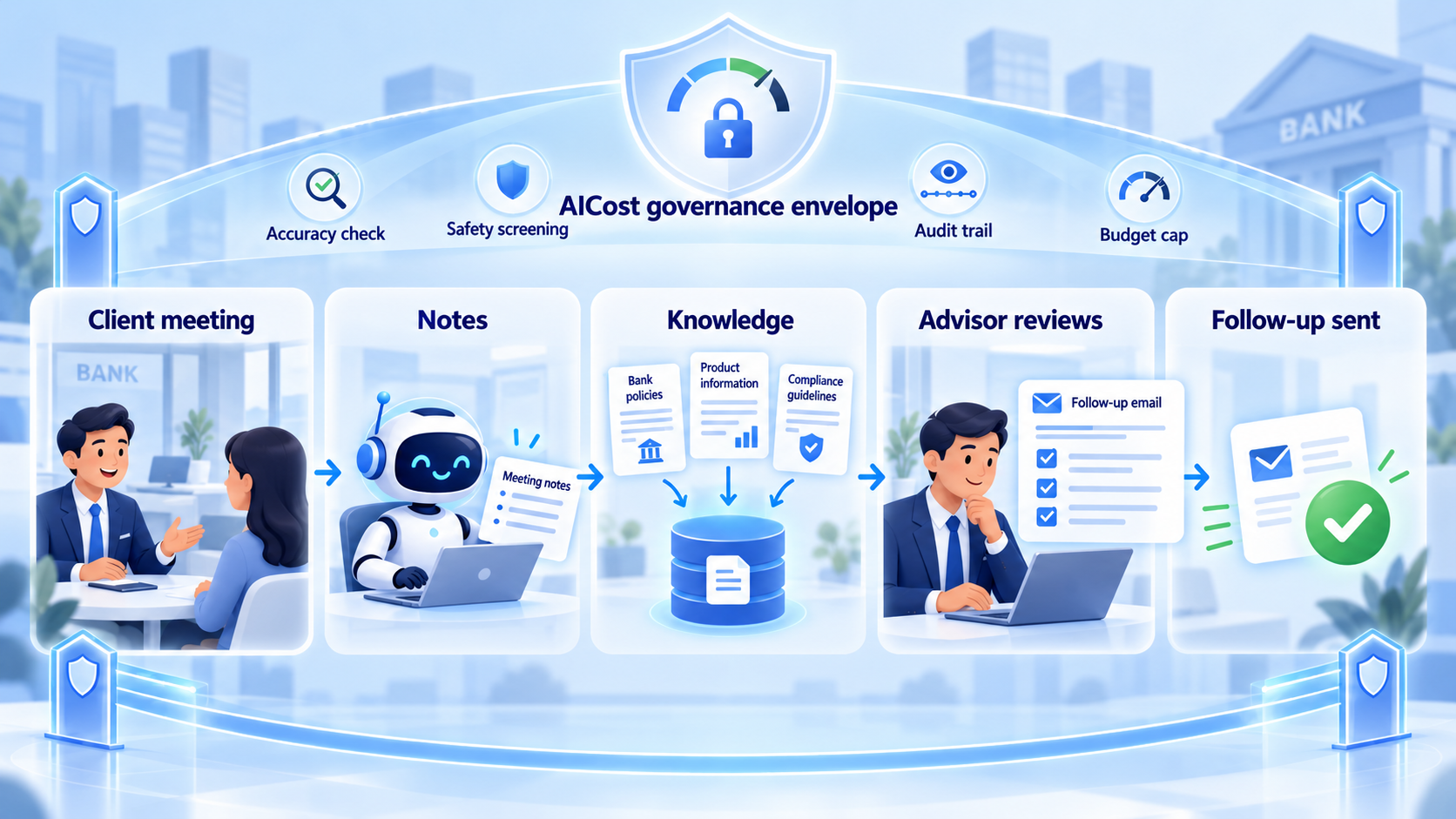
1 · cost
Answer from research and policy
$231
$69
2 · gate
Cache research and policy context
3 · gate
Small model for simple lookups
4 · cost
Meeting notes
$1,080
5 · governance
Wrong product facts
$93
6 · governance
Suitability guardrails
$4
7 · governance
Books-and-records retention
$0
8 · gate
Return per advisor seat
Without AICost
$1,408/mo
$0.23 per advisor meeting
With AICost
$1,247/mo
$0.21 per advisor meeting 11% lower
Monthly saving
$161/mo
3 cost levers applied
Governance controls
5
Monthly budget $200
Cost cutPrompt caching → Answer from research and policy −$64Context compaction → Answer from research and policy −$57Model routing → Answer from research and policy −$41
Governance✓ Accuracy and hallucination checks → Wrong product facts✓ Guardrail screening → Suitability guardrails✓ Tracing and audit log → Books-and-records retention✓ Cost firewall at the gateway✓ Data-class model allowlist
Flow, picture, cost levers, governance and policy envelope
How the work flows today
1Advisor asks the knowledge assistant over research and procedures
2Record the client meeting with consent
3Generate notes, action items and a follow-up email draft
4Save to CRM after advisor review
5Compliance supervision and record retention
AICost engine chain (blue: cost, purple: governance)
Cost levers and the step they act on
Prompt caching on step Answer from research and policy −$6460% cacheable, 75% hit (combined with the other knobs on this step) · Prompt CachingRepeated instructions and documents are cached, so you pay less for the same prompt text.
How it works: The stable part of each prompt (system instructions, tool definitions, reference text) is cached by the model provider and billed at the cached rate.
How AICost prices it: The Prompt Caching engine prices cacheable share and hit rate against the provider's cached-input price.
Governance: No change to answers, models or data. Only the billing of repeated text changes.
* Cacheable share and hit rate are typical values; your logs give the real ones.
Context compaction on step Answer from research and policy −$57trim history 60%, net of overhead (applied to every eligible workflow) (combined with the other knobs on this step) · Context TrimLong histories are trimmed each turn, so every call carries less text.
How it works: Older turns and long documents are summarized or trimmed before each call, keeping what the model needs.
How AICost prices it: The Context Trim engine prices the smaller context net of the cost of trimming.
Governance: Quality is checked before rollout; nothing reaches the model that it was not allowed to see.
* The trim size is an input; your evals confirm it keeps answer quality.
Model routing on step Answer from research and policy −$4115% of calls (transcript cleanup and coding hints) to Claude Haiku 5.5; critical work (the clinical note itself) stays on Claude Sonnet 5.5; financial data: routine steps only, approved models for this data class (combined with the other knobs on this step) · Model RouterRoutine steps run on a cheaper model; critical steps stay on the primary model.
How it works: Each workflow type has routine work (triage, lookups, extraction, summaries, drafts) and critical work (the final answer, code changes, clinical or legal output, decisions). Routine calls go to the economy model; critical work stays on the primary model.
How AICost prices it: The Model Router engine prices the split between the economy and primary model on the workflow's own volume.
Governance: Only approved models for the data class are used. For patient and privileged legal data the share is capped and calls stay with the primary model's vendor and route, so the BAA still covers every call.
* The share of routine calls per workflow type is a starting assumption; your traffic sets the real split.
Governance controls and the step they act on
Accuracy and hallucination checks on step Wrong product facts $93
Golden-set and live-traffic scoring catch silent regressions.
Guardrail screening on step Suitability guardrails $4
PII, prompt-attack and policy screening before the model acts.
Tracing and audit log on step Books-and-records retention
Every call logged with principal, model, tokens and spend state.
Cost firewall at the gateway policy only, no cost
Monthly budget, daily cap, per-run ceiling, turn cap, spike rule, kill switch.
Data-class model allowlist policy only, no cost
Only models cleared for this data class are routable; others are refused at the gateway.
Policy envelope
Monthly budget$200
Daily hard cap$9
Per-run ceiling$0.15
Turn cap6
See the policy your gateway enforces
{
  "workload_id": "advisor-and-banker-assistant-knowledge-q-a-and-meeting-notes",
  "scope": "workload",
  "monthly_budget_usd": 200,
  "daily_warning_usd": 6.07,
  "daily_hard_limit_usd": 8.67,
  "max_cost_per_run_usd": 0.15,
  "max_model_calls_per_run": 6,
  "max_retries": 2,
  "max_output_tokens": 1200,
  "requests_per_min": 60,
  "anomaly": {
    "rolling_window": "7d",
    "spike_multiplier": 3,
    "rule": "flag any hour/day exceeding 3x the rolling average, or any single day above the daily hard limit"
  },
  "actions": {
    "warning_threshold": "notify",
    "soft_limit": "route_to:claude-haiku-5-5",
    "hard_limit": "block_noncritical_requests",
    "anomaly": "throttle_and_alert",
    "emergency": "block_all_and_require_approval"
  },
  "emergency_stop": {
    "enabled": true,
    "requires_approval_to_resume": true
  }
}
Where the cost runs away
- Seat licenses for tens of thousands of employees
- Large-corpus retrieval with long contexts per question
- Meeting transcription of every call by default
Talk to us about this workflow →
☂️ Insurance · Industry solutions
Claims FNOL, triage and fraud flags
10,000 claim opened a month
AI captures the first notice of loss, triages the claim by complexity and flags possible fraud for adjusters.
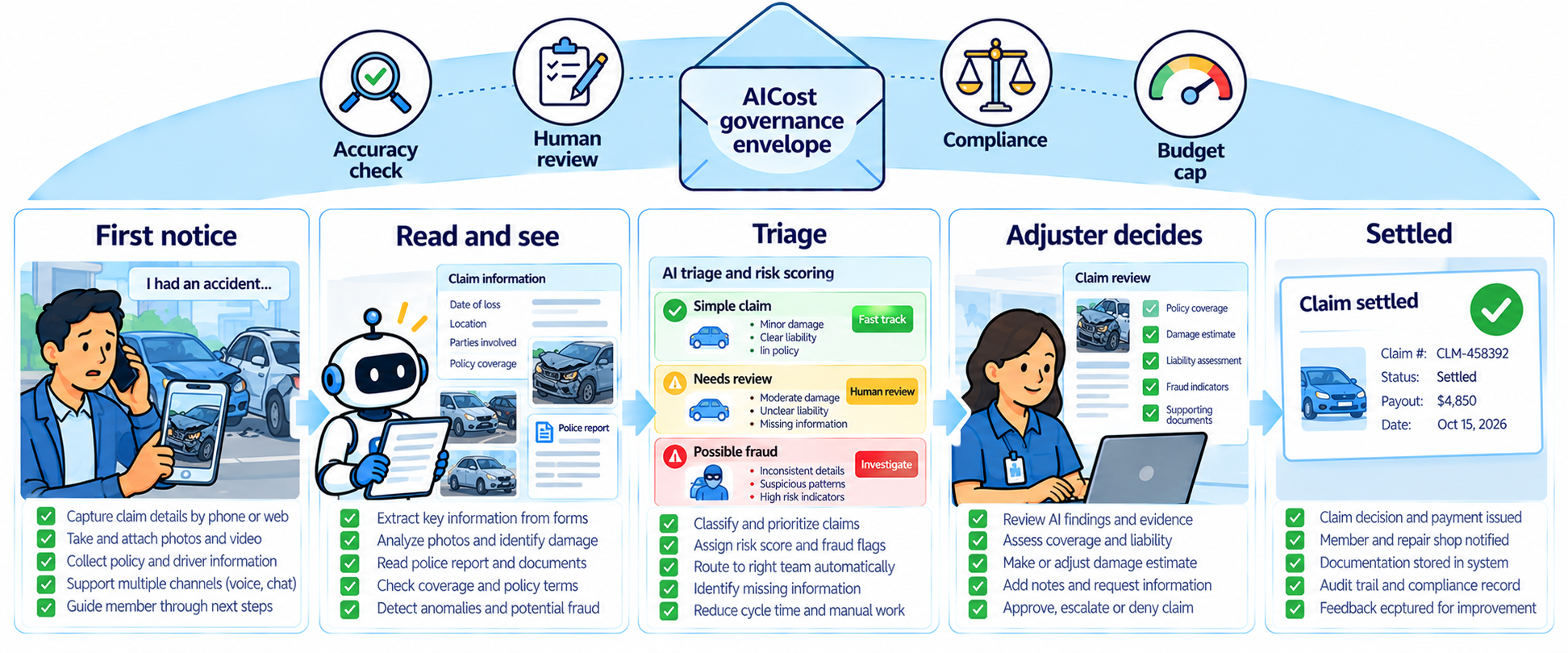
1 · cost
Transcribe first-notice calls
$480
2 · cost
Model calls
$420
$126
3 · cost
Read claim documents
$710
4 · cost
Damage photos
$300
5 · gate
Small model for simple claims
6 · governance
Fraud-flag accuracy and bias
$94
7 · governance
Adjuster decides
$32,000
$16,000
8 · governance
State AI rules for insurers
$3,654
Without AICost
$37,657/mo
$3.77 per claim opened
With AICost
$21,363/mo
$2.14 per claim opened 43% lower
Monthly saving
$16,294/mo
4 cost levers applied
Governance controls
5
Monthly budget $600
Cost cutPrompt caching → Model calls −$60Model routing → Model calls −$153Batch the non-urgent work → Model calls −$81Better grounding → Adjuster decides −$16,000
Governance✓ Accuracy and hallucination checks → Fraud-flag accuracy and bias✓ Human review → Adjuster decides✓ Compliance evidence → State AI rules for insurers✓ Cost firewall at the gateway✓ Data-class model allowlist
Flow, picture, cost levers, governance and policy envelope
How the work flows today
1First notice of loss by phone, app or email; capture photos and documents
2Coverage verification and severity triage (fast-track vs complex)
3Fraud scoring and SIU referral
4Claim file summarization for the adjuster
5Settlement, payment and subrogation or recovery
AICost engine chain (blue: cost, purple: governance)
Cost levers and the step they act on
Prompt caching on step Model calls −$6060% cacheable, 75% hit (applied to every eligible workflow) (combined with the other knobs on this step) · Prompt CachingRepeated instructions and documents are cached, so you pay less for the same prompt text.
How it works: The stable part of each prompt (system instructions, tool definitions, reference text) is cached by the model provider and billed at the cached rate.
How AICost prices it: The Prompt Caching engine prices cacheable share and hit rate against the provider's cached-input price.
Governance: No change to answers, models or data. Only the billing of repeated text changes.
* Cacheable share and hit rate are typical values; your logs give the real ones.
Model routing on step Model calls −$15360% of calls (extraction and field checks) to Claude Haiku 5.5; critical work (exceptions) stays on Claude Sonnet 5.5 (combined with the other knobs on this step) · Model RouterRoutine steps run on a cheaper model; critical steps stay on the primary model.
How it works: Each workflow type has routine work (triage, lookups, extraction, summaries, drafts) and critical work (the final answer, code changes, clinical or legal output, decisions). Routine calls go to the economy model; critical work stays on the primary model.
How AICost prices it: The Model Router engine prices the split between the economy and primary model on the workflow's own volume.
Governance: Only approved models for the data class are used. For patient and privileged legal data the share is capped and calls stay with the primary model's vendor and route, so the BAA still covers every call.
* The share of routine calls per workflow type is a starting assumption; your traffic sets the real split.
Batch the non-urgent work on step Model calls −$8160% of calls through the batch API (applied to every eligible workflow) (combined with the other knobs on this step) · Batch or RealtimeWork that can wait runs in the provider's batch mode at a lower price.
How it works: Requests that do not need an instant answer are queued and sent through the batch API.
How AICost prices it: The Batch or Realtime engine prices the batch-tolerant share at batch rates.
Governance: Urgent and customer-facing requests stay realtime.
* The batch-tolerant share is an input.
Better grounding on step Adjuster decides −$16,000escalation 40% to 20% · Human ReviewAnswers come only from your approved sources, so fewer cases go to a person.
How it works: The assistant answers from your own approved content with the source attached, and says it does not know instead of guessing. Teams get there with cleaner knowledge-base articles, better retrieval (tighter chunks, reranking) and an answer check before the reply goes out.
How AICost prices it: Fewer low-confidence answers means fewer escalations. The Human Review engine prices reviewer minutes at the lower escalation rate; the saving is the difference.
Governance: Human review stays on for refunds, policy exceptions and anything still low-confidence. Only the share of cases that needed a person goes down.
* The demo assumes escalations fall by half (for example 12% to 6%). Your number comes from your own evaluation results.
Governance controls and the step they act on
Accuracy and hallucination checks on step Fraud-flag accuracy and bias $94
Golden-set and live-traffic scoring catch silent regressions.
Human review on step Adjuster decides $32,000
Low-confidence, high-value or regulated cases go to a person.
Compliance evidence on step State AI rules for insurers $3,654
Audit logs, retention and assessments for the rules that apply.
Cost firewall at the gateway policy only, no cost
Monthly budget, daily cap, per-run ceiling, turn cap, spike rule, kill switch.
Data-class model allowlist policy only, no cost
Only models cleared for this data class are routable; others are refused at the gateway.
Policy envelope
Monthly budget$600
Daily hard cap$26
Per-run ceiling$0.17
Turn cap6
See the policy your gateway enforces
{
  "workload_id": "claims-fnol-triage-and-fraud-flags",
  "scope": "workload",
  "monthly_budget_usd": 600,
  "daily_warning_usd": 18.2,
  "daily_hard_limit_usd": 26,
  "max_cost_per_run_usd": 0.17,
  "max_model_calls_per_run": 6,
  "max_retries": 2,
  "max_output_tokens": 1200,
  "requests_per_min": 90,
  "anomaly": {
    "rolling_window": "7d",
    "spike_multiplier": 3,
    "rule": "flag any hour/day exceeding 3x the rolling average, or any single day above the daily hard limit"
  },
  "actions": {
    "warning_threshold": "notify",
    "soft_limit": "route_to:claude-haiku-5-5",
    "hard_limit": "block_noncritical_requests",
    "anomaly": "throttle_and_alert",
    "emergency": "block_all_and_require_approval"
  },
  "emergency_stop": {
    "enabled": true,
    "requires_approval_to_resume": true
  }
}
Where the cost runs away
- Vision and LLM calls on every photo and document of every claim
- Re-summarizing long files at each touch
- CAT event surges multiplying volume overnight
Talk to us about this workflow →
☂️ Insurance · Industry solutions
Commercial underwriting submission intake and triage
3,000 submission triaged a month
AI reads broker submissions, extracts the exposure data and ranks each submission against appetite for underwriters.
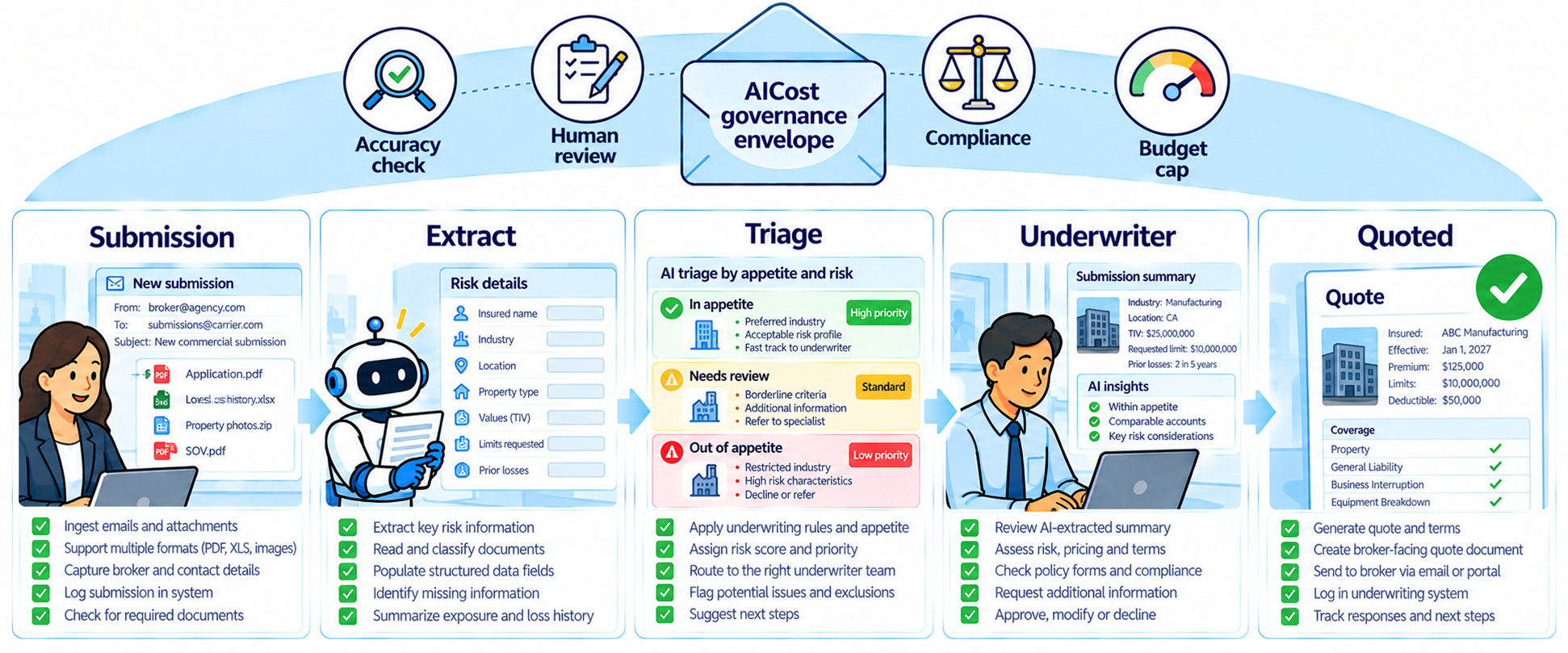
1 · cost
Read submissions and loss runs
$1,278
2 · cost
Extraction per submission
$126
$38
3 · gate
Cache appetite guidelines
5 · governance
Field accuracy
$93
6 · governance
Underwriter decides
$45,000
$36,000
7 · governance
Rating and discrimination rules
$1,754
Without AICost
$48,250/mo
$16.08 per submission triaged
With AICost
$39,162/mo
$13.05 per submission triaged 19% lower
Monthly saving
$9,088/mo
4 cost levers applied
Governance controls
5
Monthly budget $200
Cost cutPrompt caching → Extraction per submission −$18Model routing → Extraction per submission −$46Batch the non-urgent work → Extraction per submission −$24Shorter review with pre-checked drafts* → Underwriter decides −$9,000
Governance✓ Accuracy and hallucination checks → Field accuracy✓ Human review → Underwriter decides✓ Compliance evidence → Rating and discrimination rules✓ Cost firewall at the gateway✓ Data-class model allowlist
Flow, picture, cost levers, governance and policy envelope
How the work flows today
1Broker emails a submission (ACORD forms, SOV, loss runs)
2Extract and clear the submission; check appetite
3Enrich with third-party data
4Prioritize and route to an underwriter with a risk summary
5Underwriter quotes or declines; data goes to the policy admin system
AICost engine chain (blue: cost, purple: governance)
Cost levers and the step they act on
Prompt caching on step Extraction per submission −$1860% cacheable, 75% hit (combined with the other knobs on this step) · Prompt CachingRepeated instructions and documents are cached, so you pay less for the same prompt text.
How it works: The stable part of each prompt (system instructions, tool definitions, reference text) is cached by the model provider and billed at the cached rate.
How AICost prices it: The Prompt Caching engine prices cacheable share and hit rate against the provider's cached-input price.
Governance: No change to answers, models or data. Only the billing of repeated text changes.
* Cacheable share and hit rate are typical values; your logs give the real ones.
Model routing on step Extraction per submission −$4660% of calls (extraction and field checks) to Claude Haiku 5.5; critical work (exceptions) stays on Claude Sonnet 5.5 (applied to every eligible workflow) (combined with the other knobs on this step) · Model RouterRoutine steps run on a cheaper model; critical steps stay on the primary model.
How it works: Each workflow type has routine work (triage, lookups, extraction, summaries, drafts) and critical work (the final answer, code changes, clinical or legal output, decisions). Routine calls go to the economy model; critical work stays on the primary model.
How AICost prices it: The Model Router engine prices the split between the economy and primary model on the workflow's own volume.
Governance: Only approved models for the data class are used. For patient and privileged legal data the share is capped and calls stay with the primary model's vendor and route, so the BAA still covers every call.
* The share of routine calls per workflow type is a starting assumption; your traffic sets the real split.
Batch the non-urgent work on step Extraction per submission −$2460% of calls through the batch API (combined with the other knobs on this step) · Batch or RealtimeWork that can wait runs in the provider's batch mode at a lower price.
How it works: Requests that do not need an instant answer are queued and sent through the batch API.
How AICost prices it: The Batch or Realtime engine prices the batch-tolerant share at batch rates.
Governance: Urgent and customer-facing requests stay realtime.
* The batch-tolerant share is an input.
Shorter review with pre-checked drafts* on step Underwriter decides −$9,000*assumption: 20% less edit time per submission triaged when evals catch errors before the reviewer sees the draft; every submission triaged is still reviewed · Human ReviewEvery item is still reviewed, but automated checks catch errors first, so review takes less time.
How it works: An evaluation step checks each draft before the reviewer sees it, so the reviewer edits less.
How AICost prices it: The Human Review engine prices reviewer time at the shorter review time.
Governance: Every item is still reviewed by a person.
* The time saved per review is an assumption, marked with an asterisk.
Governance controls and the step they act on
Accuracy and hallucination checks on step Field accuracy $93
Golden-set and live-traffic scoring catch silent regressions.
Human review on step Underwriter decides $45,000
Low-confidence, high-value or regulated cases go to a person.
Compliance evidence on step Rating and discrimination rules $1,754
Audit logs, retention and assessments for the rules that apply.
Cost firewall at the gateway policy only, no cost
Monthly budget, daily cap, per-run ceiling, turn cap, spike rule, kill switch.
Data-class model allowlist policy only, no cost
Only models cleared for this data class are routable; others are refused at the gateway.
Policy envelope
Monthly budget$200
Daily hard cap$9
Per-run ceiling$0.17
Turn cap6
See the policy your gateway enforces
{
  "workload_id": "commercial-underwriting-submission-intake-and-triage",
  "scope": "workload",
  "monthly_budget_usd": 200,
  "daily_warning_usd": 6.07,
  "daily_hard_limit_usd": 8.67,
  "max_cost_per_run_usd": 0.17,
  "max_model_calls_per_run": 6,
  "max_retries": 2,
  "max_output_tokens": 1200,
  "requests_per_min": 60,
  "anomaly": {
    "rolling_window": "7d",
    "spike_multiplier": 3,
    "rule": "flag any hour/day exceeding 3x the rolling average, or any single day above the daily hard limit"
  },
  "actions": {
    "warning_threshold": "notify",
    "soft_limit": "route_to:claude-haiku-5-5",
    "hard_limit": "block_noncritical_requests",
    "anomaly": "throttle_and_alert",
    "emergency": "block_all_and_require_approval"
  },
  "emergency_stop": {
    "enabled": true,
    "requires_approval_to_resume": true
  }
}
Where the cost runs away
- Large SOV spreadsheets and loss runs processed for submissions that are out of appetite
- Paid third-party enrichment on every submission
- Re-extraction on broker resubmissions
Talk to us about this workflow →
☂️ Insurance · Industry solutions
Claims and policyholder communications drafting
20,000 claim letter a month
When a claim changes, AI drafts the letter or message to the policyholder for the adjuster to check and send.
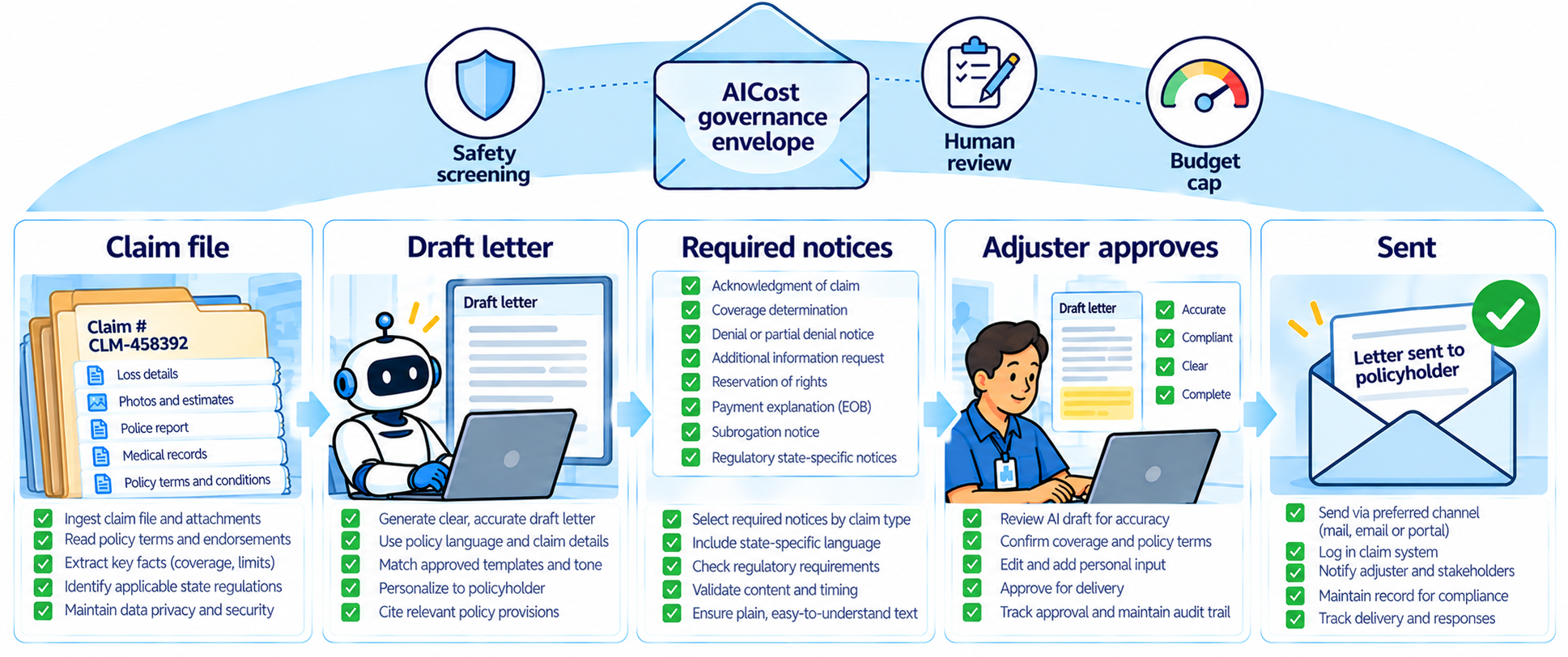
1 · cost
Policy terms and claim file
$665
$200
2 · gate
Small model for standard letters
3 · gate
Reuse letter templates
4 · cost
Drafting per letter
$760
5 · governance
Required notice language
$12
6 · governance
Check letters against the claim file
$95
7 · governance
Adjuster approves
$36,667
$29,334
Without AICost
$38,199/mo
$1.91 per claim letter
With AICost
$30,400/mo
$1.52 per claim letter 20% lower
Monthly saving
$7,799/mo
3 cost levers applied
Governance controls
5
Monthly budget $1,200
Cost cutPrompt caching → Policy terms and claim file −$140Model routing → Policy terms and claim file −$325Shorter review with pre-checked drafts* → Adjuster approves −$7,333
Governance✓ Guardrail screening → Required notice language✓ Accuracy and hallucination checks → Check letters against the claim file✓ Human review → Adjuster approves✓ Cost firewall at the gateway✓ Data-class model allowlist
Flow, picture, cost levers, governance and policy envelope
How the work flows today
1Event in the claim triggers a communication (status, document request, decision)
2LLM drafts the email or letter in company language
3Adjuster reviews and edits
4Send and log in the claim file
AICost engine chain (blue: cost, purple: governance)
Cost levers and the step they act on
Prompt caching on step Policy terms and claim file −$14060% cacheable, 75% hit (combined with the other knobs on this step) · Prompt CachingRepeated instructions and documents are cached, so you pay less for the same prompt text.
How it works: The stable part of each prompt (system instructions, tool definitions, reference text) is cached by the model provider and billed at the cached rate.
How AICost prices it: The Prompt Caching engine prices cacheable share and hit rate against the provider's cached-input price.
Governance: No change to answers, models or data. Only the billing of repeated text changes.
* Cacheable share and hit rate are typical values; your logs give the real ones.
Model routing on step Policy terms and claim file −$32550% of calls (intent detection, lookups and short answers) to Claude Haiku 5.5; critical work (policy, refund and account answers) stays on Claude Sonnet 5.5 (combined with the other knobs on this step) · Model RouterRoutine steps run on a cheaper model; critical steps stay on the primary model.
How it works: Each workflow type has routine work (triage, lookups, extraction, summaries, drafts) and critical work (the final answer, code changes, clinical or legal output, decisions). Routine calls go to the economy model; critical work stays on the primary model.
How AICost prices it: The Model Router engine prices the split between the economy and primary model on the workflow's own volume.
Governance: Only approved models for the data class are used. For patient and privileged legal data the share is capped and calls stay with the primary model's vendor and route, so the BAA still covers every call.
* The share of routine calls per workflow type is a starting assumption; your traffic sets the real split.
Shorter review with pre-checked drafts* on step Adjuster approves −$7,333*assumption: 20% less edit time per claim letter when evals catch errors before the reviewer sees the draft; every claim letter is still reviewed · Human ReviewEvery item is still reviewed, but automated checks catch errors first, so review takes less time.
How it works: An evaluation step checks each draft before the reviewer sees it, so the reviewer edits less.
How AICost prices it: The Human Review engine prices reviewer time at the shorter review time.
Governance: Every item is still reviewed by a person.
* The time saved per review is an assumption, marked with an asterisk.
Governance controls and the step they act on
Guardrail screening on step Required notice language $12
PII, prompt-attack and policy screening before the model acts.
Accuracy and hallucination checks on step Check letters against the claim file $95
Golden-set and live-traffic scoring catch silent regressions.
Human review on step Adjuster approves $36,667
Low-confidence, high-value or regulated cases go to a person.
Cost firewall at the gateway policy only, no cost
Monthly budget, daily cap, per-run ceiling, turn cap, spike rule, kill switch.
Data-class model allowlist policy only, no cost
Only models cleared for this data class are routable; others are refused at the gateway.
Policy envelope
Monthly budget$1,200
Daily hard cap$52
Per-run ceiling$0.13
Turn cap6
See the policy your gateway enforces
{
  "workload_id": "claims-and-policyholder-communications-drafting",
  "scope": "workload",
  "monthly_budget_usd": 1200,
  "daily_warning_usd": 36.4,
  "daily_hard_limit_usd": 52,
  "max_cost_per_run_usd": 0.13,
  "max_model_calls_per_run": 6,
  "max_retries": 2,
  "max_output_tokens": 1200,
  "requests_per_min": 190,
  "anomaly": {
    "rolling_window": "7d",
    "spike_multiplier": 3,
    "rule": "flag any hour/day exceeding 3x the rolling average, or any single day above the daily hard limit"
  },
  "actions": {
    "warning_threshold": "notify",
    "soft_limit": "route_to:claude-haiku-5-5",
    "hard_limit": "block_noncritical_requests",
    "anomaly": "throttle_and_alert",
    "emergency": "block_all_and_require_approval"
  },
  "emergency_stop": {
    "enabled": true,
    "requires_approval_to_resume": true
  }
}
Where the cost runs away
- Full claim file in context for short status notes
- Re-drafting loops on edits
- Premium models for template-level messages
Talk to us about this workflow →
🛒 Retail and e-commerce · Industry solutions
Product content and catalog enrichment
50,000 enriched product a month
AI turns supplier product data and images into complete, consistent product listings for every channel.
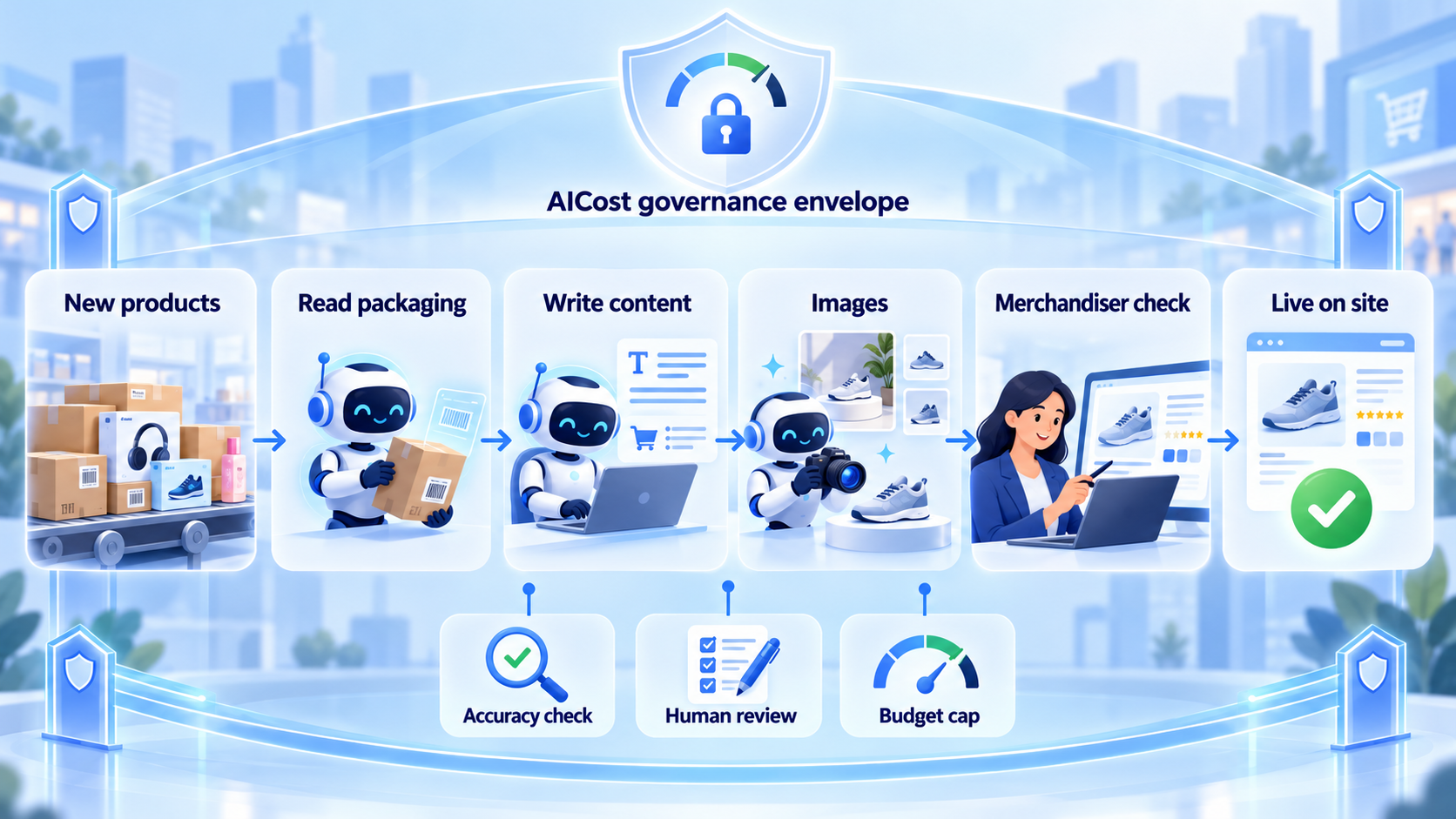
1 · gate
Generate the catalog in batch
2 · cost
Read packaging images
$500
3 · cost
Model calls
$2,100
$630
4 · cost
Lifestyle images
$10,560
5 · gate
Cost by catalog size
6 · governance
Wrong specs and claims
$99
7 · governance
Merchandiser spot-checks
$2,917
$1,750
Without AICost
$16,175/mo
$0.32 per enriched product
With AICost
$13,539/mo
$0.27 per enriched product 16% lower
Monthly saving
$2,636/mo
4 cost levers applied
Governance controls
4
Monthly budget $1,400
Cost cutPrompt caching → Model calls −$196Model routing → Model calls −$835Batch the non-urgent work → Model calls −$439Better grounding → Merchandiser spot-checks −$1,167
Governance✓ Accuracy and hallucination checks → Wrong specs and claims✓ Human review → Merchandiser spot-checks✓ Cost firewall at the gateway✓ Data-class model allowlist
Flow, picture, cost levers, governance and policy envelope
How the work flows today
1Ingest supplier product data and images
2Normalize attributes and fix missing or incorrect data
3Generate titles, descriptions and SEO copy
4Classify into the taxonomy and tag for search
5Human spot-check; publish to site and marketplaces
AICost engine chain (blue: cost, purple: governance)
Cost levers and the step they act on
Prompt caching on step Model calls −$19660% cacheable, 75% hit (applied to every eligible workflow) (combined with the other knobs on this step) · Prompt CachingRepeated instructions and documents are cached, so you pay less for the same prompt text.
How it works: The stable part of each prompt (system instructions, tool definitions, reference text) is cached by the model provider and billed at the cached rate.
How AICost prices it: The Prompt Caching engine prices cacheable share and hit rate against the provider's cached-input price.
Governance: No change to answers, models or data. Only the billing of repeated text changes.
* Cacheable share and hit rate are typical values; your logs give the real ones.
Model routing on step Model calls −$83550% of calls (variants, rewrites and translations) to Claude Haiku 5.5; critical work (final approved copy) stays on Claude Sonnet 5.5 (applied to every eligible workflow) (combined with the other knobs on this step) · Model RouterRoutine steps run on a cheaper model; critical steps stay on the primary model.
How it works: Each workflow type has routine work (triage, lookups, extraction, summaries, drafts) and critical work (the final answer, code changes, clinical or legal output, decisions). Routine calls go to the economy model; critical work stays on the primary model.
How AICost prices it: The Model Router engine prices the split between the economy and primary model on the workflow's own volume.
Governance: Only approved models for the data class are used. For patient and privileged legal data the share is capped and calls stay with the primary model's vendor and route, so the BAA still covers every call.
* The share of routine calls per workflow type is a starting assumption; your traffic sets the real split.
Batch the non-urgent work on step Model calls −$43950% of calls through the batch API (combined with the other knobs on this step) · Batch or RealtimeWork that can wait runs in the provider's batch mode at a lower price.
How it works: Requests that do not need an instant answer are queued and sent through the batch API.
How AICost prices it: The Batch or Realtime engine prices the batch-tolerant share at batch rates.
Governance: Urgent and customer-facing requests stay realtime.
* The batch-tolerant share is an input.
Better grounding on step Merchandiser spot-checks −$1,167escalation 5% to 3% · Human ReviewAnswers come only from your approved sources, so fewer cases go to a person.
How it works: The assistant answers from your own approved content with the source attached, and says it does not know instead of guessing. Teams get there with cleaner knowledge-base articles, better retrieval (tighter chunks, reranking) and an answer check before the reply goes out.
How AICost prices it: Fewer low-confidence answers means fewer escalations. The Human Review engine prices reviewer minutes at the lower escalation rate; the saving is the difference.
Governance: Human review stays on for refunds, policy exceptions and anything still low-confidence. Only the share of cases that needed a person goes down.
* The demo assumes escalations fall by half (for example 12% to 6%). Your number comes from your own evaluation results.
Governance controls and the step they act on
Accuracy and hallucination checks on step Wrong specs and claims $99
Golden-set and live-traffic scoring catch silent regressions.
Human review on step Merchandiser spot-checks $2,917
Low-confidence, high-value or regulated cases go to a person.
Cost firewall at the gateway policy only, no cost
Monthly budget, daily cap, per-run ceiling, turn cap, spike rule, kill switch.
Data-class model allowlist policy only, no cost
Only models cleared for this data class are routable; others are refused at the gateway.
Policy envelope
Monthly budget$1,400
Daily hard cap$61
Per-run ceiling$0.17
Turn cap6
See the policy your gateway enforces
{
  "workload_id": "product-content-and-catalog-enrichment",
  "scope": "workload",
  "monthly_budget_usd": 1400,
  "daily_warning_usd": 42.47,
  "daily_hard_limit_usd": 60.67,
  "max_cost_per_run_usd": 0.17,
  "max_model_calls_per_run": 6,
  "max_retries": 2,
  "max_output_tokens": 1200,
  "requests_per_min": 470,
  "anomaly": {
    "rolling_window": "7d",
    "spike_multiplier": 3,
    "rule": "flag any hour/day exceeding 3x the rolling average, or any single day above the daily hard limit"
  },
  "actions": {
    "warning_threshold": "notify",
    "soft_limit": "route_to:claude-haiku-5-5",
    "hard_limit": "block_noncritical_requests",
    "anomaly": "throttle_and_alert",
    "emergency": "block_all_and_require_approval"
  },
  "emergency_stop": {
    "enabled": true,
    "requires_approval_to_resume": true
  }
}
Where the cost runs away
- Regenerating content for the whole catalog on every model or prompt change
- Using real-time API instead of batch pricing
- Image (vision) calls for every SKU variant
Talk to us about this workflow →
🛒 Retail and e-commerce · Industry solutions
Conversational shopping assistant (agentic commerce)
200,000 shopping conversation a month
A shopping assistant answers need-based questions, recommends products and helps the shopper complete the purchase.
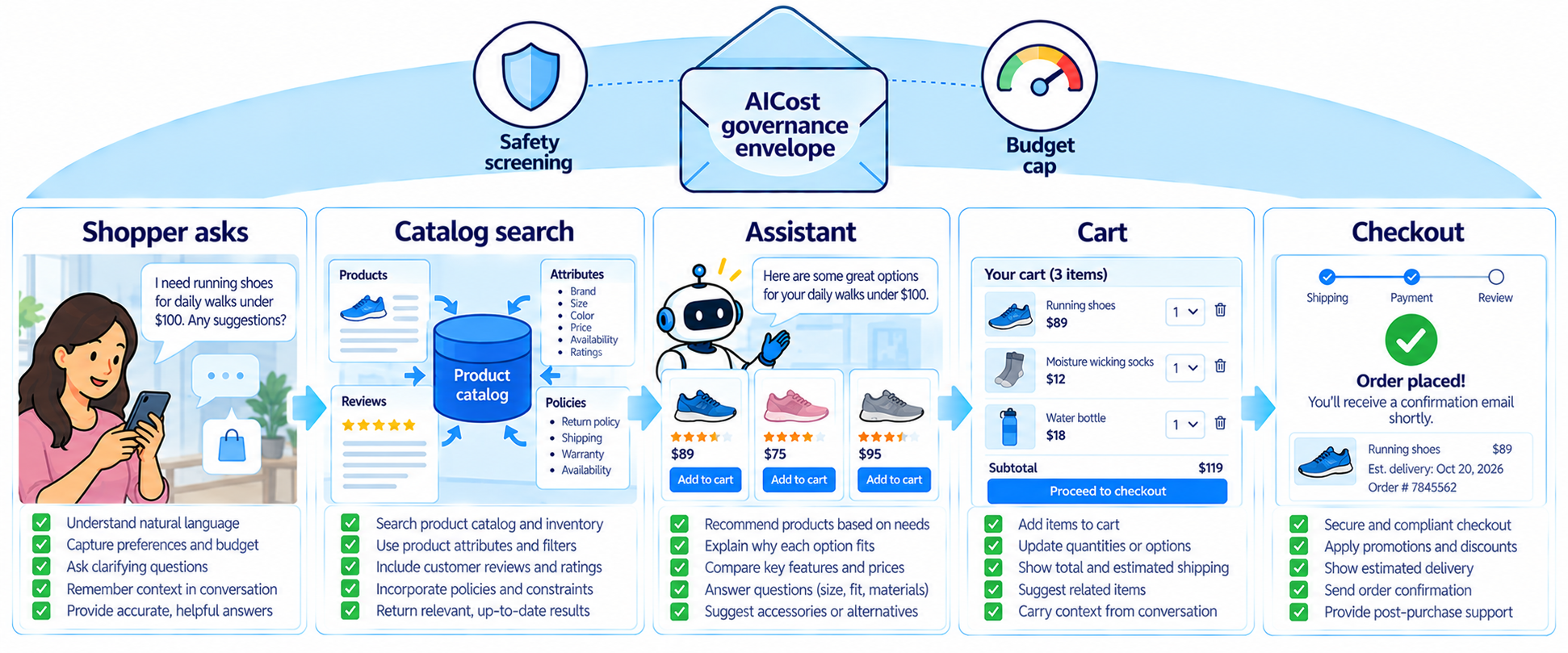
1 · cost
Catalog and reviews
$6,243
$1,872
3 · gate
Reuse the store prompt
4 · gate
Cheap model for simple questions
5 · governance
Price and promise guardrails
$250
6 · gate
Traffic-spike budget
Without AICost
$6,498/mo
$0.03 per shopping conversation
With AICost
$2,128/mo
$0.01 per shopping conversation 67% lower
Monthly saving
$4,370/mo
2 cost levers applied
Governance controls
3
Monthly budget $2,400
Cost cutPrompt caching → Catalog and reviews −$1,616Model routing → Catalog and reviews −$2,755
Governance✓ Guardrail screening → Price and promise guardrails✓ Cost firewall at the gateway✓ Data-class model allowlist
Flow, picture, cost levers, governance and policy envelope
How the work flows today
1Shopper asks a need-based question in the search bar or chat
2Retrieve over catalog, reviews and Q&A
3Compare and recommend products
4Answer product-detail questions
5Add to cart or check out (including via third-party AI agents)
AICost engine chain (blue: cost, purple: governance)
Cost levers and the step they act on
Prompt caching on step Catalog and reviews −$1,61660% cacheable, 75% hit (combined with the other knobs on this step) · Prompt CachingRepeated instructions and documents are cached, so you pay less for the same prompt text.
How it works: The stable part of each prompt (system instructions, tool definitions, reference text) is cached by the model provider and billed at the cached rate.
How AICost prices it: The Prompt Caching engine prices cacheable share and hit rate against the provider's cached-input price.
Governance: No change to answers, models or data. Only the billing of repeated text changes.
* Cacheable share and hit rate are typical values; your logs give the real ones.
Model routing on step Catalog and reviews −$2,75550% of calls (intent detection, lookups and short answers) to Claude Haiku 5.5; critical work (policy, refund and account answers) stays on Claude Sonnet 5.5 (combined with the other knobs on this step) · Model RouterRoutine steps run on a cheaper model; critical steps stay on the primary model.
How it works: Each workflow type has routine work (triage, lookups, extraction, summaries, drafts) and critical work (the final answer, code changes, clinical or legal output, decisions). Routine calls go to the economy model; critical work stays on the primary model.
How AICost prices it: The Model Router engine prices the split between the economy and primary model on the workflow's own volume.
Governance: Only approved models for the data class are used. For patient and privileged legal data the share is capped and calls stay with the primary model's vendor and route, so the BAA still covers every call.
* The share of routine calls per workflow type is a starting assumption; your traffic sets the real split.
Governance controls and the step they act on
Guardrail screening on step Price and promise guardrails $250
PII, prompt-attack and policy screening before the model acts.
Cost firewall at the gateway policy only, no cost
Monthly budget, daily cap, per-run ceiling, turn cap, spike rule, kill switch.
Data-class model allowlist policy only, no cost
Only models cleared for this data class are routable; others are refused at the gateway.
Policy envelope
Monthly budget$2,400
Daily hard cap$104
Per-run ceiling$0.12
Turn cap8
See the policy your gateway enforces
{
  "workload_id": "conversational-shopping-assistant-agentic-commerce",
  "scope": "workload",
  "monthly_budget_usd": 2400,
  "daily_warning_usd": 72.8,
  "daily_hard_limit_usd": 104,
  "max_cost_per_run_usd": 0.12,
  "max_model_calls_per_run": 8,
  "max_retries": 2,
  "max_output_tokens": 1200,
  "requests_per_min": 1890,
  "anomaly": {
    "rolling_window": "7d",
    "spike_multiplier": 3,
    "rule": "flag any hour/day exceeding 3x the rolling average, or any single day above the daily hard limit"
  },
  "actions": {
    "warning_threshold": "notify",
    "soft_limit": "route_to:claude-haiku-5-5",
    "hard_limit": "block_noncritical_requests",
    "anomaly": "throttle_and_alert",
    "emergency": "block_all_and_require_approval"
  },
  "emergency_stop": {
    "enabled": true,
    "requires_approval_to_resume": true
  }
}
Where the cost runs away
- Inference cost per shopping session at peak traffic (holiday)
- Long review corpora in context
- Bot or scraper traffic consuming LLM calls
Talk to us about this workflow →
🛒 Retail and e-commerce · Industry solutions
Customer service agent (WISMO, returns, refunds)
60,000 resolved contact a month
An AI agent answers order status questions and handles returns and refunds within policy.
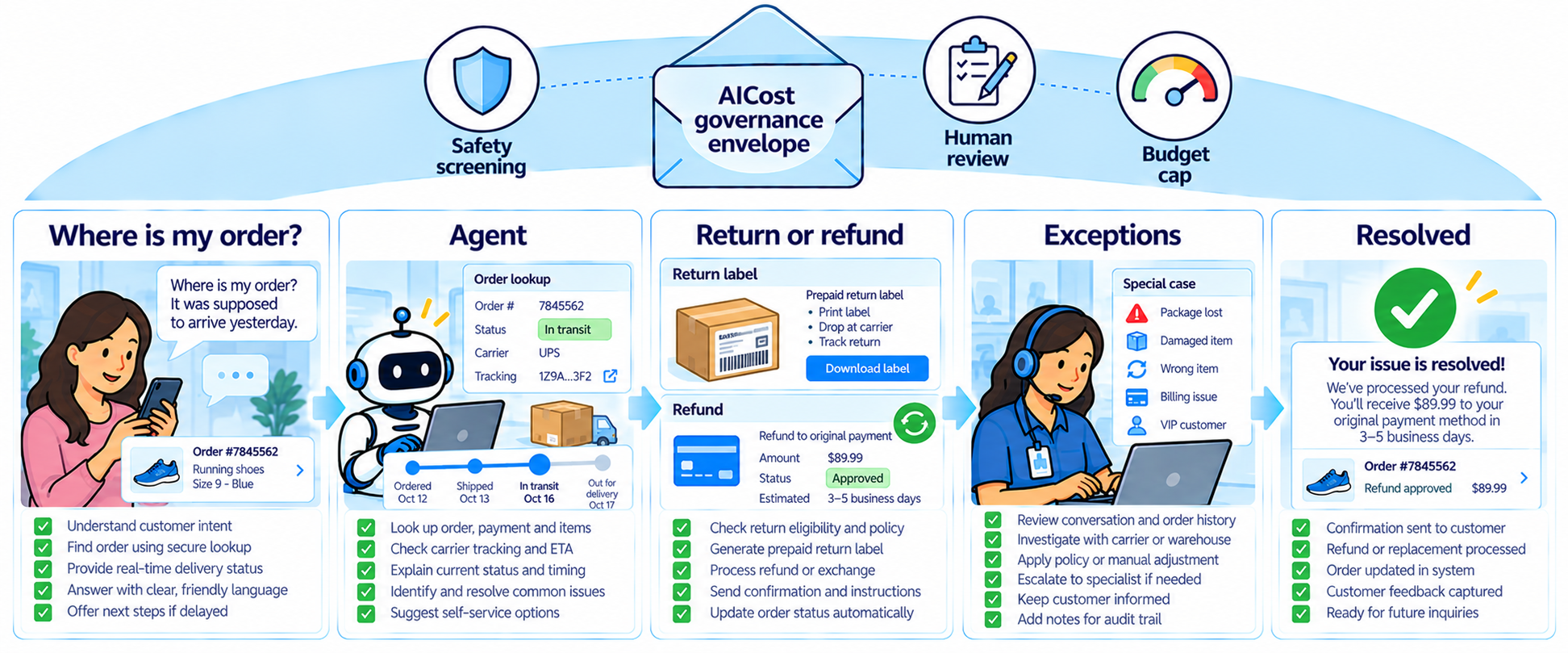
1 · cost
Cap retries before handoff
$29,045
$8,713
2 · cost
Order and payment systems
$1,472
3 · governance
Refund limits
$112
4 · governance
Exceptions to a person
$21,600
$10,800
5 · gate
Cost per contact vs a person
6 · gate
Daily budget and runaway stop
Without AICost
$52,230/mo
$0.87 per resolved contact
With AICost
$21,098/mo
$0.35 per resolved contact 60% lower
Monthly saving
$31,132/mo
5 cost levers applied
Governance controls
4
Monthly budget $9,800
Cost cutLoop cap → Cap retries before handoff −$14,785Prompt caching → Cap retries before handoff −$1,340Context compaction → Cap retries before handoff −$1,923Model routing → Cap retries before handoff −$2,284Better grounding → Exceptions to a person −$10,800
Governance✓ Guardrail screening → Refund limits✓ Human review → Exceptions to a person✓ Cost firewall at the gateway✓ Data-class model allowlist
Flow, picture, cost levers, governance and policy envelope
How the work flows today
1Customer contacts by chat, email or voice
2Identify intent (where is my order, return, refund, product issue)
3Agent calls OMS, shipping and payments tools to resolve
4Apply return or refund policy within limits
5Escalate to a human with a summary
AICost engine chain (blue: cost, purple: governance)
Cost levers and the step they act on
Loop cap on step Cap retries before handoff −$14,78512 turns, 60k tokens, enforced by cost-firewall (combined with the other knobs on this step) · Agent LoopA ceiling on turns and tokens per agent run, so a stuck agent cannot run up the bill.
How it works: Each agent run gets a maximum number of turns and tokens. A run that hits the ceiling stops and hands off instead of looping.
How AICost prices it: The Agent Loop engine prices the runs with and without the ceiling, including the runaway tail.
Governance: The cap is enforced by the cost firewall at your gateway, with an alert when it trips.
Prompt caching on step Cap retries before handoff −$1,34060% cacheable, 75% hit (applied to every eligible workflow) (combined with the other knobs on this step) · Prompt CachingRepeated instructions and documents are cached, so you pay less for the same prompt text.
How it works: The stable part of each prompt (system instructions, tool definitions, reference text) is cached by the model provider and billed at the cached rate.
How AICost prices it: The Prompt Caching engine prices cacheable share and hit rate against the provider's cached-input price.
Governance: No change to answers, models or data. Only the billing of repeated text changes.
* Cacheable share and hit rate are typical values; your logs give the real ones.
Context compaction on step Cap retries before handoff −$1,923trim history 60%, net of overhead (applied to every eligible workflow) (combined with the other knobs on this step) · Context TrimLong histories are trimmed each turn, so every call carries less text.
How it works: Older turns and long documents are summarized or trimmed before each call, keeping what the model needs.
How AICost prices it: The Context Trim engine prices the smaller context net of the cost of trimming.
Governance: Quality is checked before rollout; nothing reaches the model that it was not allowed to see.
* The trim size is an input; your evals confirm it keeps answer quality.
Model routing on step Cap retries before handoff −$2,28450% of calls (intent detection, lookups and short answers) to Claude Haiku 5.5; critical work (policy, refund and account answers) stays on Claude Sonnet 5.5 (applied to every eligible workflow) (combined with the other knobs on this step) · Model RouterRoutine steps run on a cheaper model; critical steps stay on the primary model.
How it works: Each workflow type has routine work (triage, lookups, extraction, summaries, drafts) and critical work (the final answer, code changes, clinical or legal output, decisions). Routine calls go to the economy model; critical work stays on the primary model.
How AICost prices it: The Model Router engine prices the split between the economy and primary model on the workflow's own volume.
Governance: Only approved models for the data class are used. For patient and privileged legal data the share is capped and calls stay with the primary model's vendor and route, so the BAA still covers every call.
* The share of routine calls per workflow type is a starting assumption; your traffic sets the real split.
Better grounding on step Exceptions to a person −$10,800escalation 12% to 6% · Human ReviewAnswers come only from your approved sources, so fewer cases go to a person.
How it works: The assistant answers from your own approved content with the source attached, and says it does not know instead of guessing. Teams get there with cleaner knowledge-base articles, better retrieval (tighter chunks, reranking) and an answer check before the reply goes out.
How AICost prices it: Fewer low-confidence answers means fewer escalations. The Human Review engine prices reviewer minutes at the lower escalation rate; the saving is the difference.
Governance: Human review stays on for refunds, policy exceptions and anything still low-confidence. Only the share of cases that needed a person goes down.
* The demo assumes escalations fall by half (for example 12% to 6%). Your number comes from your own evaluation results.
Governance controls and the step they act on
Guardrail screening on step Refund limits $112
PII, prompt-attack and policy screening before the model acts.
Human review on step Exceptions to a person $21,600
Low-confidence, high-value or regulated cases go to a person.
Cost firewall at the gateway policy only, no cost
Monthly budget, daily cap, per-run ceiling, turn cap, spike rule, kill switch.
Data-class model allowlist policy only, no cost
Only models cleared for this data class are routable; others are refused at the gateway.
Policy envelope
Monthly budget$9,800
Daily hard cap$425
Per-run ceiling$1.94
Turn cap12
See the policy your gateway enforces
{
  "workload_id": "customer-service-agent-wismo-returns-refunds",
  "scope": "workload",
  "monthly_budget_usd": 9800,
  "daily_warning_usd": 297.27,
  "daily_hard_limit_usd": 424.67,
  "max_cost_per_run_usd": 1.94,
  "max_model_calls_per_run": 12,
  "max_retries": 2,
  "max_output_tokens": 1200,
  "requests_per_min": 570,
  "anomaly": {
    "rolling_window": "7d",
    "spike_multiplier": 3,
    "rule": "flag any hour/day exceeding 3x the rolling average, or any single day above the daily hard limit"
  },
  "actions": {
    "warning_threshold": "notify",
    "soft_limit": "route_to:claude-haiku-5-5",
    "hard_limit": "block_noncritical_requests",
    "anomaly": "throttle_and_alert",
    "emergency": "block_all_and_require_approval"
  },
  "emergency_stop": {
    "enabled": true,
    "requires_approval_to_resume": true
  }
}
Where the cost runs away
- Agent loops and retries on tool failures
- Per-resolution vendor pricing on contacts that deflection would have handled
- Voice minutes at peak season
Talk to us about this workflow →
🏭 Manufacturing · Industry solutions
Predictive maintenance with technician copilot
3,000 technician question a month
AI watches sensor data for early signs of failure, and a copilot guides technicians through diagnosis and repair.
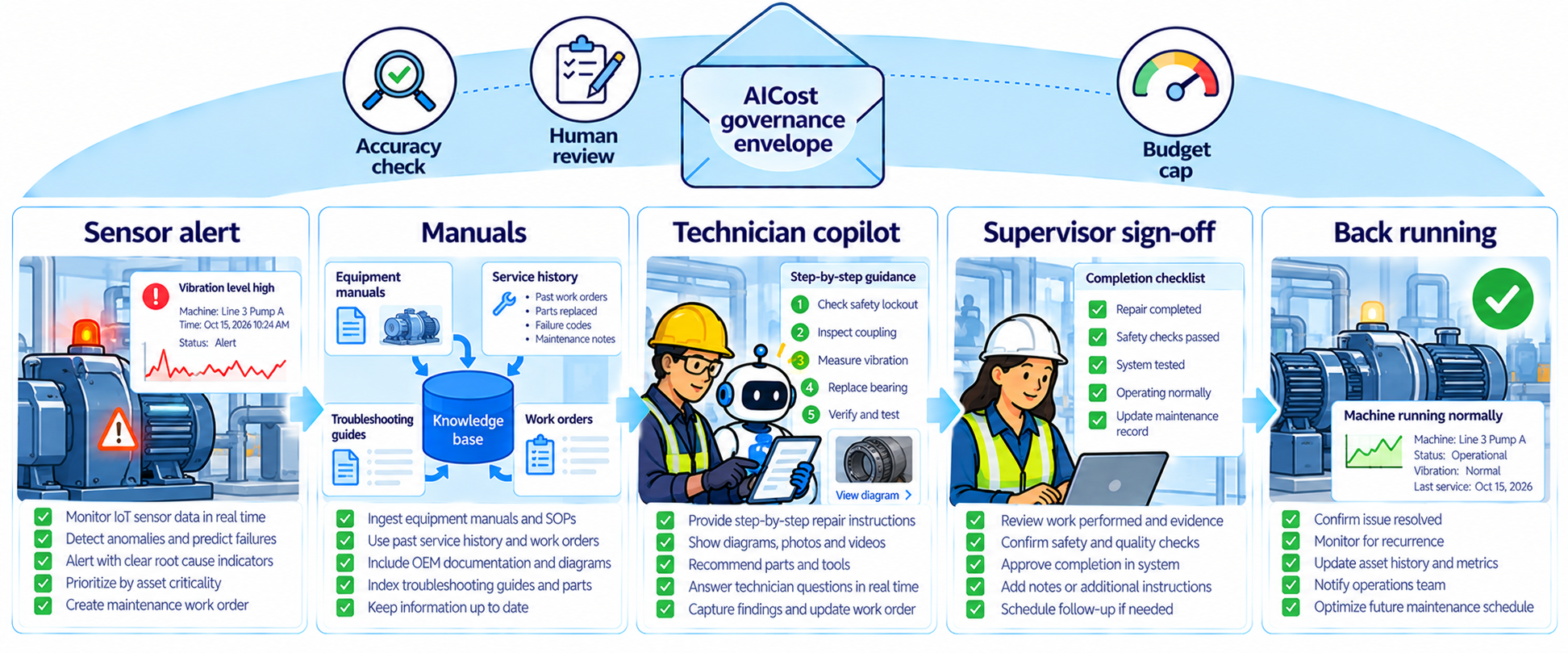
1 · cost
Digitize manuals and work orders
$177
2 · cost
Answer from manuals
$138
$41
3 · gate
Cache equipment manual context
4 · gate
Plant floor vs cloud
5 · governance
Wrong procedure steps
$93
6 · governance
Supervisor signs off safety work
$1,680
$840
7 · gate
Downtime avoided vs AI cost
Without AICost
$2,087/mo
$0.70 per technician question
With AICost
$1,151/mo
$0.38 per technician question 45% lower
Monthly saving
$936/mo
4 cost levers applied
Governance controls
4
Monthly budget $200
Cost cutPrompt caching → Answer from manuals −$23Context compaction → Answer from manuals −$34Model routing → Answer from manuals −$40Better grounding → Supervisor signs off safety work −$840
Governance✓ Accuracy and hallucination checks → Wrong procedure steps✓ Human review → Supervisor signs off safety work✓ Cost firewall at the gateway✓ Data-class model allowlist
Flow, picture, cost levers, governance and policy envelope
How the work flows today
1Stream sensor data (vibration, temperature, torque)
2Detect anomalies and predict failure
3Auto-create the work order in the CMMS / EAM
4Technician asks the copilot for a troubleshooting procedure over manuals and history
5Close out with voice or text notes; feed back into models
AICost engine chain (blue: cost, purple: governance)
Cost levers and the step they act on
Prompt caching on step Answer from manuals −$2360% cacheable, 75% hit (combined with the other knobs on this step) · Prompt CachingRepeated instructions and documents are cached, so you pay less for the same prompt text.
How it works: The stable part of each prompt (system instructions, tool definitions, reference text) is cached by the model provider and billed at the cached rate.
How AICost prices it: The Prompt Caching engine prices cacheable share and hit rate against the provider's cached-input price.
Governance: No change to answers, models or data. Only the billing of repeated text changes.
* Cacheable share and hit rate are typical values; your logs give the real ones.
Context compaction on step Answer from manuals −$34trim history 60%, net of overhead (applied to every eligible workflow) (combined with the other knobs on this step) · Context TrimLong histories are trimmed each turn, so every call carries less text.
How it works: Older turns and long documents are summarized or trimmed before each call, keeping what the model needs.
How AICost prices it: The Context Trim engine prices the smaller context net of the cost of trimming.
Governance: Quality is checked before rollout; nothing reaches the model that it was not allowed to see.
* The trim size is an input; your evals confirm it keeps answer quality.
Model routing on step Answer from manuals −$4050% of calls (intent detection, lookups and short answers) to Claude Haiku 5.5; critical work (policy, refund and account answers) stays on Claude Sonnet 5.5 (applied to every eligible workflow) (combined with the other knobs on this step) · Model RouterRoutine steps run on a cheaper model; critical steps stay on the primary model.
How it works: Each workflow type has routine work (triage, lookups, extraction, summaries, drafts) and critical work (the final answer, code changes, clinical or legal output, decisions). Routine calls go to the economy model; critical work stays on the primary model.
How AICost prices it: The Model Router engine prices the split between the economy and primary model on the workflow's own volume.
Governance: Only approved models for the data class are used. For patient and privileged legal data the share is capped and calls stay with the primary model's vendor and route, so the BAA still covers every call.
* The share of routine calls per workflow type is a starting assumption; your traffic sets the real split.
Better grounding on step Supervisor signs off safety work −$840escalation 12% to 6% · Human ReviewAnswers come only from your approved sources, so fewer cases go to a person.
How it works: The assistant answers from your own approved content with the source attached, and says it does not know instead of guessing. Teams get there with cleaner knowledge-base articles, better retrieval (tighter chunks, reranking) and an answer check before the reply goes out.
How AICost prices it: Fewer low-confidence answers means fewer escalations. The Human Review engine prices reviewer minutes at the lower escalation rate; the saving is the difference.
Governance: Human review stays on for refunds, policy exceptions and anything still low-confidence. Only the share of cases that needed a person goes down.
* The demo assumes escalations fall by half (for example 12% to 6%). Your number comes from your own evaluation results.
Governance controls and the step they act on
Accuracy and hallucination checks on step Wrong procedure steps $93
Golden-set and live-traffic scoring catch silent regressions.
Human review on step Supervisor signs off safety work $1,680
Low-confidence, high-value or regulated cases go to a person.
Cost firewall at the gateway policy only, no cost
Monthly budget, daily cap, per-run ceiling, turn cap, spike rule, kill switch.
Data-class model allowlist policy only, no cost
Only models cleared for this data class are routable; others are refused at the gateway.
Policy envelope
Monthly budget$200
Daily hard cap$9
Per-run ceiling$0.18
Turn cap12
See the policy your gateway enforces
{
  "workload_id": "predictive-maintenance-with-technician-copilot",
  "scope": "workload",
  "monthly_budget_usd": 200,
  "daily_warning_usd": 6.07,
  "daily_hard_limit_usd": 8.67,
  "max_cost_per_run_usd": 0.18,
  "max_model_calls_per_run": 12,
  "max_retries": 2,
  "max_output_tokens": 1200,
  "requests_per_min": 60,
  "anomaly": {
    "rolling_window": "7d",
    "spike_multiplier": 3,
    "rule": "flag any hour/day exceeding 3x the rolling average, or any single day above the daily hard limit"
  },
  "actions": {
    "warning_threshold": "notify",
    "soft_limit": "route_to:claude-haiku-5-5",
    "hard_limit": "block_noncritical_requests",
    "anomaly": "throttle_and_alert",
    "emergency": "block_all_and_require_approval"
  },
  "emergency_stop": {
    "enabled": true,
    "requires_approval_to_resume": true
  }
}
Where the cost runs away
- High-frequency sensor data pushed to cloud LLMs instead of edge models
- Re-indexing large manual libraries per plant
- Pilots that never scale (sunk cost)
Talk to us about this workflow →
🏭 Manufacturing · Industry solutions
Visual quality inspection
300,000 inspected part a month
Cameras on the line capture images, and AI flags defects for removal or human review.
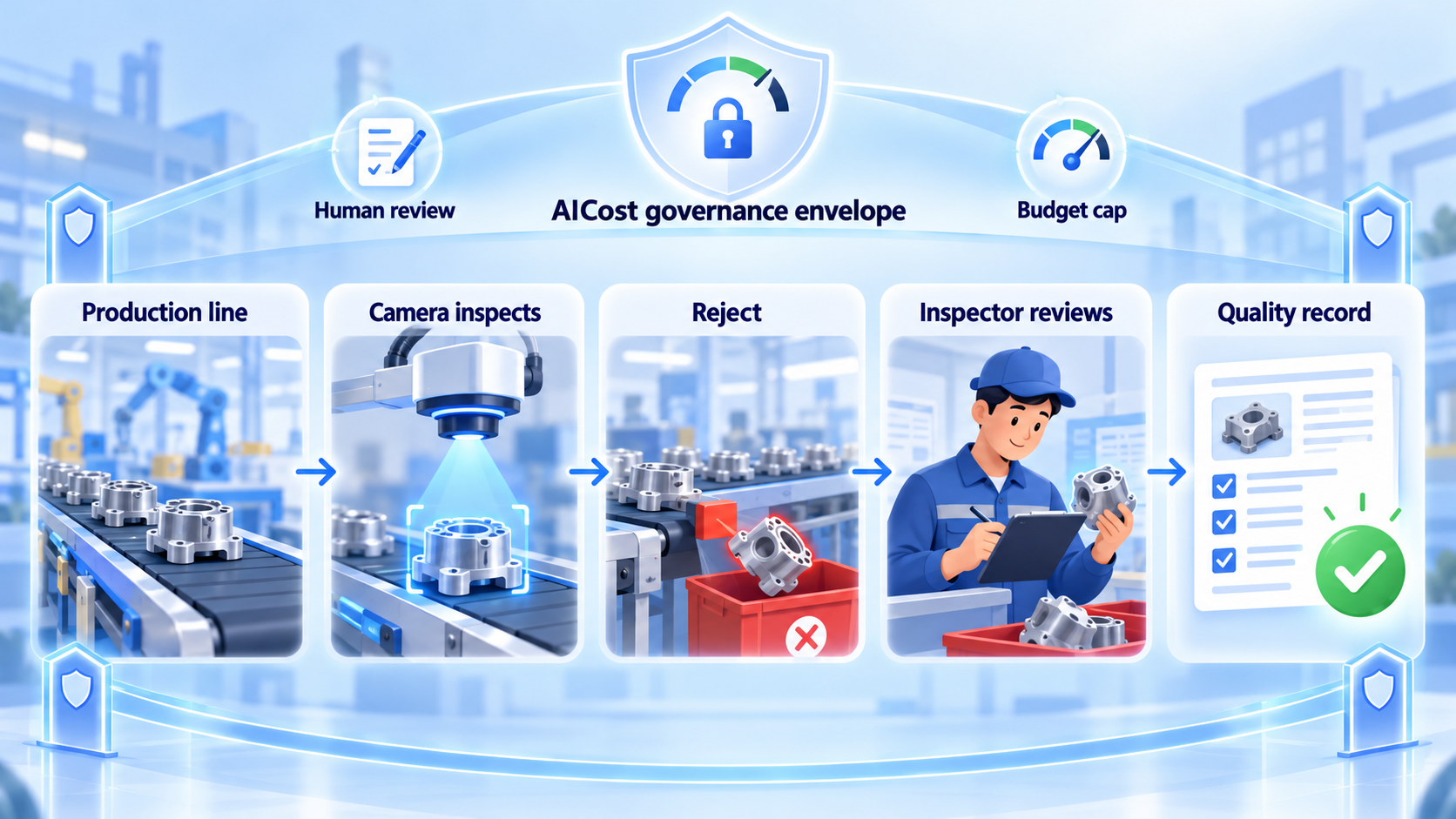
1 · cost
Inspect each part
$1,500
2 · cost
Model calls
$1,500
$450
4 · cost
Train on defect images
$333
5 · cost
Retrain as products change
$3,333
6 · governance
Inspector reviews rejects
$2,250
$1,125
Without AICost
$8,917/mo
$0.03 per inspected part
With AICost
$6,742/mo
$0.02 per inspected part 24% lower
Monthly saving
$2,175/mo
4 cost levers applied
Governance controls
3
Monthly budget $2,600
Cost cutPrompt caching → Model calls −$270Model routing → Model calls −$549Batch the non-urgent work → Model calls −$231Better grounding → Inspector reviews rejects −$1,125
Governance✓ Human review → Inspector reviews rejects✓ Cost firewall at the gateway✓ Data-class model allowlist
Flow, picture, cost levers, governance and policy envelope
How the work flows today
1Capture images on the line
2AI classifies good or defect in real time
3Reject, rework or route to manual inspection
4Log defects and root cause (SPC)
5Retrain on new defect types
AICost engine chain (blue: cost, purple: governance)
Cost levers and the step they act on
Prompt caching on step Model calls −$27060% cacheable, 75% hit (applied to every eligible workflow) (combined with the other knobs on this step) · Prompt CachingRepeated instructions and documents are cached, so you pay less for the same prompt text.
How it works: The stable part of each prompt (system instructions, tool definitions, reference text) is cached by the model provider and billed at the cached rate.
How AICost prices it: The Prompt Caching engine prices cacheable share and hit rate against the provider's cached-input price.
Governance: No change to answers, models or data. Only the billing of repeated text changes.
* Cacheable share and hit rate are typical values; your logs give the real ones.
Model routing on step Model calls −$54950% of calls (image pre-screening) to Claude Haiku 5.5; critical work (flagged cases) stays on Claude Sonnet 5.5 (applied to every eligible workflow) (combined with the other knobs on this step) · Model RouterRoutine steps run on a cheaper model; critical steps stay on the primary model.
How it works: Each workflow type has routine work (triage, lookups, extraction, summaries, drafts) and critical work (the final answer, code changes, clinical or legal output, decisions). Routine calls go to the economy model; critical work stays on the primary model.
How AICost prices it: The Model Router engine prices the split between the economy and primary model on the workflow's own volume.
Governance: Only approved models for the data class are used. For patient and privileged legal data the share is capped and calls stay with the primary model's vendor and route, so the BAA still covers every call.
* The share of routine calls per workflow type is a starting assumption; your traffic sets the real split.
Batch the non-urgent work on step Model calls −$23140% of calls through the batch API (applied to every eligible workflow) (combined with the other knobs on this step) · Batch or RealtimeWork that can wait runs in the provider's batch mode at a lower price.
How it works: Requests that do not need an instant answer are queued and sent through the batch API.
How AICost prices it: The Batch or Realtime engine prices the batch-tolerant share at batch rates.
Governance: Urgent and customer-facing requests stay realtime.
* The batch-tolerant share is an input.
Better grounding on step Inspector reviews rejects −$1,125escalation 2% to 1% · Human ReviewAnswers come only from your approved sources, so fewer cases go to a person.
How it works: The assistant answers from your own approved content with the source attached, and says it does not know instead of guessing. Teams get there with cleaner knowledge-base articles, better retrieval (tighter chunks, reranking) and an answer check before the reply goes out.
How AICost prices it: Fewer low-confidence answers means fewer escalations. The Human Review engine prices reviewer minutes at the lower escalation rate; the saving is the difference.
Governance: Human review stays on for refunds, policy exceptions and anything still low-confidence. Only the share of cases that needed a person goes down.
* The demo assumes escalations fall by half (for example 12% to 6%). Your number comes from your own evaluation results.
Governance controls and the step they act on
Human review on step Inspector reviews rejects $2,250
Low-confidence, high-value or regulated cases go to a person.
Cost firewall at the gateway policy only, no cost
Monthly budget, daily cap, per-run ceiling, turn cap, spike rule, kill switch.
Data-class model allowlist policy only, no cost
Only models cleared for this data class are routable; others are refused at the gateway.
Policy envelope
Monthly budget$2,600
Daily hard cap$113
Per-run ceiling$0.05
Turn cap6
See the policy your gateway enforces
{
  "workload_id": "visual-quality-inspection",
  "scope": "workload",
  "monthly_budget_usd": 2600,
  "daily_warning_usd": 78.87,
  "daily_hard_limit_usd": 112.67,
  "max_cost_per_run_usd": 0.05,
  "max_model_calls_per_run": 6,
  "max_retries": 2,
  "max_output_tokens": 1200,
  "requests_per_min": 2840,
  "anomaly": {
    "rolling_window": "7d",
    "spike_multiplier": 3,
    "rule": "flag any hour/day exceeding 3x the rolling average, or any single day above the daily hard limit"
  },
  "actions": {
    "warning_threshold": "notify",
    "soft_limit": "route_to:claude-haiku-5-5",
    "hard_limit": "block_noncritical_requests",
    "anomaly": "throttle_and_alert",
    "emergency": "block_all_and_require_approval"
  },
  "emergency_stop": {
    "enabled": true,
    "requires_approval_to_resume": true
  }
}
Where the cost runs away
- Sending every frame to cloud vision APIs instead of edge
- Per-camera licensing across lines
- Retraining for every product changeover
Talk to us about this workflow →
🏭 Manufacturing · Industry solutions
Industrial copilot for automation engineering and operations
1,500 engineering task a month
Engineers describe control logic or changes in plain language, and a copilot drafts the code and documentation for review and testing.
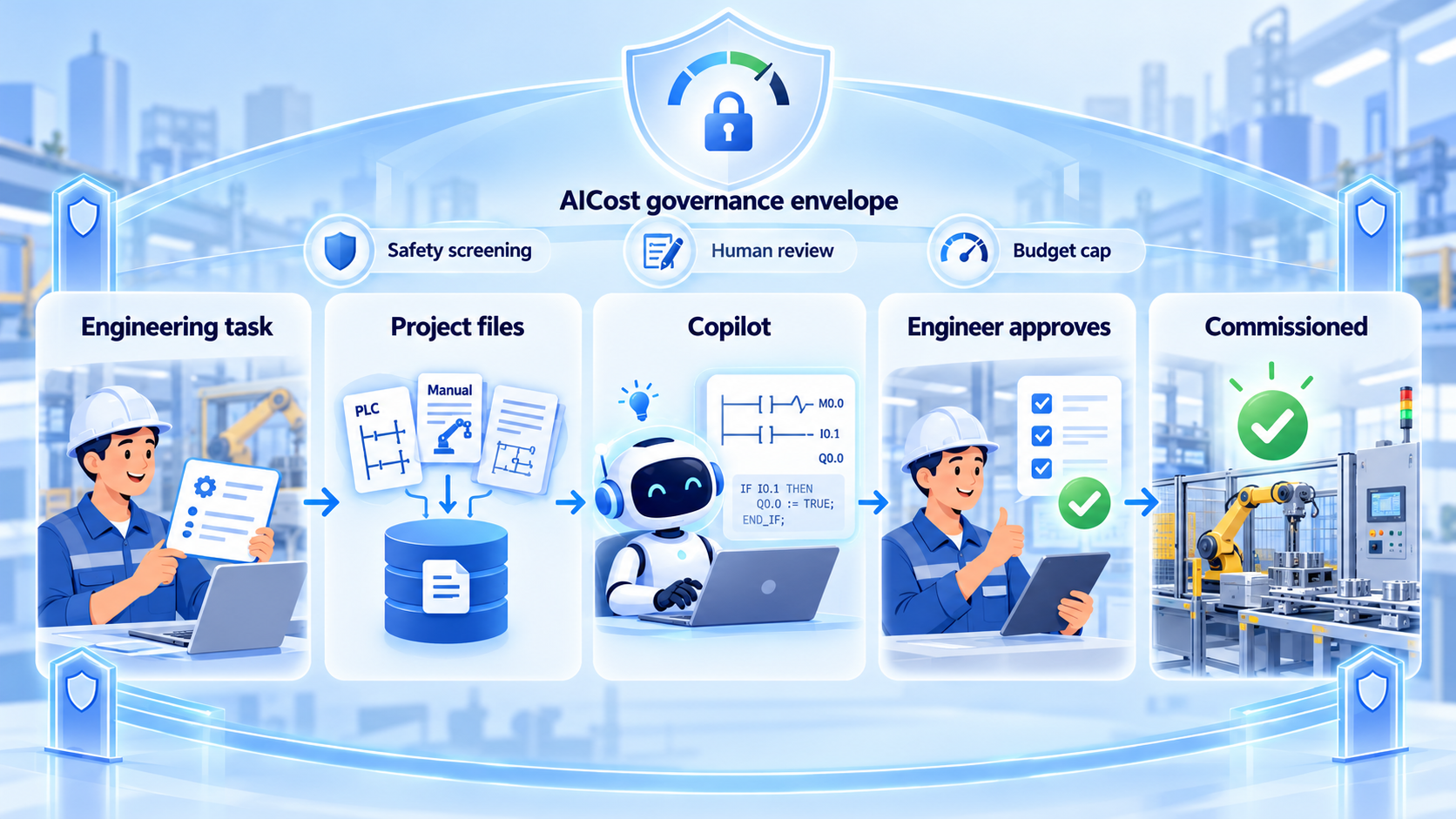
1 · cost
Project files and manuals
$92
$28
2 · gate
Cache project context
3 · cost
Steps per engineering task
$2,332
$1,952
4 · governance
OT safety and code checks
$5
5 · governance
Simulate logic before review
$769
6 · governance
Engineer approves code
$25,000
$20,000
7 · gate
Return per engineer seat
Without AICost
$28,197/mo
$18.80 per engineering task
With AICost
$22,754/mo
$15.17 per engineering task 19% lower
Monthly saving
$5,443/mo
6 cost levers applied
Governance controls
5
Monthly budget $3,100
Cost cutLoop cap → Steps per engineering task −$380Prompt caching → Project files and manuals −$20Context compaction → Project files and manuals −$18Model routing → Project files and manuals −$18Batch the non-urgent work → Project files and manuals −$8Shorter review with pre-checked drafts* → Engineer approves code −$5,000
Governance✓ Guardrail screening → OT safety and code checks✓ Accuracy and hallucination checks → Simulate logic before review✓ Human review → Engineer approves code✓ Cost firewall at the gateway✓ Data-class model allowlist
Flow, picture, cost levers, governance and policy envelope
How the work flows today
1Engineer describes the required logic or change in natural language
2Copilot generates PLC code (SCL), HMI screens or test cases
3Simulate or virtually commission
4Engineer review and approval under change management
5Operations copilot answers alarm and shift questions
AICost engine chain (blue: cost, purple: governance)
Cost levers and the step they act on
Loop cap on step Steps per engineering task −$38020 turns, 60k tokens, enforced by cost-firewall · Agent LoopA ceiling on turns and tokens per agent run, so a stuck agent cannot run up the bill.
How it works: Each agent run gets a maximum number of turns and tokens. A run that hits the ceiling stops and hands off instead of looping.
How AICost prices it: The Agent Loop engine prices the runs with and without the ceiling, including the runaway tail.
Governance: The cap is enforced by the cost firewall at your gateway, with an alert when it trips.
Prompt caching on step Project files and manuals −$2060% cacheable, 75% hit (combined with the other knobs on this step) · Prompt CachingRepeated instructions and documents are cached, so you pay less for the same prompt text.
How it works: The stable part of each prompt (system instructions, tool definitions, reference text) is cached by the model provider and billed at the cached rate.
How AICost prices it: The Prompt Caching engine prices cacheable share and hit rate against the provider's cached-input price.
Governance: No change to answers, models or data. Only the billing of repeated text changes.
* Cacheable share and hit rate are typical values; your logs give the real ones.
Context compaction on step Project files and manuals −$18trim history 60%, net of overhead (applied to every eligible workflow) (combined with the other knobs on this step) · Context TrimLong histories are trimmed each turn, so every call carries less text.
How it works: Older turns and long documents are summarized or trimmed before each call, keeping what the model needs.
How AICost prices it: The Context Trim engine prices the smaller context net of the cost of trimming.
Governance: Quality is checked before rollout; nothing reaches the model that it was not allowed to see.
* The trim size is an input; your evals confirm it keeps answer quality.
Model routing on step Project files and manuals −$1825% of calls (file reading, test triage and summaries) to Claude Haiku 5.5; critical work (code changes) stays on Claude Sonnet 5.5 (applied to every eligible workflow) (combined with the other knobs on this step) · Model RouterRoutine steps run on a cheaper model; critical steps stay on the primary model.
How it works: Each workflow type has routine work (triage, lookups, extraction, summaries, drafts) and critical work (the final answer, code changes, clinical or legal output, decisions). Routine calls go to the economy model; critical work stays on the primary model.
How AICost prices it: The Model Router engine prices the split between the economy and primary model on the workflow's own volume.
Governance: Only approved models for the data class are used. For patient and privileged legal data the share is capped and calls stay with the primary model's vendor and route, so the BAA still covers every call.
* The share of routine calls per workflow type is a starting assumption; your traffic sets the real split.
Batch the non-urgent work on step Project files and manuals −$820% of calls through the batch API (applied to every eligible workflow) (combined with the other knobs on this step) · Batch or RealtimeWork that can wait runs in the provider's batch mode at a lower price.
How it works: Requests that do not need an instant answer are queued and sent through the batch API.
How AICost prices it: The Batch or Realtime engine prices the batch-tolerant share at batch rates.
Governance: Urgent and customer-facing requests stay realtime.
* The batch-tolerant share is an input.
Shorter review with pre-checked drafts* on step Engineer approves code −$5,000*assumption: 20% less edit time per engineering task when evals catch errors before the reviewer sees the draft; every engineering task is still reviewed · Human ReviewEvery item is still reviewed, but automated checks catch errors first, so review takes less time.
How it works: An evaluation step checks each draft before the reviewer sees it, so the reviewer edits less.
How AICost prices it: The Human Review engine prices reviewer time at the shorter review time.
Governance: Every item is still reviewed by a person.
* The time saved per review is an assumption, marked with an asterisk.
Governance controls and the step they act on
Guardrail screening on step OT safety and code checks $5
PII, prompt-attack and policy screening before the model acts.
Accuracy and hallucination checks on step Simulate logic before review $769
Golden-set and live-traffic scoring catch silent regressions.
Human review on step Engineer approves code $25,000
Low-confidence, high-value or regulated cases go to a person.
Cost firewall at the gateway policy only, no cost
Monthly budget, daily cap, per-run ceiling, turn cap, spike rule, kill switch.
Data-class model allowlist policy only, no cost
Only models cleared for this data class are routable; others are refused at the gateway.
Policy envelope
Monthly budget$3,100
Daily hard cap$134
Per-run ceiling$0.24
Turn cap20
See the policy your gateway enforces
{
  "workload_id": "industrial-copilot-for-automation-engineering-and-operations",
  "scope": "workload",
  "monthly_budget_usd": 3100,
  "daily_warning_usd": 94.03,
  "daily_hard_limit_usd": 134.33,
  "max_cost_per_run_usd": 0.24,
  "max_model_calls_per_run": 20,
  "max_retries": 2,
  "max_output_tokens": 1200,
  "requests_per_min": 60,
  "anomaly": {
    "rolling_window": "7d",
    "spike_multiplier": 3,
    "rule": "flag any hour/day exceeding 3x the rolling average, or any single day above the daily hard limit"
  },
  "actions": {
    "warning_threshold": "notify",
    "soft_limit": "route_to:claude-haiku-5-5",
    "hard_limit": "block_noncritical_requests",
    "anomaly": "throttle_and_alert",
    "emergency": "block_all_and_require_approval"
  },
  "emergency_stop": {
    "enabled": true,
    "requires_approval_to_resume": true
  }
}
Where the cost runs away
- Large project files and documentation in context per prompt
- Seat licenses across engineering teams with uneven use
- Iterative generate-simulate loops
Talk to us about this workflow →