Twenty modules, 247 controls, connected to your real systems. The findings are priced in dollars, the decisions are compiled into policy your gateways load, and the result is re-proved nightly in a journal you can verify yourself. Not a consultant's document that is true for a week.
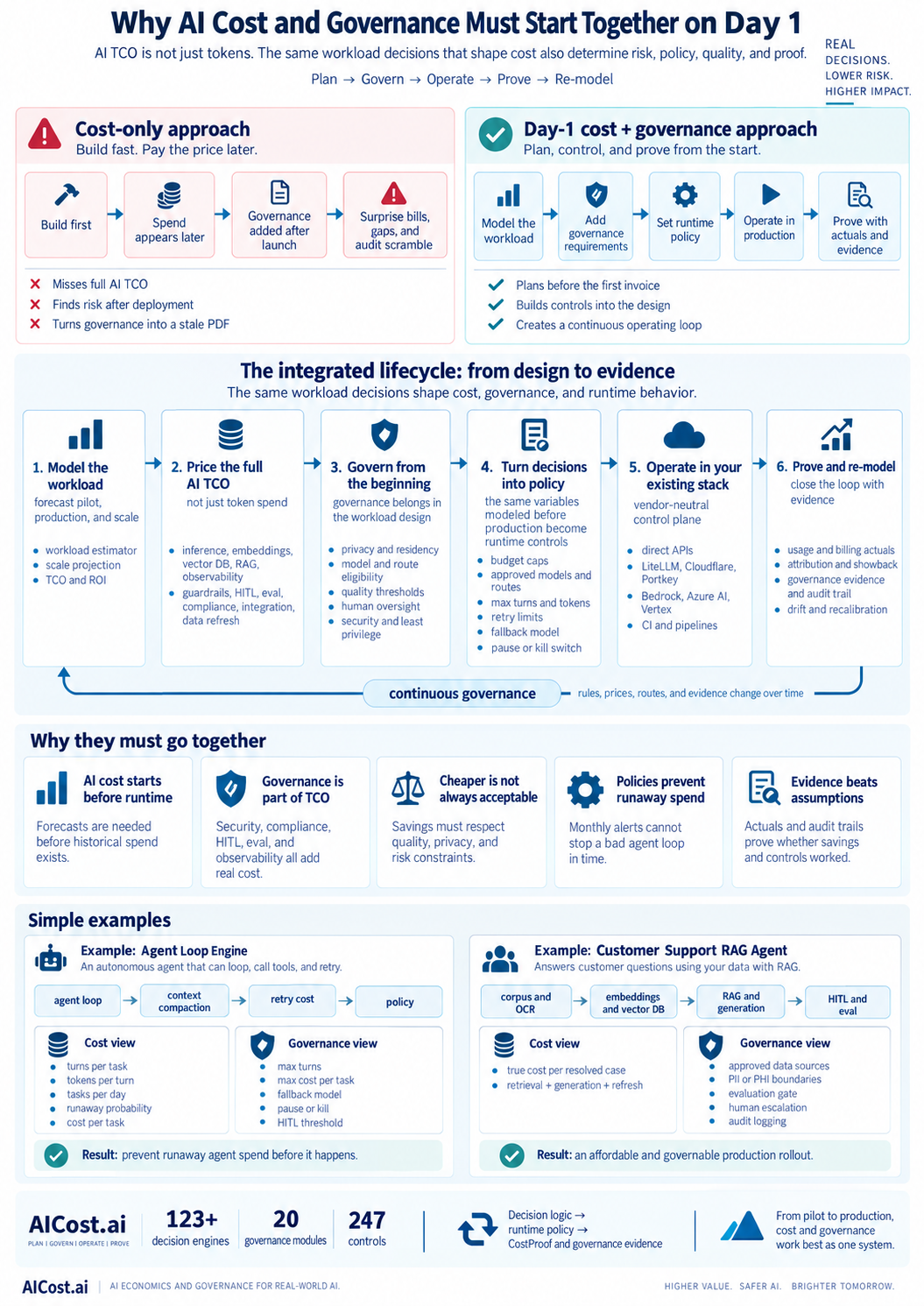
The usual sequence is build the thing, watch the spend, add governance when somebody asks. That order produces a surprise bill, a risk discovered after deployment, and a governance document that is stale the week it is signed. AICost models the workload once and uses the same variables for both views.
| Cost-only approach | Cost and governance from day one |
|---|---|
| Build first, spend appears later, governance added after launch, then surprise bills and an audit scramble | Model the workload, add governance requirements, set runtime policy, operate in production, prove with actuals and evidence |
| Misses full AI TCO: evaluation, guardrails, human review, observability, data pipelines, maintenance | Plans before the first invoice, with the governance premium priced as part of TCO |
| Finds risk after deployment | Builds controls into the design: eligibility, residency, oversight settled before build |
| Turns governance into a stale document | Creates a continuous operating loop: plan, control, prove, re-model |

Five groups, four modules each. Every module is scored from evidence where we can read it and from a scoped questionnaire where we cannot, and every finding it produces carries a price, an owner and a remediation window.
What you have before you spend more
Controls that hold in production
Which workloads, on what
Where the cost engines become policy
Making it stick
CSA AICM is the spine: 247 controls expanded into the questionnaire. Answer once and the obligations matrix reports across every framework, so the same evidence answers the auditor, the regulator, the board and the security team.
247 controls, 18 domains. The most technical of the four, so platform and security teams can implement it. Feeds the STAR for AI working sheet.
The AI management system. Proves governance runs as an operating system, not a document. Procurement increasingly asks for it.
Govern, Map, Measure, Manage, with the Generative AI profile. Our eval gates are Measure; the enforcement ladder is Manage. OSCAL export into your GRC tool.
Risk classification per workload; Article 14 oversight log, Article 15 eval heartbeat, Article 50 transparency, Article 73 incident clock, Annex IV pack regenerated from the journal. Dates tracked as the Digital Omnibus moves them.
SB 53, AB 2013, SB 942, AB 489 (healthcare), Texas RAIGA, Colorado ADMT. Every obligation dated and watched at 90, 30 and 7 days.
Read-only. Never in your inference path. No prompts or content. Every source file is hashed into the evidence store before it is parsed, so even an unparsed export is valid evidence.
Eleven intake questions, ordered so a low-sensitivity workload finishes in three and a regulated one earns the long path. Six gates applied in order per route. Price is last on purpose: a model that fails residency is not expensive, it is ineligible.
policy_patch for LiteLLM, Portkey, Cloudflare, Kong and OpenRouter; Bedrock IAM per-model conditions; Azure RBAC; Vertex org policy; vendor-console caps for teams on direct keys.
A plain-English reason for every model ruled out, with the vendor fact relied on and the date it was captured. Defensible to the same auditor for marketing and for legal.
Open and cost optimized; internal business; regulated personal data; health or financial with agreement; export-controlled; self-host or open weight.
The first four steps remove cost, the fifth asks a person, the sixth stops. Regulated work can be marked a no-downgrade zone, which skips the economy route entirely. A blunt cap treats a legitimate spike and a pathological loop identically; this does not.
Cost velocity or context growth crosses a threshold. Nothing restricted.
Above plan but legitimate. Cost removed before capability.
Routine substeps move to a cheaper route that passed eligibility.
The cheaper route must still pass the accepted evaluation.
Spend beyond the envelope is a recorded human decision.
Loop outside the hard envelope. Smallest useful scope, journaled.
A report describes a state at a point in time. This is generated from the live model on demand, so the answer given to a board in October and to an auditor in January come from the same source, and the journal shows what changed in between.
| Cadence | What runs | Evidence produced |
|---|---|---|
| Daily | Cost actuals ingest, bill vs gates, engine audit | Per tenant, workload and agent showback; untagged spend as a named residual |
| Weekly | The seven watchers | Journaled sweep, drift rows, alerts to Slack or webhook |
| Monthly | Branded drift report | Chain-verified, HMAC-signed, with the verify command |
| Quarterly | Access recertification | Who can call vs who did; unused grants and unknown actors |
| Continuous | Art. 73 incident clock, Art. 14 oversight log, Art. 15 eval heartbeat | Annex IV pack regenerated on demand from the journal |
A model repriced, a vendor certificate aging out, an owner leaving, an agent tripling its retries: named and dated. Serious incidents open with the 15, 10 or 2-day deadline attached, and overdue renders red before a regulator asks.
What the ceiling prevented becomes a reportable line, not an anecdote. FinOps tools have half of this; GRC tools have neither. Audits, insurers and procurement get current evidence instead of last year's document.
| The usual assessment | AICost |
|---|---|
| Questionnaire and interviews; findings rest on what people remember | Connected to real systems. Entra ID, Defender, licensing, Bedrock CUR and logs, Azure and GCP exports, gateways, corporate card and AP exports. Evidence first; a scoped questionnaire only for what cannot be read. |
| Maturity heatmap in five colors | The Compliance Premium in dollars. What governing your AI costs, per control and per system, computed by engines you can re-run. |
| A policy memo nobody can enforce | A policy engine. Six gates per route with the elimination reasoning shown, exported as gateway config or IAM conditions. |
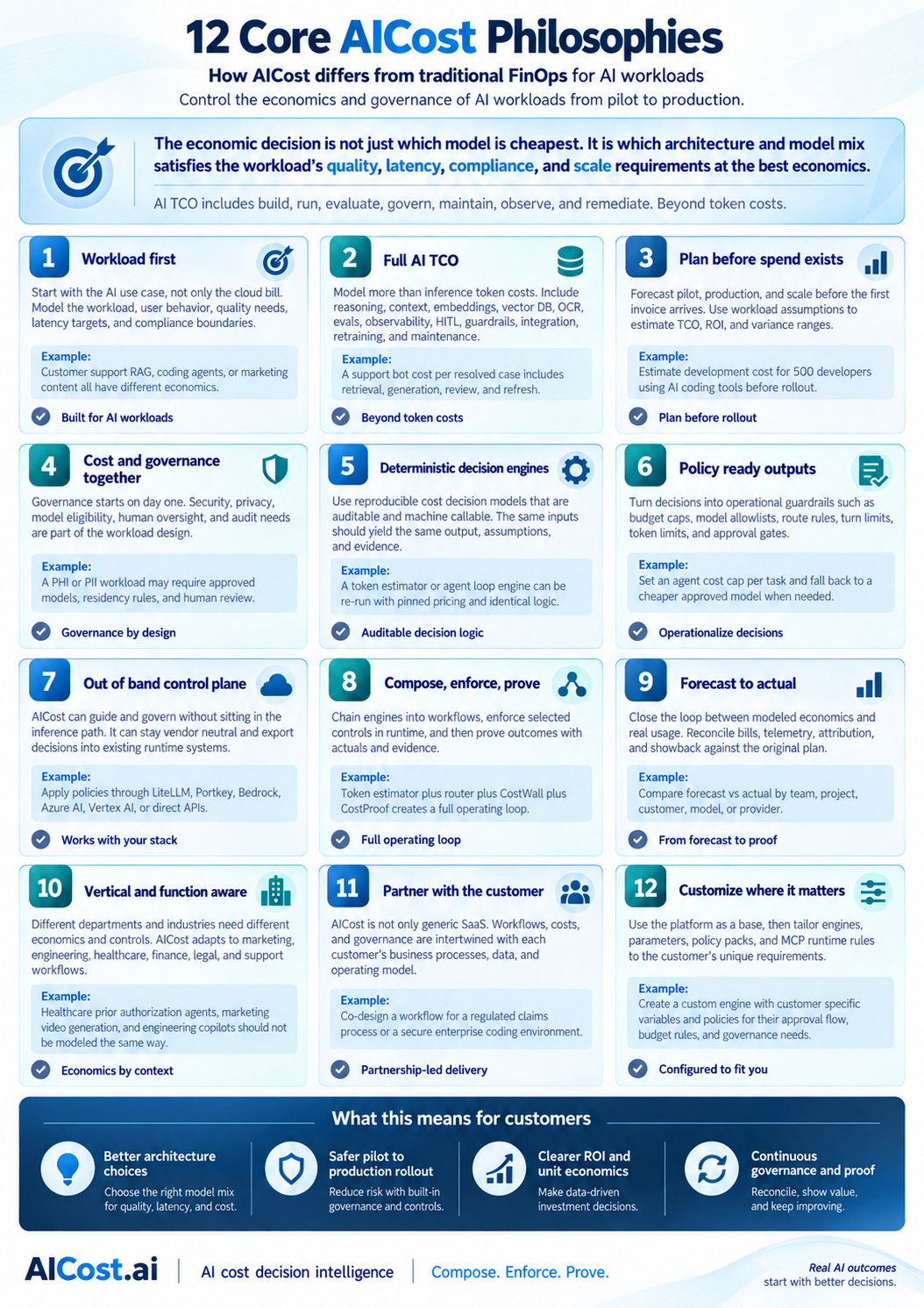
| Numbers estimated by an analyst | 120+ deterministic engines in MCP chains. No model calls inside the math; same inputs, same answer, auditable. |
| A PDF that is true on delivery day | Continuous governance. Watchers, heartbeats, incidents and recertification keep it true; every event HMAC-signed. |
| Governance as a separate program from cost | One loop. The cost engines are the policy engines. The ceiling a team lead agreed to in a meeting is the ceiling enforced in production, produced by the same code. |
| A rip-and-replace platform | Your stack stays. FinOps, GRC, gateway and observability tools keep doing their jobs; we add the decision layer and export FOCUS, OSCAL and STAR back into them. |

Your EU AI Act risk class and likely obligations. No signup wall.
Your issues taken stock of, two workflows named and priced, a same-day written plan.
Where money and hours leak, fastest ROI, daily cost visibility, governance cleared before you build.
Inventory, 247-control mapping, Compliance Premium, stop / fix / approve / scale roadmap.
The assessment that re-proves itself every night. Resellable per client for MSPs.
No. Read-only cost and usage, a team-scoped key convention, a workload description and an owner per workload. No prompts, completions or customer data, and no production access.
No. Traffic keeps flowing application to gateway to vendor as it does today. Policy goes out as configuration; actuals come back to the ledger.
A read-only role scoped to cost and metadata, revocable by you at any time. On AWS that is a cross-account role with a per-customer external ID and two S3 prefixes; on Microsoft, read-only Graph and Defender permissions; on Azure and GCP, the cost export.
Every monthly report ships with the command you run yourself against the hash-chained, signed journal. If a single entry had changed, verification fails.
Five objective criteria your own team can verify: a per-team cost number that did not exist before, at least one structural saving with the arithmetic shown, a policy patch loaded by your gateway, a working enforcement event you trigger deliberately, and forecast accuracy scored as a percentage.
No. FinOps platforms hold cloud actuals, GRC platforms hold controls and attestations, gateways route requests, observability holds traces. None of them owns the complete workload economic decision. That is the gap AICost fills, and it exports back into each of them.
We sell you the camera, running nightly. One workload, one exhaust path, first graded report in 48 hours.
✉ [email protected]