With AICost.ai cost and governance control,implement enterprise AI with confidence.
AICost models them once with 120+ cost and governance decision engines, turns the approved numbers into enforceable policy in your gateways, and proves every night that the workload is still inside its cost and risk envelope.
An agent loop has a cost view (turns, tokens, tasks per day, runaway probability) and a governance view (maximum turns, cost per task, fallback model, kill switch, review threshold). They are the same variables. Modelling them once is why the policy is consistent with the economics instead of negotiated against them. Visibility and optimization pay for the program; planning and governance are what let it reach production.
Visibility
See where AI spend goes
Attribute every dollar by team, workload, key and agent across AWS, Azure, GCP, direct vendors and gateways.
Bill diagnosis names the drivers
Shadow AI found on the bill, not in a survey
Untagged spend shown as a named residual
Optimization
Cut cost without moving it
Every lever priced against your shape and gated on quality, so a cheaper model that escalates more is not called a saving.
Caching, batch, routing, placement
Self-host and fine-tune break-even
Stacked savings, not double counted
Planning and forecasting
Cost it before it exists
A defensible number for a workload that has not shipped, with the variance reserve stated separately.
Scale projection and tier transitions
Agentic variance reserve
Forecast scored against actuals
Governance
Make the decision enforceable
Eligibility per route, ceilings per team, evidence per call, mapped to 247 controls and kept current after go-live.
Policy engine with six ordered gates
Graduated enforcement: warn to stop
Signed journal, verify command
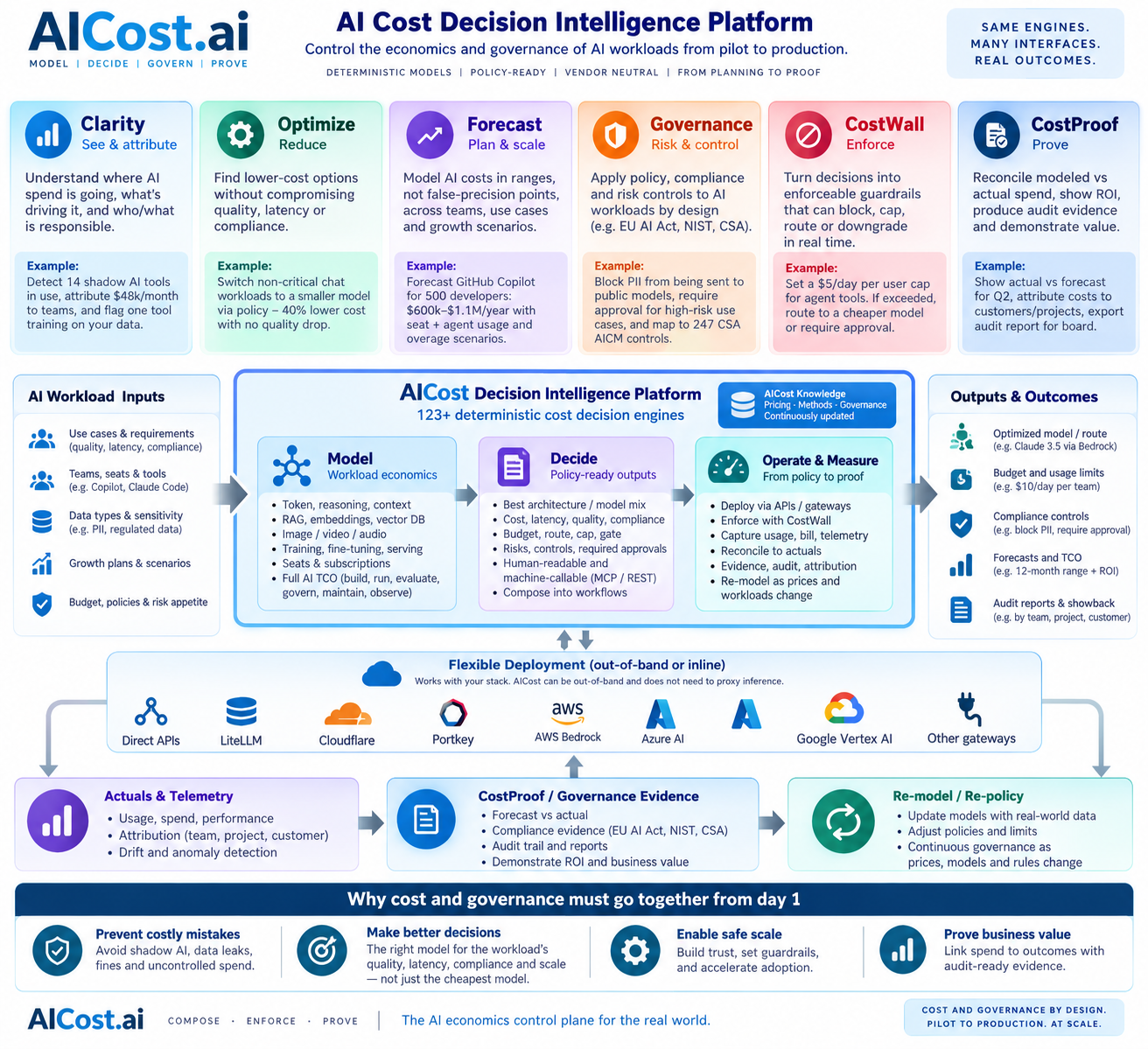
The platform: six pillars, one engine set. Inputs on the left, decisions in the middle, policy and evidence on the right. (tap to open full size)
The difference, on three workloads
A bill shows compute. A workload has a shape.
Retrospective cost tools read the invoice after the fact and allocate it. That is useful, and it is not the decision. The three examples below show the same workload from both sides.
Customer support with RAG
retrieval assistant over internal documents, human review on escalation
What a cost dashboard shows
One line of LLM API spend, and the rest scattered as undifferentiated compute and storage: the embedding job, the vector database, the re-indexing, the reviewer hours. The dashboard can tell you the token line grew 30 percent. It cannot tell you why, or what a cheaper model would do to the review queue.
LLM API ........ $18,400 / mo (+30%) EC2 / storage .. "compute" Reviewer time .. not on the bill
What the AICost RAG decision engine shows
Eight priced layers of one workflow, and a unit that support leaders already report.
Corpus onboarding and re-embedding as documents change
Chunk size and retrieved context, which drive tokens per call
Inference at your cache hit rate, plus retries billed in full
Guardrails, evaluation golden set, human review per escalated case
cost per resolved case ..... $0.71 of which human review ...... 38% cheaper model swap ......... escalations +11%, net cost UP
The decision it changes: the eval gate blocks the "cheaper" model because it moves cost from the token bill to the reviewer. The chunking optimizer and cache hit rate deliver the 30 percent instead, and the result compiles into the team's allowlist and budget cap.
Distributed dev teams with agentic AI
coding assistants and long-running agent loops across several teams
What a cost dashboard shows
Seat licences on one line, metered API on another, and a bill that tripled although "nobody changed anything". Per-user cost looks like headcount. It cannot see that agentic sessions replaced chat calls, that context grows with every turn, or which loop ran for 47 turns overnight.
Copilot seats ... $19 x 500 API usage ....... $61,200 (3x last month) one developer ... $750 (why?)
What the AICost agent engines show
The bill decomposed by name, and a ceiling with a reason behind it.
Per-key attribution: which developer, which agent, which repo
Agent Loop Cost: turns per task, tokens per turn, the runaway tail priced separately from the mean
Context compaction and prompt caching, worth more than any model swap
Seat vs metered break-even per developer, not one policy for everyone
base loops ....... $1,447 / mo runaway tail ..... $734 / mo (34%) policy_patch ..... max 12 turns, soft cap, downgrade, hard stop
The decision it changes: platform engineering keeps the frontier model with a per-run envelope; feature teams get mid-tier with a per-key daily budget. Both rules land in one gateway config, and a loop that misbehaves at 2am is constrained, downgraded, then stopped, with every step in the ledger by morning.
Marketing and multimodal AI
image, video and voice generation on public data, many vendors
What a cost dashboard shows
Four vendor invoices, two on a corporate card the dashboard never sees, priced per image, per second and per credit. No way to compare a campaign across vendors, and no idea whether the brand and content policy was followed.
Vendor A ... per image Vendor B ... per second of video Vendor C ... credits (card, not on the bill)
What the AICost media engines show
One cost per campaign asset across vendors, and a policy that is light because the data class is public.
Image and video generation priced on one rate catalogue, refreshed daily
Corporate card and AP exports pull the shadow vendors into the same total
Eligibility: widest vendor set, optimized purely for cost and speed
Usage and campaign cost tracked by team, with the content policy attached
cost per approved asset ... $3.10 vs $8.40 shadow vendors found ...... 2 policy template ........... open, cost optimized
The decision it changes: marketing gets the cheapest capable vendors without a governance burden it does not need, and still appears in the same enterprise total as legal, which carries the heaviest.
Figures are illustrative of the structure of each workload, not any customer's actual spend. Every engine returns the source and date of each rate it used.
The breadth
120+ engines across every AI cost shape.
An enterprise runs seat-based, token-based, GPU-based, media-based and per-episode workloads at once. One model prices them wrong in several directions. Each domain below has engines built for its shape, all on one rate catalogue (150 models, 17 providers, refreshed daily) and one ledger.
Humanoid Labor ROI · Robot Fleet Cost · Buy vs RaaS
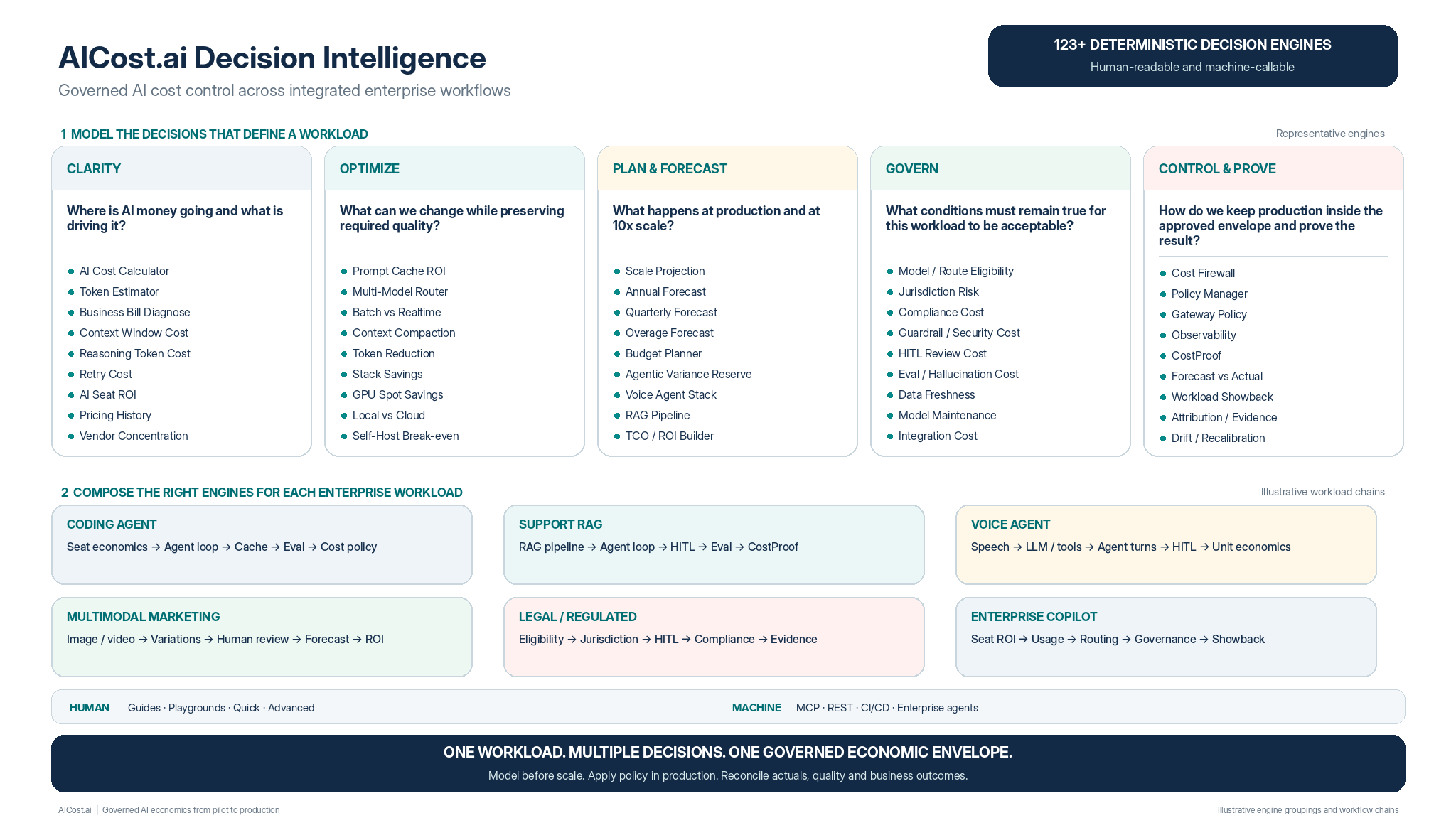
Representative engines by job, and the chains composed for six common workloads. (tap to open full size)
MCP chains and workflow integration
Same engines, reached by a person or by a machine.
A finance manager uses a calculator with three sliders. An agent, IDE or CI job calls the same engine over MCP at mcp.aicost.ai and gets a typed answer with cost per unit, the source of every rate, and the next engine to call. That last field is how chains assemble themselves.
Last month doubled and nobody can say whydiagnose, then prevent the repeat
Bill Diagnose→Agent Loop Cost→Context Window Cost→Retry Cost→Cost Firewall
30 percent out of the support assistant without breaking itoptimize, gated on quality
Two teams want two different models, one billgovernance, compiled to config
Model Eligibility→policy_patch→Gateway config→Ledger
Runs where you already are. Claude Code and Desktop by MCP, Cursor and Codex by config, your own application by REST, CI and nightly jobs by run-batch. Policy flows out as configuration to LiteLLM, Portkey, Cloudflare, Kong, OpenRouter, Bedrock IAM, Azure RBAC and Vertex org policy. Zero inference through us.
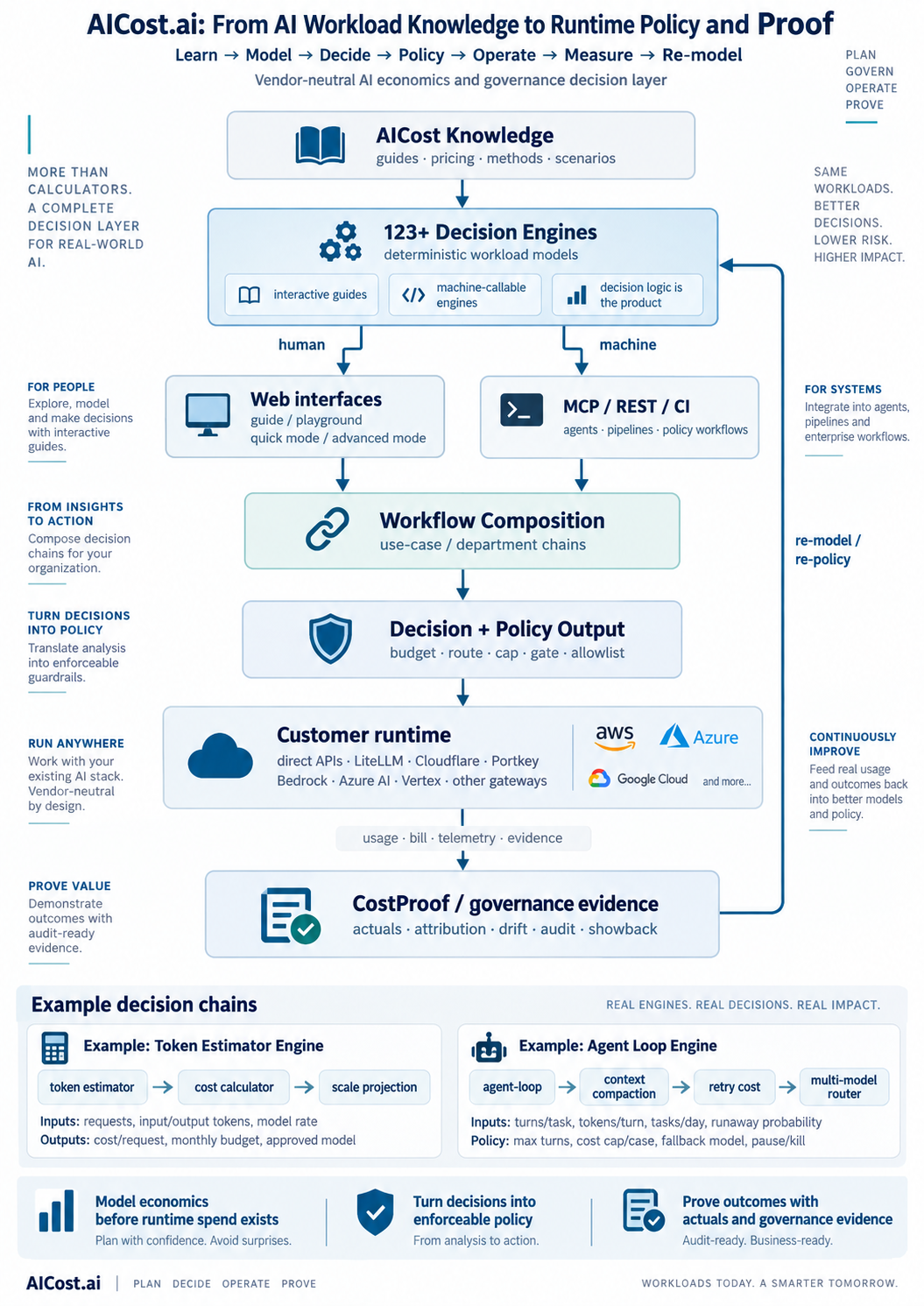
From workload knowledge to runtime policy and proof. Human and machine reach the same engines; the loop closes on evidence. (tap to open full size)
Governance, from the same engines
The cost engines are the policy engines.
Every engine output that is a number today (a ceiling, an eligible model set, a review rate) becomes a rule tomorrow: compiled into gateway or IAM configuration, enforced on every call, and re-proved on a schedule. The full assessment covers 20 modules and 247 controls mapped to CSA AICM, ISO 42001, NIST AI RMF, the EU AI Act and 2026 US state law.
Inventory from evidence
Built from metered spend and identity (Entra ID, Defender, licensing, CUR, billing exports), so an unregistered workload shows up as an unattributed line, not a survey gap.
Assess: 20 modules
Discover, secure and comply, prioritize and design, govern and control, operate and adopt. 200 questions, most answered from portal evidence, the rest by a scoped questionnaire with assurance levels.
Compile and enforce
Six gates per route, price last. Policy patch loaded by your gateway. Graduated ladder: warn, constrain, downgrade, gate, approve, break. No-downgrade zones for regulated work.
Prove, continuously
Seven weekly watchers, a monthly signed drift report, quarterly access recertification, the EU AI Act Article 73 incident clock, and a verify command in every report.
The usual assessment
AICost
Questionnaire and interviews
Connected to real systems. Read-only cost, identity and usage. No prompts, no content, never in the inference path.
Maturity heatmap in five colors
The Compliance Premium in dollars. What governing your AI costs, per control and per system.
A policy memo
A policy engine. Configuration your gateway loads, with the reasoning shown.
True on delivery day
Continuous. Watchers, heartbeats, incidents and recertification, every event HMAC-signed.
Every AI system, owner and risk tier, including the shadow AI found on the bill and the corporate card.
Budget
Governance has a price
One dollar figure a CFO can budget, with every finding priced, owned and given a remediation window.
Enforce
Decisions hold
Allowed models, ceilings and routes live in your gateway. A runaway agent loop at 2am is constrained, downgraded, then stopped, and it is all in the ledger by morning.
Ship
Pilots reach production
Eligibility, residency and human oversight settled before build, not after the audit. About three weeks to first enforcement.
Prove
Board, auditor, regulator
Answered from one live source: inventory, policy estate, ceilings, exposure, cost of controls, signed journal.
Keep
No rip and replace
Your FinOps, GRC, gateway and observability stack stay. We add the decision layer and a FOCUS export back into your tools.
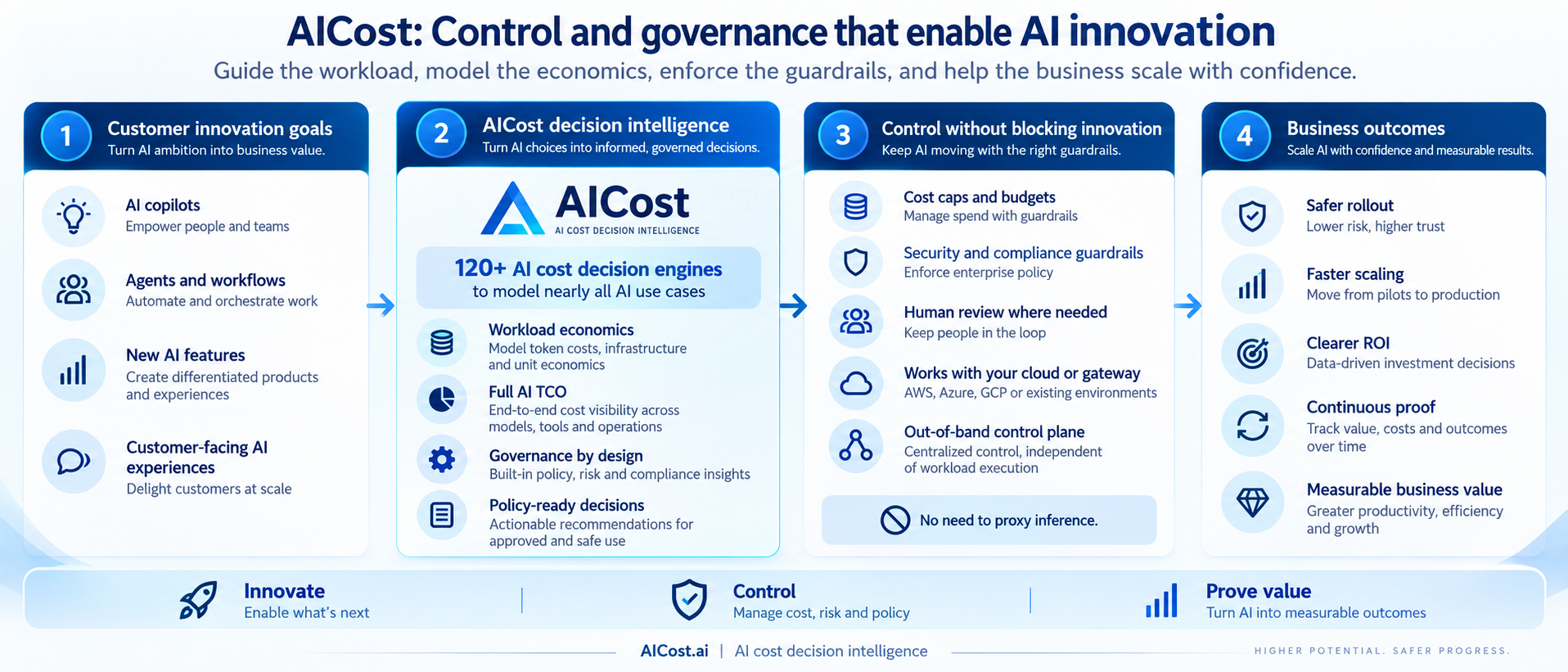
Control and governance that enable innovation: from customer goals to measurable business outcomes. (tap to open full size)
01
AI Act Quick-Check
Free, 2 minutes
Your EU AI Act risk class and likely obligations. No signup wall.
02
Take-Stock Session
One hour, fixed fee
Your issues taken stock of, two workflows named and priced, a same-day written plan.
03
AI Opportunity Snapshot
One week
Where money and hours leak, fastest ROI, daily cost visibility, governance cleared before you build.
AI cost governance helps enterprises move from pilot to production with enforceable controls, measurable outcomes, and the confidence that every approved workload remains within its cost and risk profile.Subu Vdaygiri, Founder, AICost.ai
For VC and PE
Two reasons an investor lands here.
Invest in AICost.ai
A decision layer, not a dashboard.
CloudIntelligence.ai LLC builds AICost.ai: 120+ deterministic engines, a multi-tenant MCP server in production, Stripe billing live, and a governance suite mapped to 247 controls, bootstrapped from Irvine and Austin by a founder who built the CloudBlue data lake at Ingram Micro and launched its Microsoft NCE, AWS and GCP programs. We are raising to extend cost and governance intelligence across the enterprise and into physical AI.
Diligence engines price a target's or portfolio company's AI cost claims vendor-exact: full AI TCO, agentic variance, unit economics, the governance premium and the exposure a buyer inherits. The same engines that govern an enterprise workload tell you whether a pitch deck's AI margin survives real pricing. Plus the thesis itself: why cost and governance are one product, and why the market runs from the enterprise agent fleet to the solo vibe coder, from cloud to mobile to robots.
No. We need read-only cost and usage, a team-scoped key convention, a workload description and an owner per workload. No prompts, completions or customer data, and no production access.
Do you sit in our inference path?
No. AICost is out of band. Traffic keeps flowing application to gateway to vendor exactly as it does today. Policy goes out as configuration; actuals come back to the ledger.
Are the numbers generated by an AI model?
No. The decision engines make no model calls. Same inputs produce the same answer with the source and date of every rate, which is what lets an auditor reproduce a figure and lets a policy rely on it.
What if you cannot read our systems?
Then we ask, precisely. A scoped questionnaire is generated from the 247 controls for your profile, must-tier first. Every answer carries a justification, an evidence link and an assurance level.
How do we know you never edited the record?
Every monthly report ships with the command you run yourself against the hash-chained, signed journal. If a single entry had changed, verification fails.
How long until something is enforced?
About three weeks in a pilot: connector exchange on day 1, first attributed number in week 1, policy patch in one session, soft and hard caps live by week 2 to 3.