Know what AI you run, what it can reach and what it costs
The AICost assessment collects from your tenant, your network discovery, your invoices and your AI vendors, then scores every system against the AICost governance controls. Basic gives you the facts in days. Advanced rates you against the standards.
In short
- Workflows first. AICost sits above your FinOps, GRC, gateway and cloud tools. It reads from them and prices and governs each AI workflow end to end.
- Measure before you govern. The assessment is the first step of governance and the check you repeat every quarter.
- Data first, questions second. Read-only collectors find most of the facts. The questionnaire covers what data cannot show: purpose, owners and decisions.
- Spend is part of the finding. Every AI system comes with its monthly cost, including the ones nobody approved.
- Two levels. Basic: inventory, spend, shadow AI, access and risk tiers. Advanced: every control scored against NIST AI RMF, ISO/IEC 42001, the EU AI Act and sector rules, with an evidence pack.
- Output you can act on. Tables with owners, fixes and the control number for each finding, not a slide of principles.
Three things you can do this week
Grant read-only Microsoft access
Approve the read-only app in Entra. It collects identities, AI app sign-ins, OAuth grants and Copilot usage. No mail or file content.
AICost-GovControl401Upload 90 days of card and AP exports
AI vendors on statements show up with exact spend, including tools never approved.
AICost-GovControl101Answer the 20-minute questionnaire
Purpose, owners, regulations in scope and the decisions your AI informs.
AICost-GovControl201Start your AI assessment
Tell us your identity provider, your AI vendors and your regulators. We send the read-only setup steps and the questionnaire, and walk you through the results.
Workflows first: a layer above the tools you already run
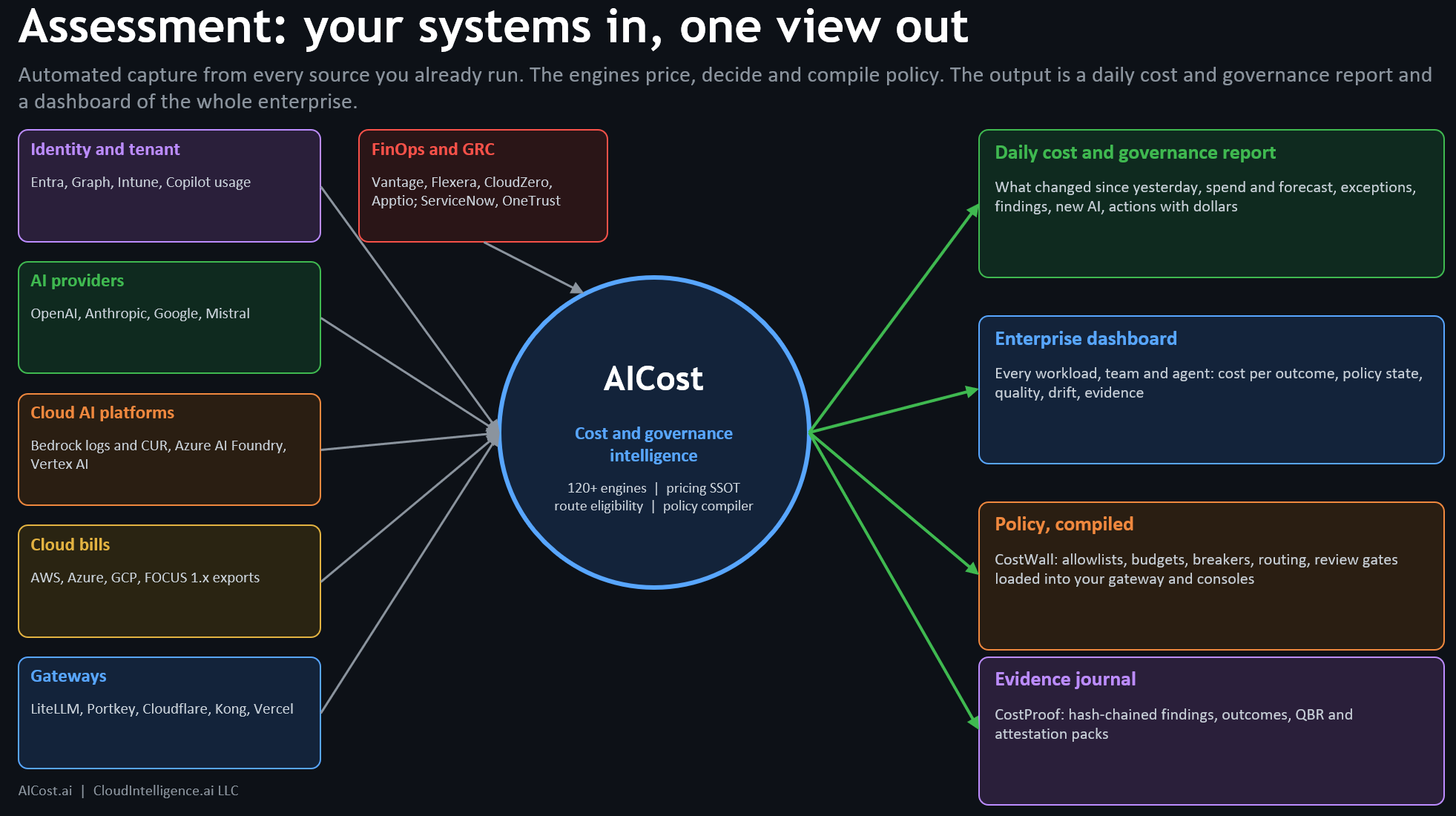
AICost does not replace your FinOps, GRC, gateway or cloud tools. It reads from them, prices and governs every AI workflow step by step, and sends the decisions back.
 Open full size
Workflows, not line items.
FinOps tools show spend by account and tag. GRC tools hold policies and risks. AICost ties both to the workflow doing the work: each step's cost, its controls and its owner.
Connects to what you run.
Identity (Entra, Graph, Intune), AI providers, cloud AI platforms (Bedrock, Azure AI Foundry, Vertex AI), cloud bills and FOCUS exports, gateways (LiteLLM, Portkey, Cloudflare, Kong), FinOps (Vantage, Flexera, CloudZero, Apptio) and GRC (ServiceNow, OneTrust).
A layer above, not another silo.
Your FinOps tool keeps the bill and your GRC tool keeps the register. AICost adds the workflow view and sends policy, findings and evidence back to them.
Read-only in, policy out.
Collectors only read and nothing sits in your request path. Out come a daily report, an enterprise dashboard, policy compiled for your gateway and an evidence journal.
What is an AI assessment?
An AI assessment is a structured look at the AI an organization uses: what exists, who owns it, what data and access it has, what it can do, what it costs, which rules apply and how well it is controlled.
In AICost the assessment and governance share the same controls and engines. The assessment measures where you are. Governance keeps you there and improves it.
Why enterprises run one
A regulator, customer or insurer asked
Security reviews and new AI rules ask what AI you run and how it is controlled.
AI spend is growing without a clear owner
Invoices from several AI vendors land in different cost centers with no link to outcomes.
A copilot or agent rollout is planned
Oversharing and excess access need fixing before AI can surface them.
The board wants a baseline
A measured starting point makes progress and spend easy to report.
Basic and advanced
| Basic assessment | Advanced assessment | |
|---|---|---|
| Goal | Facts: what AI exists, what it costs, what it can reach, how risky it is | Rating: how well each control works against the standards you answer to |
| Data | Automated collection plus a short questionnaire | Basic data plus control interviews, document review and evidence sampling |
| Standards | Risk tiers using EU AI Act categories | NIST AI RMF, ISO/IEC 42001, EU AI Act, GDPR and sector rules |
| Output | Inventory, spend, shadow AI, access findings, risk tiers, top 10 fixes | Control-by-control maturity, gap list, evidence pack, board report, 90-day plan |
| Who it suits | Any company using AI, a first look, a quarterly check | Regulated firms, firms preparing for ISO/IEC 42001 or an audit |
| Repeat | Monthly or quarterly, same collectors | Yearly, or before a certification or audit |
Basic assessment: automated collection
Read-only collectors gather most of the facts. Each source feeds named controls.
| Source | What we read | Access | Feeds | Status |
|---|---|---|---|---|
| Microsoft Graph and Entra ID | Service principals, OAuth grants, app registrations, sign-ins to AI apps, Copilot usage reports. Read-only scopes, metadata only. | Read-only Graph app consent | GC101 GC401 GC505 GC901 | Runs today |
| Defender for Cloud Apps | The discovered Generative AI apps export: which AI sites people use, how often, and Microsoft risk scores. | CSV export you provide | GC101 GC901 | Partly automated |
| SharePoint access reports | Data access governance reports showing which sites and files are shared widely, the content Copilot and agents can reach. | Report export you provide | GC301 | Partly automated |
| Invoices, card and AP exports | AI vendors found on statements and invoices, including ones never approved. Spend is exact because it is on the statement. | CSV export you provide | GC101 GC501 GC505 | Partly automated |
| AI gateway telemetry | LiteLLM, Cloudflare AI Gateway or AICost CostWall logs: cost per team, workload, agent and outcome. | Log or database export | GC501 GC502 GC503 GC504 | Partly automated |
| Azure and AWS cost exports | Azure OpenAI and Bedrock spend from the cloud bill. | Cost export | GC501 GC507 | Runs today |
| OpenAI Usage and Costs API | Organization usage and cost by project and model, read with an Admin API key. | Admin API key, read-only use | GC501 GC503 | Wave 2 |
| Anthropic Usage and Cost API | Token usage by model, workspace and API key, and daily cost, read with an Admin API key. | Admin API key, read-only use | GC501 GC503 | Wave 2 |
| Google Cloud billing export | Gemini and Vertex AI cost per model from the billing export to BigQuery. | BigQuery billing export access | GC501 GC503 | Wave 2 |
| Questionnaire | The short interview for what data cannot show: purpose, owners, decisions AI informs, regulations in scope. | Interview, about 20 minutes | GC102 GC103 GC201 GC202 | Runs today |
How it runs
Kickoff
Agree scope, period (usually 90 days) and contacts.
Connect
Approve the read-only Microsoft app and share the exports.
Collect
Collectors run and record per-source status. An empty result is reported as a finding, never as a pass.
Questionnaire
Owners, purposes, regulations and decisions for each system.
Score
Engines tier each system, price it and raise findings with control numbers.
Review
We walk through the findings, the spend and the first fixes with you.
What we do not collect: mail, chat or file contents, prompts or AI outputs. We record that a credential exists, its type and expiry, never its value.
What the basic report looks like
Every table is built from collected data. Example rows show the shape, not your results.
AI inventory
GC101| App | Vendor | Found by | Users | Monthly spend | Data class | Risk tier | Owner |
|---|---|---|---|---|---|---|---|
| ChatGPT Team | OpenAI | Card statement, network discovery | From sign-in data | From statement | Internal | Medium | To assign |
| Copilot for Microsoft 365 | Microsoft | Graph licenses and usage | Licensed and active | From license count | Confidential | Medium | IT |
| Support RAG assistant | Anthropic via gateway | Gateway logs | Support team | From gateway | Customer data | High | Support lead |
AI spend
GC501| Vendor | Product | Source | Period spend | Sanctioned | Lever |
|---|---|---|---|---|---|
| Anthropic | Claude API | Usage and Cost API or gateway | Exact | Yes | Prompt caching, model routing |
| OpenAI | ChatGPT Plus (personal) | Card statement | Exact | No | Move to approved plan or stop |
| Microsoft | Copilot seats | Graph and invoice | Exact | Yes | Reclaim inactive seats |
Findings
GC805| Finding | Severity | Control | Fix | Owner |
|---|---|---|---|---|
| AI vendor paid by card with no approval | High | AICost-GovControl101 | Review and approve or stop | Finance |
| AI app with a hardcoded secret | High | AICost-GovControl401 | Move to managed identity or a vault | Engineering |
| Agent with no per-run cost cap | High | AICost-GovControl502 | Set cap at the gateway | Platform |
| Copilot seats inactive for 90 days | Medium | AICost-GovControl505 | Reclaim and reassign | IT |
Scorecard by area
GC903| Area | Score | Main gap |
|---|---|---|
| Inventory and ownership | 1 to 5 | Owners missing on shadow AI |
| Data and access | 1 to 5 | Sites shared organization-wide |
| Agents | 1 to 5 | No stop switch test |
| Cost | 1 to 5 | No caps on agent workloads |
| Evidence | 1 to 5 | Approvals not recorded |
Advanced assessment: against the standards
Everything in basic, plus each AICost control rated for design and operation against the frameworks you answer to.
| Standard | What we check | AICost controls |
|---|---|---|
| NIST AI RMF and NIST AI 600-1 | Govern, Map, Measure and Manage activities, including the generative AI risks | GC103 GC201 GC601 GC801 |
| ISO/IEC 42001 | AI management system: policy, roles, risk treatment, suppliers, monitoring, internal audit, improvement | GC103 GC203 GC701 GC803 GC903 |
| EU AI Act | Category and role per system, prohibited uses, high-risk duties, transparency, AI literacy, incident reporting | GC201 GC202 GC602 GC802 GC901 |
| GDPR and CCPA/CPRA | Lawful basis, minimization, transfers, retention, explanation duties | GC302 GC304 |
| OWASP Top 10 for LLM | Prompt injection, data leakage, excessive agency, supply chain | GC402 GC403 GC605 |
| Sector rules | Healthcare, financial model risk, employment AI laws | GC603 GC906 |
| FinOps Framework and FOCUS | Cost visibility, allocation, budgets, forecasting and unit economics for AI | GC501 GC502 GC504 GC507 |
Maturity scale
| 1 Initial | Ad hoc, depends on individuals |
| 2 Developing | Some practice, not consistent |
| 3 Defined | Documented and applied to most systems |
| 4 Managed | Measured, monitored and evidenced |
| 5 Optimized | Improved from data, automated where it makes sense |
How it runs
- Basic assessment. The collected facts are the starting point.
- Control interviews. Owners walk through how each control works today.
- Evidence sampling. We test a sample of approvals, reviews, logs and fixes per control.
- Rating. Each control gets a design and an operating rating with the evidence behind it.
- Plan. Gaps sequenced into a 90-day plan with owners and costs.
- Board report. A short report on posture, spend and the decisions needed.
What the advanced report adds
Control maturity
GC903| Control | Now | Target | Evidence | Gap | Owner | Due |
|---|---|---|---|---|---|---|
| AICost-GovControl101 AI inventory | 2 | 4 | Collector run logs, inventory export | No monthly refresh | IT | Q1 |
| AICost-GovControl402 Agent limits | 1 | 4 | Gateway config | No stop switch test | Platform | Q1 |
| AICost-GovControl603 Bias testing | 1 | 3 | None | No tests on hiring screen | HR | Q2 |
Standards coverage
GC203| Framework | Requirements mapped | Met | Partly met | Not met |
|---|---|---|---|---|
| NIST AI RMF | All functions | Counted | Counted | Counted |
| ISO/IEC 42001 | Clauses and Annex A controls | Counted | Counted | Counted |
| EU AI Act | Duties for your role and categories | Counted | Counted | Counted |
90-day plan
GC805| Week | Action | Control | Owner | Cost |
|---|---|---|---|---|
| 1 to 2 | Cap spend on all agent workloads | AICost-GovControl502 | Platform | Priced by engine |
| 3 to 6 | Fix oversharing before Copilot expansion | AICost-GovControl301 | IT | Priced by engine |
| 7 to 12 | Owners and tiers for all systems | AICost-GovControl103 | Risk | Internal time |
How governance uses the assessment
Assess
Measure the baseline with the same controls and engines.
Decide
Agree tiers, owners, budgets and the controls to switch on.
Enforce
Caps, approvals and limits run where AI traffic flows.
Watch
Collectors and engines run again each month or quarter.
Prove
The evidence journal keeps the record for audits and the board.
Questions people ask
How long does the basic assessment take?
Most of the time is waiting for access and exports. Once the read-only app is approved and the exports arrive, collection and scoring are quick, and we review results with you.
Do we need Microsoft 365?
No. Microsoft Graph and Entra make collection fastest for Microsoft tenants. For other identity providers we use exports, finance data, gateway logs and the questionnaire.
Which AI vendors can you read spend from?
Today: card, AP and invoice exports, Azure and AWS cost exports, and AI gateway logs. Next: the OpenAI Usage and Costs API, the Anthropic Usage and Cost API and the Google Cloud billing export for Gemini and Vertex AI.
Will this change anything in our tenant?
No. Every Microsoft permission is read-only. Changes are recommendations for your team to apply.
Is the advanced assessment a certification?
No. It shows readiness and the gaps. Certification against ISO/IEC 42001 is done by an accredited certification body.
How does it connect to governance?
Each finding carries an AICost-GovControl number. Governance tracks the same numbers, so the fix, the evidence and the next assessment line up.
Start your AI assessment
Tell us your identity provider, your AI vendors and your regulators. We send the read-only setup steps and the questionnaire, and walk you through the results.